Context in News
The Indravati Tiger Reserve in Chhattisgarh’s Bastar region is being prepared for organised wildlife tourism from 1 November 2026, after nearly four decades of highly restricted public access.
For years, Left-Wing Extremism and difficult terrain limited the regular presence of forest officials and prevented development of organised tourism in large parts of the reserve. Improved access is now allowing the Forest Department to plan safari routes, visitor zones and carrying-capacity limits.
About Indravati Tiger Reserve
- It is located mainly in the Bijapur–Bastar landscape of Chhattisgarh.
- It was brought under Project Tiger in 1982–83.
- The reserve covers around 2,799 sq km, including:
- 1,258.37 sq km core/critical tiger habitat;
- 1,540.70 sq km buffer area.
- The larger Indravati landscape includes:
- Indravati Tiger Reserve;
- Bhairamgarh Wildlife Sanctuary;
- Pamed Wildlife Sanctuary.
River and Landscape
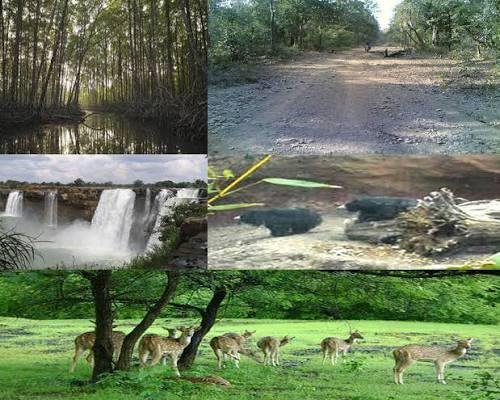
The reserve derives its name from the Indravati River, a major tributary of the Godavari.
- The river forms much of the reserve’s northern boundary.
- It also marks part of the Chhattisgarh–Maharashtra interstate boundary.
- Numerous seasonal streams, grasslands, hills and riverine habitats create a highly heterogeneous landscape.
This combination of river systems, forest and grassland creates diverse ecological niches for both predators and herbivores.
Vegetation
The major forest types include:
- Southern Moist Mixed Deciduous Forest with teak;
- Southern Moist Mixed Deciduous Forest without teak;
- Southern Dry Mixed Deciduous Forest.
Important flora include:
- teak;
- achar;
- salai;
- shisham;
- semal;
- arjun;
- bel;
- jamun.
The reserve therefore represents a transition between Central Indian forests and the Eastern Ghats landscape.
Conservation Challenges
- Security legacy: Some areas may remain difficult to monitor consistently.
- Sparse wildlife data: NTCA assessments have noted limited sampling in parts of the reserve, making robust prey estimation difficult.
- Poaching and bush-meat hunting: These can reduce herbivore populations and weaken the predator-prey base.
- Tourism pressure: Unregulated safari traffic can disturb wildlife and fragment sensitive habitats.
FAQs
Q1. Where is Indravati Tiger Reserve located?
In the Bastar region of Chhattisgarh, mainly in Bijapur district.
Q2. Which river gives the reserve its name?
The Indravati River.
Q3. Which important endangered herbivore is found here?
The wild water buffalo (Bubalus arnee).
Q4. Which tiger landscapes are connected with Indravati?
It has landscape connectivity towards Kawal, Tadoba and Kanha.
Q5. Why is the proposed tourism reopening significant?
It may improve conservation access, monitoring and local livelihood opportunities, provided tourism remains ecologically regulated.