Context
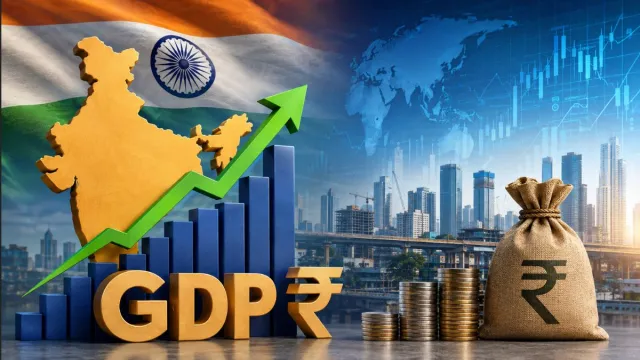
- Real GDP grew 7.8% in Q1 FY2026–27, above the RBI’s 7% estimate and 6.9% a year earlier.
- Growth moderated from 8.6% in Q4 FY2025–26; real Gross Value Added (GVA) grew 8.2% and nominal GDP 10.3%. However, future growth faces risks from high crude prices, weak monsoon and El Niño.
Key Growth Drivers
- Manufacturing & Services
-
- Manufacturing grew2%, while services expanded 10%, led by finance, real estate, IT and professional services (12.1%).
- Construction grew7% and utilities 8.9%; agriculture rose 3.6%, while mining contracted 2.4%.
- Consumption & Exports
-
- Rural and urban demand remained strong, supported by PM-KISAN, higher MSPs and affordable fertilisers.
- Non-oil, non-gems and jewellery exports improved, supporting external demand.
- Investment
-
- Gross Fixed Capital Formation (GFCF) rose9% in real terms, raising its GDP share from 31.4% to 34.3%.
- The Economic Advisory Council to the PM identifies 34–35% investment-to-GDP as important for sustaining growth above 7%.
- Public Capital Expenditure
-
- Continued government infrastructure spending supported construction and economic activity.
- Higher public investment can crowd in private investment and strengthen productive capacity.
Significance
- Broad-based growth: Agriculture, manufacturing and services all expanded, making growth more balanced.
- Investment-led potential: Higher GFCF can increase productive capacity and support future growth.
- Service-sector strength: 10% services growth highlights the sector’s continued role in the economy.
- Economic resilience: Strong growth despite global uncertainty and West Asian tensions shows India’s relative resilience.
- Viksit Bharat: Sustained high growth, investment and productivity are essential for long-term development.
Challenges
- High crude prices: Geopolitical tensions may raise import costs, inflation and production costs.
- El Niño & weak monsoon: A stronger El Niño could reduce rainfall then, it can reduce crop output, especially wheat and mustard, and weaken rural demand.
- Unfavourable base effect: High growth in the previous year may lead to slower year-on-year growth in coming quarters.
- Global uncertainty: Higher energy costs and weaker global demand may affect exports and overall growth.
Way Forward
- Raise Investment: Improve the business environment, infrastructure and finance access to boost private investment while sustaining public capital expenditure.
- Strengthen Manufacturing & Exports: Diversify production, improve competitiveness and logistics, and reduce external vulnerabilities.
- Build Climate-Resilient Agriculture: Expand irrigation, crop diversification and climate-smart practices to manage monsoon and El Niño risks.
- Accelerate Reforms & Productivity: Advance reforms in energy, labour and technology to raise productivity.
- Ensure Macroeconomic Stability: Maintain a balance between growth, inflation and external-sector stability.
Conclusion
India’s 7.8% Q1 FY27 GDP growth shows strong performance across key sectors and sustained economic resilience. However, sustaining this momentum will require higher investment, structural reforms and effective management of energy, climate and global risks.
Key Terms
| Term | Simple Meaning |
| Gross Domestic Product (GDP) | The total monetary value of all final goods and services produced within a country’s borders during a specific period.
Methods of Calculating GDP:
|
| Real GDP | GDP measured at constant prices of a base year (currently 2022-23 in India), removing the effect of inflation. It shows the actual increase in economic output. |
| Nominal GDP | GDP measured at current prices without adjusting for inflation. It reflects both changes in output and prices. |
| Gross Value Added (GVA) | It measures the value of goods and services produced in an economy after deducting the cost of intermediate inputs.
[GVA = Value of Output – Value of Intermediate Consumption] |
| Real GVA | GVA measured at constant prices, showing the real growth in value added by economic sectors. |
| Gross Fixed Capital Formation (GFCF) | It measures the net addition to fixed assets (like factories, machinery, and roads) in an economy during a specific period. |
| Investment-to-GDP Ratio | Share of total investment in the economy relative to GDP; a higher ratio generally indicates stronger capital formation. |
| Base Effect | the distortion in current economic indicators—such as inflation or growth rates—caused by abnormally high or low values in the reference period. |
FAQs
Q1. What does India’s 7.8% GDP growth in Q1 FY27 indicate?
Ans. It indicates strong and broad-based economic expansion, supported by manufacturing, services, consumption and investment. However, future growth may face external and climate-related risks.
Q2. Why is the rise in GFCF significant?
Ans. GFCF increased 11.9% in real terms, raising its GDP share to 34.3%. This suggests stronger investment and can expand India’s future productive capacity.
Q3. How can El Niño affect India’s economic growth?
Ans. A stronger El Niño can disturb rainfall and reduce crop yields. This may increase food inflation and weaken agricultural output and rural demand.
Q4. Why are high crude oil prices a risk for India?
Ans. India is heavily dependent on imported crude oil. Higher prices can raise the import bill, inflation and production costs, while reducing household purchasing power.