Context
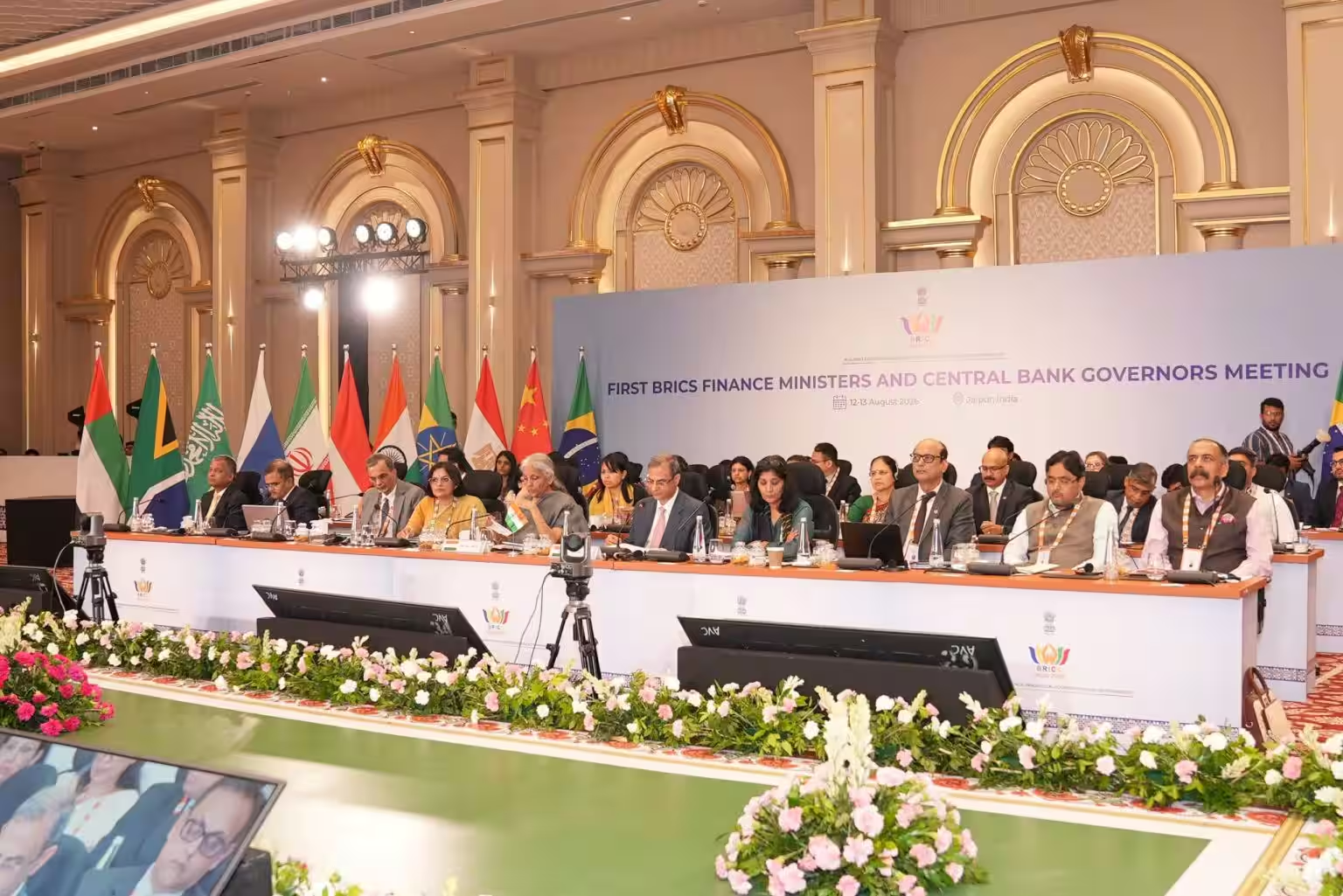
- The 18th BRICS Summit is scheduled in New Delhi on September 12–13, 2026, with India as the chair.
- India’s presidency provides an opportunity to bring greater coherence and direction to the expanded grouping.
BRICS and Its Original Purpose
- BRICS was created by Brazil, Russia, India, China and South Africa to give emerging economies a stronger voice in global governance, particularly in financial and economic institutions.
- India viewed the grouping as a means of creating a more equitable multilateral order.
- India hosted the 2012 BRICS Summit, its first as host, under the theme “Global Stability, Security and Prosperity.”
- Its presidency contributed to the creation of the New Development Bank and pushed for a counter-terrorism architecture within BRICS.
China’s Growing Influence
- China increasingly treated BRICS as a counterweight to Western dominance and used BRICS-Plus and BRICS Outreach to expand its engagement with the Global South.
- In 2010, BRICS members together accounted for nearly 20% of world GDP, adding to the grouping’s strategic importance.
- China did not support the demand of India, Brazil and South Africa for permanent seats on the UN Security Council.
- India therefore shifted greater attention towards intra-BRICS cooperation and consolidation while also balancing China’s influence.
Expansion and Strain on Consensus
- Consensus has traditionally helped BRICS accommodate differences among its members.
- India and Brazil resisted arrangements that could weaken this principle. The 2019 Brasilia Summit was consequently held with only the five original members and without invited guests.
- Under the Russian presidency in 2020, a non-consensus chair’s statement was issued on COVID-19.
- The same difficulty surfaced at the BRICS Foreign Ministers’ meeting in New Delhi in May 2026 when members could not reach agreement.
- BRICS has now expanded to 11 members with the addition of Egypt, Ethiopia, Iran, Saudi Arabia, the UAE and Indonesia, besides the original five. It also has 10 partner countries.
- Differences among the expanded membership have raised concerns that bilateral disputes could weaken the grouping, similar to the experience of SAARC.
“Non-West” versus “Anti-West”
- India wants BRICS to remain a “non-West” grouping rather than develop into an “anti-West” bloc.
- This distinction has become more important amid China-US competition, the Russia-Ukraine war and the conflict involving Iran, the US and Israel.
- India also faces tensions with the US over punitive tariffs, proposed measures on Russian oil, pressure on the Quad and growing US engagement with Pakistan.
- Several BRICS members, however, prefer to engage with multiple centres of power instead of aligning exclusively with China or Russia.
Emergence of Parallel Global Structures
- The source highlights growing competition between the US and China to shape new international systems outside existing institutions.
- Major areas include Artificial Intelligence, digital and internet governance, data ownership, 5G/6G, telecommunications, satellite navigation and electric vehicles.
- China’s initiatives include the World AI Cooperation Organisation, Asian Infrastructure Investment Bank, Belt and Road Initiative and Digital Silk Road.
- China has also promoted de-dollarisation and a possible common BRICS currency. However, members have shown limited support for a renminbi-dominated currency.
- Greater preference exists for national-currency transactions, payment-system linkages and central bank digital currencies. China is also formally launching mBridge, an alternative payment system.
- India does not favour an alternative Bretton Woods system dominated by China.
India’s Agenda for BRICS
- India has promoted “reformed multilateralism”, which seeks changes in existing international institutions rather than creating parallel systems.
- Prime Minister Narendra Modi first articulated this approach at the 2018 BRICS Summit in South Africa. In 2019, India, Brazil and South Africa included it in the Brasilia Summit document.
- India’s 2026 chairship is based on Resilience, Innovation, Cooperation and Sustainability, guided by “Humanity First” and a people-centric approach.
- India seeks to use the Delhi Summit to manage differences, strengthen cooperation and restore BRICS as a platform for Global South middle powers.
- Despite limitations such as China’s disproportionate influence and the absence of some other middle powers, BRICS retains significant geopolitical and geo-economic potential.
India’s Opportunity to Put BRICS Back Together FAQs
Q1. Why was BRICS created?
Ans: BRICS was established to strengthen the voice of emerging economies in global governance and seek a more equitable international order, especially in financial and economic institutions.
Q2. Why is the consensus principle important for BRICS?
Ans: Members have major political and strategic differences. Consensus provides a common basis for cooperation, while repeated non-consensus decisions could weaken the grouping’s cohesion.
Q3. Why has BRICS expansion created difficulties?
Ans: Adding more members has brought additional political interests and bilateral disputes into the grouping. This makes agreement on common positions more difficult.
Q4. What is meant by India’s “non-West” approach?
Ans: India supports a more balanced global order without turning BRICS into a bloc directed against Western countries.
Q5. What does “reformed multilateralism” mean?
Ans: It means reforming existing international institutions to make them more representative and effective rather than replacing them with separate structures.
Q6. Why has a common BRICS currency received limited support?
Ans: Members are uncomfortable with a renminbi-dominated arrangement. They instead favour greater use of national currencies, linked payment systems and central bank digital currencies.
Q7. Why does India consider BRICS important for the Global South?
Ans: BRICS provides a platform through which Global South middle powers can seek greater influence in global affairs while maintaining relations with different centres of power.