Context
India’s maritime domain includes offshore installations, shipping routes, fishing activity and ecologically sensitive areas. The Indian Coast Guard (ICG) is a key institution responsible for maintaining safety and security across this domain, while also performing law-enforcement and environmental functions.
About the Indian Coast Guard
- The Indian Coast Guard is an Armed Force of the Union under the Ministry of Defence.
- It is governed by the Coast Guard Act, 1978.
- The interim Coast Guard came into existence on 1 February 1977.
- It was formally inaugurated on 19 August 1978.
- Its headquarters is located in New Delhi.
- The force is headed by the Director General, Indian Coast Guard.
Statutory Mandate
The Coast Guard Act, 1978 assigns the ICG specific responsibilities within India’s maritime zones. These include:
- Protecting artificial islands, offshore terminals, installations and other structures.
- Providing assistance to fishermen, including those in distress.
- Taking measures for the safety of life and property at sea.
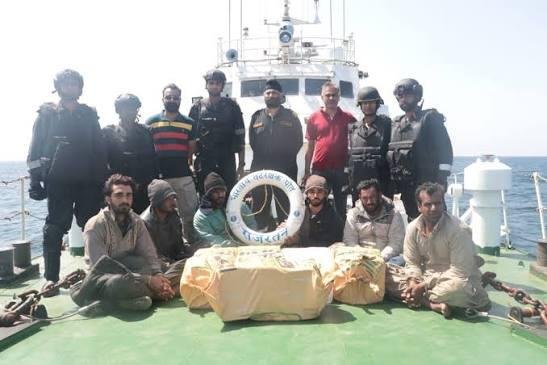
- Enforcing applicable laws in India’s maritime zones.
- Assisting Customs and other authorities in anti-smuggling operations.
- Protecting the marine environment and preventing and controlling marine pollution.
- Collecting scientific data as prescribed.
Operational Role
The ICG contributes to India’s broader maritime-security framework through:
- Surveillance of coastal and offshore areas.
- Search and rescue operations for persons and vessels in distress.
- Marine pollution response, including action during oil-spill incidents.
- Coordination with the Indian Navy, Coastal Police, Customs and other maritime agencies.
- Support for the broader coastal-security framework.
Conclusion
The Indian Coast Guard occupies a distinctive position in India’s maritime institutional framework. Its responsibilities combine security, safety, law enforcement and environmental protection, enabling it to address both security threats and non-traditional challenges in the maritime domain.
FAQs
- What distinguishes the Indian Coast Guard from a civilian maritime agency?
The ICG is an Armed Force of the Union, unlike a purely civilian regulatory or enforcement organisation. It therefore combines statutory law-enforcement responsibilities with operational maritime capabilities.
- What is the significance of the Coast Guard Act, 1978?
It provides the legal foundation for the constitution, regulation, duties and functions of the Indian Coast Guard and defines its responsibilities in India’s maritime zones.
- Why is the year 1977 associated with the Coast Guard?
The interim Indian Coast Guard came into existence on 1 February 1977, before its formal statutory constitution and inauguration in 1978.
- Which aspect of the Coast Guard’s mandate relates to marine ecology?
The ICG is responsible for protecting the marine environment and preventing and controlling marine pollution, making environmental protection a statutory component of its mandate.
- What is the Coast Guard’s relationship with the Indian Navy?
The ICG is a separate Armed Force and is not a component of the Navy. However, the two forces coordinate closely as part of India’s maritime-security architecture.
- Does the Coast Guard have a role beyond security?
Yes. Its responsibilities cover search and rescue, assistance to fishermen, maritime law enforcement, anti-smuggling operations, marine pollution control and scientific data collection, in addition to security-related functions.
- Why is the Indian Coast Guard relevant to maritime governance?
Its mandate brings together several dimensions of maritime governance—security, safety, enforcement and environmental protection—within a single specialised force.