| Important questions for UPSC Pre/ Mains/ Interview:
1. Why is Seychelles strategically important for India? 2. What is Vision MAHASAGAR and how does Seychelles fit into it? 3. What is the SESEL Joint Vision announced during the visit? 4. What were the major development partnership announcements? 5. How is digital cooperation being expanded? 6. How is cooperation in health and essential commodities structured? 7. How is capacity building institutionalised? 8. What is the scope of renewable energy and climate cooperation? 9. How is maritime and defence cooperation deepening? 10.What is the regional and multilateral dimension? 11.What is the status of trade, tourism and connectivity? 12.What are the associated Security Benefits and Concerns? 13.What institutional safeguards exist? |
Context
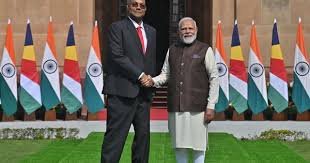
The State Visit of Patrick Herminie to India (5–10 February 2026), at the invitation of Narendra Modi, marked the 50th anniversary of Seychelles’ Independence and 50 years of diplomatic relations, leading to the announcement of a new Joint Vision titled SESEL.
Q1. Why is Seychelles strategically important for India?
- Located in the Western Indian Ocean, near key Sea Lines of Communication (SLOCs).
- Enhances India’s maritime domain awareness in the Indian Ocean Region (IOR).
- Serves as a key pillar in India’s MAHASAGAR Vision.
- Important partner in addressing piracy, narcotics trafficking, and illegal fishing.
Q2. What is Vision MAHASAGAR and how does Seychelles fit into it?
- MAHASAGAR = Mutual and Holistic Advancement for Security and Growth Across Regions.
- Focuses on:
- Maritime security
- Blue economy cooperation
- Capacity building
- Sustainable development
- Seychelles acts as:
- A frontline maritime partner
- A security and surveillance collaborator
- A gateway to Western IOR engagement
Q3. What is the SESEL Joint Vision announced during the visit?
- SESEL = Sustainability, Economic Growth and Security through Enhanced Linkages.
- Core pillars:
- Sustainable development
- Maritime and defence security
- Digital transformation
- Climate resilience
- Trade and connectivity enhancement
- It provides a structured framework for long-term bilateral engagement.
Q4. What were the major development partnership announcements?
- India announced a USD 175 million Special Economic Package:
- USD 125 million Line of Credit (Rupee-denominated)
- USD 50 million Grant assistance
- Focus areas:
- Defence & maritime security
- Infrastructure
- Capacity building
- Development projects
Q5. How is digital cooperation being expanded?
- India to support Seychelles in building Digital Public Infrastructure (DPI).
- Potential areas:
- Digital payments
- Governance digitisation
- Administrative service delivery
- Aligns with India’s Global South digital outreach strategy.
Q6. How is cooperation in health and essential commodities structured?
- Key initiatives:
- Donation of 10 advanced ambulances.
- Support for new hospital construction.
- Recognition of Indian Pharmacopoeia standards.
- Collaboration under Jan Aushadhi for affordable medicines.
- Donation of 1000 metric tons of food grains to enhance food security.
- Structural impact:
- Reduces cost of living pressures.
- Ensures reliable supply chains for essential commodities.
- Enhances healthcare resilience.
Q7. How is capacity building institutionalised?
- Expansion of Indian Technical and Economic Cooperation (ITEC) programmes.
- Customised civil servant training via National Centre for Good Governance.
- Cybersecurity and financial intelligence collaboration.
- Institutional linkages in:
- Marine sciences
- Renewable energy
- Policing
- Fisheries
- Climate action
Q8. What is the scope of renewable energy and climate cooperation?
- Support for solar projects under the International Solar Alliance.
- Implementation of Multi-Hazard Early Warning Systems.
- Technical assistance for green public transport grid management.
- Seychelles to join the Coalition for Disaster Resilient Infrastructure.
- Advocacy for Multidimensional Vulnerability Index (MVI) in global finance discussions.
Q9. How is maritime and defence cooperation deepening?
- Operational dimensions:
- Joint maritime surveillance.
- Hydrographic surveys and establishment of Seychelles Hydrographic Unit.
- Refitting of Seychelles naval assets.
- Donation of vehicles and patrol equipment.
- Training and capacity building for Seychelles Defence Forces.
- Strategic goal:
- Ensure a free, open, rules-based Indian Ocean.
- Combat piracy, IUU fishing, narcotics smuggling, and trafficking.
- Strengthen maritime domain awareness.
Q10. What is the regional and multilateral dimension?
- Seychelles to become a full member of the Colombo Security Conclave.
- Continued cooperation in UN forums.
- Seychelles reaffirmed support for India’s UNSC permanent membership.
- Coordination in multilateral financial and development institutions.
Q11. What is the status of trade, tourism and connectivity?
- Increasing direct flight connectivity.
- Indian tourists strengthening Seychelles’ tourism resilience.
- Opportunities in:
- Blue economy
- Financial services
- Affordable housing
- Fisheries
- Digital and AI sectors.
Q12. What are the associated Security Benefits and Concerns?
- Benefits
- Enhanced maritime stability in Western IOR.
- Improved surveillance against transnational crime.
- Strengthened supply chain and digital connectivity.
- Strategic counterbalance in Indian Ocean geopolitics.
- Concerns
- Overdependence risks for small island states.
- Debt sustainability concerns in Line of Credit models.
- Vulnerability of SIDS to climate change despite cooperation.
- Need for sustained implementation beyond announcements.
Q13. What institutional safeguards exist?
- Joint Commission Meetings.
- Defence and maritime dialogue mechanisms.
- Structured hydrography cooperation platform.
- Parliamentary exchanges.
- Multilevel political consultations.
Conclusion
The India–Seychelles partnership has evolved from development assistance to a comprehensive maritime-security and sustainability framework. The SESEL Vision institutionalises cooperation across defence, digital, climate and economic domains. As Small Island Developing States face rising vulnerabilities, calibrated cooperation must balance strategic depth with equitable and sustainable growth.