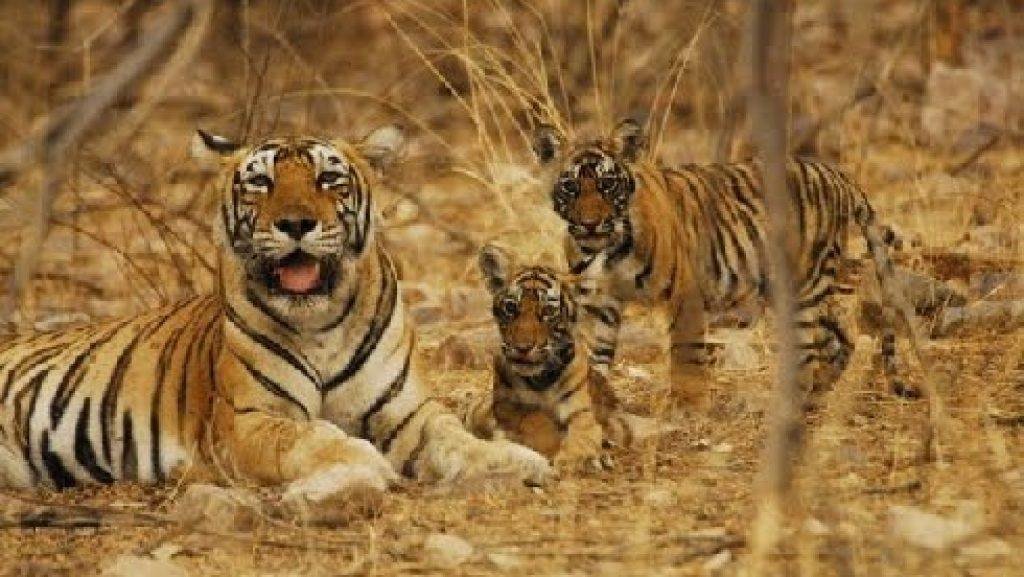
- Prime Minister Narendra Modi praised the addition of Madhav Tiger Reserve in Madhya Pradesh as the 58th tiger reserve in India.
- Environment Minister announced this on March 8, 2025.
Key Stats and Facts:
|
Key details :
- Madhav Tiger Reserve (Madhya Pradesh) becomes the 58th tiger reserve in India.
- Previous Addition: On December 2, 2024, India added its 57th tiger reserve at Ratapani Wildlife Sanctuary in Madhya Pradesh.
- India’s 56th Newest Tiger Reserve tiger reserve : Chhattisgarh’s Guru Ghasidas-Tamor Pingla Tiger Reserve
Conservation of Tigers (Panthera Tigris):
- IUCN Status: The tiger is classified as Endangered on the IUCN Red List of Threatened Species.
- Protection: Tigers are listed under Schedule I of the Wildlife Protection Act, 1972, granting them the highest level of protection in India.
- Transboundary Conservation: India works closely with neighboring countries like Bangladesh to protect tigers in shared ecosystems such as the Sundarbans.
What is Project Tiger?
- Project Tiger was launched by the Indian government on April 1, 1973, as a conservation initiative aimed at protecting the country’s rapidly dwindling tiger population.
- At the time, India’s tiger population was critically low, primarily due to rampant hunting and poaching.
Background:
- Declining Tiger Population: Before Independence, India was home to around 40,000 tigers.
- However, by the 1970s, the population had plummeted to below 2,000 due to excessive hunting, poaching, and habitat loss.
- Endangered Status: In 1970, the International Union for Conservation of Nature (IUCN) declared the tiger an endangered species.
- This was confirmed by a 1972 census which estimated the tiger population in India to be a mere 1,800.
- Wildlife Protection Act, 1972: To address the growing crisis of poaching and hunting, the Indian government passed the Wildlife Protection Act in 1972, which laid the legal foundation for tiger conservation and wildlife protection.
- Every year on July 29, International Tiger Day is celebrated to highlight the importance of tiger conservation across the globe.
Launch of Project Tiger:
- Prime Minister Indira Gandhi’s Vision: In response to the alarming tiger population decline, Prime Minister Indira Gandhi unveiled Project Tiger in 1973, after the government received recommendations from a task force.
- Initial Launch: The program was officially launched at Jim Corbett National Park, and initially, nine tiger reserves were established across different states. These were located in:
- Assam
- Bihar
- Karnataka
- Madhya Pradesh
- Maharashtra
- Odisha
- Rajasthan
- Uttar Pradesh
- West Bengal
- These reserves covered over 14,000 sq km of land.
- Holistic Approach: Project Tiger wasn’t solely about protecting tigers; it also emphasized protecting their habitats.
- Indira Gandhi noted that tigers, being apex predators, cannot survive in isolation, and their habitat must be safeguarded from threats like human intrusion, commercial forestry, and cattle grazing.
Progress and Challenges:
- Growth of Tiger Population:
- By the 1990s, the tiger population in India had increased to around 3,000.
- However, Sariska Tiger Reserve in Rajasthan faced a major setback when tigers were wiped out by poaching in the reserve, making headlines in 2005.
- This led to a national outcry and prompted further reforms in tiger conservation.
- Reconstitution of Project Tiger (2005):
- In response to the crisis at Sariska, then Prime Minister Manmohan Singh set up a task force to reshape the future of tiger conservation.
- A year later, the government reconstituted Project Tiger and established the National Tiger Conservation Authority (NTCA), which had more authority and resources to prevent poaching and safeguard tiger habitats.
- The NTCA was empowered to create the Tiger Protection Force and oversee the relocation of villages that were encroaching upon protected areas.
Tiger Population Growth: The tiger population in India has shown a steady increase:
About National Tiger Conservation Authority (NTCA):
The NTCA is a statutory body under the Ministry of Environment, Forests, and Climate Change. It was constituted under the Wildlife (Protection) Act, 1972 to monitor and strengthen tiger conservation efforts across India.
Key Role:
- The NTCA conducts the All India Tiger Estimation every four years, providing crucial data on tiger populations and habitat quality.
- As per the 2022 report, India is home to 3,167 tigers.
Process of Creating a Tiger Reserve:
- Identification of Suitable Areas: The state government identifies areas with a viable tiger population and appropriate habitats based on ecological assessments, including studies on vegetation and prey base.
- Proposal Preparation: A detailed proposal, including maps, ecological studies, and management plans, is prepared by the state government and submitted to the NTCA for review.
- Approval and Notification: After NTCA approval, the proposal is forwarded to the Union Ministry of Environment, Forest and Climate Change for final consideration. A preliminary notification is issued under the Wildlife Protection Act, 1972, declaring the area as a tiger reserve, followed by a final notification after addressing objections.
- De-notification: As per Section 38W of the Wildlife Protection Act, no state government can de-notify a tiger reserve except in the public interest, requiring approval from the Tiger Conservation Authority and the National Board for Wildlife.
Conservation Assured Tiger Standards (CA|TS) Accreditation:
International Big Cats Alliance (IBCA):
|
List of Tiger Reserves in India |
|||
| Sl No | Tiger Reserve (TR) | State | TR Notification Year |
| 1 | Bandipur | Karnataka | 2007 |
| 2 | Corbett | Uttarakhand | 2010 |
| Amanagarh buffer | Uttar Pradesh | 2012 | |
| 3 | Kanha | Madhya Pradesh | 2007 |
| 4 | Manas | Assam | 2008 |
| 5 | Melghat | Maharashtra | 2007 |
| 6 | Palamau | Jharkhand | 2012 |
| 7 | Ranthambore | Rajasthan | 2007 |
| 8 | Simlipal | Orissa | 2007 |
| 9 | Sunderban | West Bengal | 2007 |
| 10 | Periyar | Kerala | 2007 |
| 11 | Sariska | Rajasthan | 2007 |
| 12 | Buxa | West Bengal | 2009 |
| 13 | Indravati | Chattisgarh | 2009 |
| 14 | Namdapha | Arunachal Pradesh | 1987 |
| 15 | Nagarjunsagar Sagar | Andhra Pradesh | 2007 |
| 16 | Dudhwa | Uttar Pradesh | 2010 |
| 17 | Kalakad Mundanthurai | Tamil Nadu | 2007 |
| 18 | Valmiki | Bihar | 2012 |
| 19 | Pench | Madhy Pradesh | 2007 |
| 20 | Tadobha Andhari | Maharashtra | 2007 |
| 21 | Bandhavgarh | Madhy Pradesh | 2007 |
| 22 | Panna | Madhy Pradesh | 2007 |
| 23 | Dampa | Mizoram | 2007 |
| 24 | Bhadra | Karnataka | 2007 |
| 25 | Pench – MH | Maharashtra | 2007 |
| 26 | Pakke | Arunachal Pradesh | 2012 |
| 27 | Nameri | Assam | 2000 |
| 28 | Satpura | Madhya Pradesh | 2007 |
| 29 | Anamalai | Tamil Nadu | 2007 |
| 30 | Udanti Sitanadi | Chattisgarh | 2009 |
| 31 | Satkoshia | Odisha | 2007 |
| 32 | Kaziranga | Assam | 2007 |
| 33 | Achanakmar | Chattisgarh | 2009 |
| 34 | Kali | Karnataka | 2007 |
| 35 | Sanjay Dhubri | Madhya Pradesh | 2011 |
| 36 | Mudumalai | Tamil Nadu | 2007 |
| 37 | Nagarhole | Karnataka | 2007 |
| 38 | Parambikulam | Kerala | 2009 |
| 39 | Sahyadri | Maharashtra | 2012 |
| 40 | Biligiri Ranganatha Temple | Karnataka | 2007 |
| 41 | Kawal | Telangana | 2012 |
| 42 | Sathyamangalam | Tamil Nadu | 2013 |
| 43 | Mukundara | Rajasthan | 2013 |
| 44 | Nawegaon Nagzira | Maharashtra | 2013 |
| 45 | Amrabad | Telangana | 2015 |
| 46 | Pilibhit | Uttar Pradesh | 2014 |
| 47 | Bor | Maharashtra | 2012 |
| 48 | Rajaji | Uttarakhand | 2015 |
| 49 | Orang | Assam | 2016 |
| 50 | Kamlang | Arunachal Pradesh | 2017 |
| 51 | Srivilliputhur Megamalai | Tamil Nadu | 2021 |
| 52 | Ramgarh Vishdhari Tiger Reserve | Rajasthan | 2022 |
| 53 | Ranipur Tiger Reserve | Uttar Pradesh | 2022 |
| 54 | Veerangana Durgavati Tiger Reserve | Madhya Pradesh | 2023 |
| 55 | Dholpur – Karauli Tiger Reserve | Rajasthan | 2023 |
| 56 | Guru Ghasidas – Tamor Pingla Tiger Resereve | Chhattisgarh | 2024 |
| 57 | Ratapani Wildlife Sanctuary | Madhya Pradesh | 2024 |
| 58 | Madhav Tiger Reserve | Madhya Pradesh | 2025 |