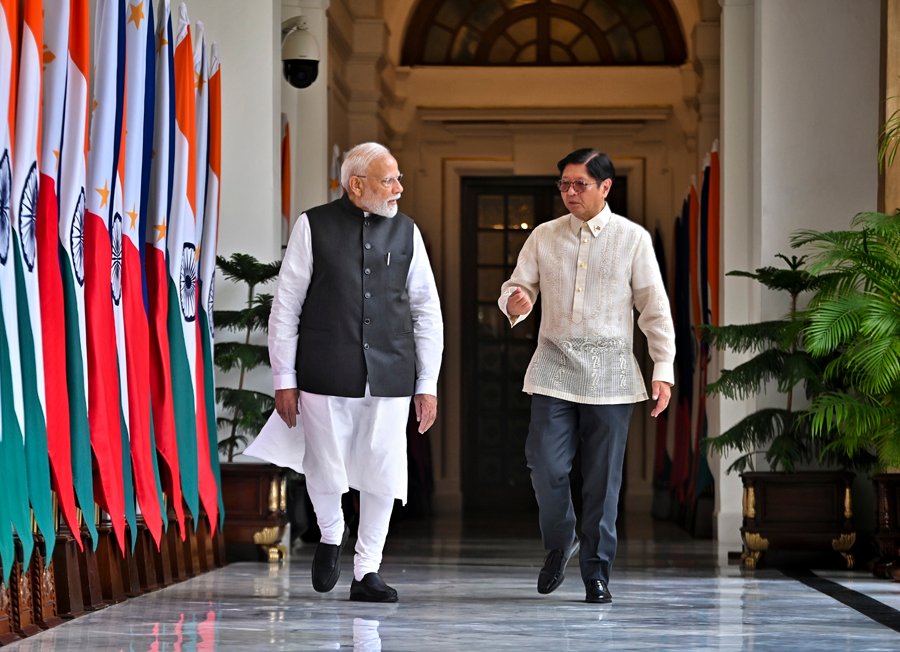
Why in the News?
- India and the Philippines have decided to upgrade their bilateral relationship to the level of a “Strategic Partnership” during the state visit of Filipino President Ferdinand Marcos Jr. to India.
- The announcement came amid increasing geopolitical tensions in the Indo-Pacific, especially in the South China Sea, with both countries supporting freedom of navigation and international law.
- This visit marks a significant leap in defence, maritime, economic, and digital cooperation between the two democracies in the Indo-Pacific region.
Key Highlights
- Strategic Partnership & Action Plan
- India and the Philippines upgraded ties to a Strategic Partnership.
- A comprehensive action plan was prepared to operationalise this partnership.
- The Philippines is now a key part of India’s Act East Policy.
- Defence and Maritime Cooperation
- First-time participation of three Indian naval ships in exercises in the Philippines.
- India’s hydrography ship also joined these naval engagements.
- Agreements were signed for capacity building, joint activities, and training exchanges across the armies, navies, and air forces.
- Finalisation of Terms of Reference for cooperation between Indian and Philippine Coast Guards.
- Commitment to Indo-Pacific Stability
- Both countries reiterated support for freedom of navigation under UNCLOS 1982.
- India reaffirmed the South China Sea as a global commons.
- Both sides support a rules-based order and peace in the Indo-Pacific.
- Connectivity and Tourism
- Direct flights between India and the Philippines to begin in 2025.
- Announcement of a one-year free e-tourist visa for Filipino nationals starting August 2025.
- Digital and Legal Cooperation
- India to support a pilot project for the Philippines’ Sovereign Data Cloud infrastructure.
- Treaties signed on:
- Mutual Legal Assistance in Criminal Matters
- Transfer of Sentenced Persons
- Philippines invited to join India’s Information Fusion Centre for the Indian Ocean Region.
Indo-Pacific
- The Indo-Pacific region is a term used to refer to the vast geographic area that encompasses the Indian Ocean and the western and central Pacific Ocean, including the seas and straits that connect them.
- It is a region that spans from the eastern coast of Africa to the western coast of the Americas and from the Arctic to the Antarctic.
- Significance of Indo-Pacific region:
- Geopolitical importance: It is home to some of the world’s most populous and powerful nations, including China, India, Japan, and the United States.
- Economic growth: contributes 65% of the world’s population, accounting for 63% of the world’s GDP.
- Security challenges: such as territorial disputes, piracy, terrorism, and nuclear proliferation.
- Environmental concerns: related to coral reefs, rainforests, and biodiversity hotspots.
- China’s rise and hegemony: China’s rapid economic and military growth has contributed to the shift in global focus towards the Indo-Pacific.
- Initiatives taken by India in the Indo-Pacific region
- Hosting HACGAM: India stands for open & rule-based maritime borders in the Indo-Pacific during 18th Heads of Asian Coast Guard Agencies Meeting (HACGAM) in New Delhi in October 2022.
- SAGAR initiative: SAGAR provides a mechanism for India to expand strategic partnerships with other Indian ocean region littorals in Asia and Africa.
- Indo-Pacific Regional Dialogue (IPRD): Being a Track 1.5 event that aims to encourage discussions on public policy, the IPRD endeavors for a balanced representation of government and non-government agencies and institutions.
- Indo-Pacific Oceans Initiative (IPOI): Pillars of cooperation with other countries include Maritime Security, Maritime Ecology, Maritime Resources, Capacity Building and Resource Sharing, Disaster Risk Reduction and Management, Science, Technology and Academic Cooperation, Trade, Connectivity, and Maritime Transport.
- QUAD: India is a member of the Quadrilateral security dialogue promoting regional security and economic cooperation in the Indo-Pacific region.
- Indo-Pacific Division in MEA: India has set up an Indo-Pacific division in the Ministry of External Affairs. The division will cooperate with all the matters related to the Indo-Pacific.
Implications
- Strengthening Indo-Pacific Architecture
- Consolidates India’s outreach under the Act East Policy.
- Builds a democratic security network in the Indo-Pacific.
- Counters unilateral actions in the South China Sea through regional solidarity.
- Enhanced Maritime Security
- Joint naval exercises and coast guard collaboration enhance maritime domain awareness.
- Hydrography and naval engagements contribute to peaceful maritime order.
- Strengthens deterrence against coercive maritime behavior.
- Boost to Trade and Connectivity
- Beginning of preferential trade agreement (PTA) negotiations opens up new economic avenues.
- Direct flights and visa liberalization to enhance people-to-people and business ties.
- Strategic economic ties may offset dependence on regional giants like China.
- Legal and Digital Infrastructure Building
- Legal treaties strengthen cooperation in criminal justice and extradition.
- The Sovereign Data Cloud project aids in digital sovereignty and cybersecurity.
- Integration into India’s data and security frameworks promotes regional tech cooperation.
- Multilateral Coordination and Institutional Links
- Participation in the Information Fusion Centre fosters real-time maritime intelligence sharing.
- Positions India as a regional hub for coordination in the Indian Ocean Region.
- Encourages institutional frameworks that promote collective regional security.
Challenges and Way Forward
| Challenges | Way Forward |
| Geopolitical pressure from dominant powers in the South China Sea | Strengthen strategic autonomy and collective diplomacy with ASEAN partners |
| Logistical and infrastructure constraints for defence and maritime operations | Invest in joint capacity-building, defence hardware supply, and training |
| Delays in finalising trade agreements due to regulatory mismatches | Focus on early harvest schemes and sector-specific trade facilitation |
| Cybersecurity risks in digital collaborations like the Data Cloud | Establish joint protocols and ensure data localization with secure frameworks |
| Visa and connectivity reforms may face bureaucratic hurdles | Ensure time-bound implementation of direct flights and e-tourist visa system |
Conclusion
The elevation of India-Philippines ties to a strategic partnership is a milestone in India’s Act East Policy and Indo-Pacific outreach. It reflects a convergence of values in upholding international law, maritime freedom, and democratic cooperation. With enhanced defence, economic, and digital engagements, the partnership not only strengthens bilateral relations but also contributes meaningfully to regional stability. However, timely implementation, careful navigation of geopolitical sensitivities, and sustained engagement will be crucial to unlocking the full potential of this evolving relationship.
| EnsureIAS Mains Question Q. India and the Philippines have recently upgraded their ties to a Strategic Partnership. In this context, examine the significance of this development for India’s Act East Policy and maritime security in the Indo-Pacific region. (250 words) |
| EnsureIAS Prelims Question Q. With reference to recent developments in India-Philippines relations, consider the following statements: 1. India and the Philippines have upgraded their relationship to a Strategic Partnership. 2. Indian naval ships recently participated for the first time in a naval exercise in the Philippines. 3. The two countries signed a Free Trade Agreement (FTA) covering goods and services. 4. India has invited the Philippines to join the Information Fusion Centre – Indian Ocean Region (IFC-IOR). Which of the statements given above are correct? a. 1, 2 and 4 only Answer: a. 1, 2 and 4 only Explanation: |