Context
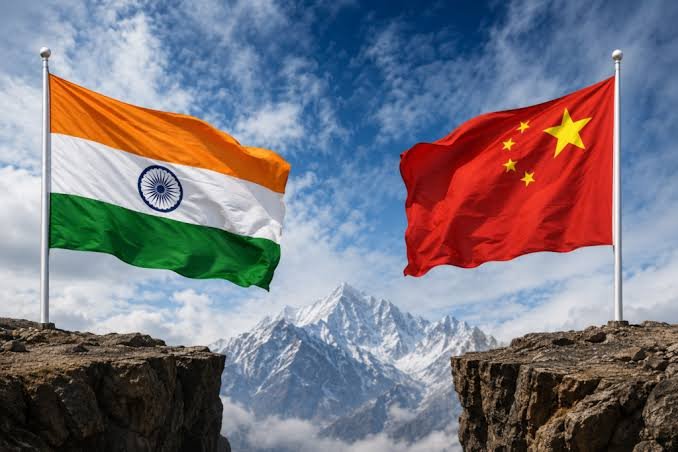
- India–China relations are witnessing cautious diplomatic engagement amid renewed high-level interaction and the upcoming BRICS Summit in New Delhi.
- The relationship remains shaped by border tensions, economic interdependence, strategic competition and multilateral engagement.
- The key challenge for India is to strengthen security while reducing excessive dependence on China without disrupting essential economic linkages.
Evolution of Bilateral Relations
- 1954: India and China signed the Panchsheel Agreement, based on mutual respect for sovereignty and territorial integrity, non-aggression, non-interference, equality and peaceful coexistence.
- 1962: The Sino-Indian War sharply deteriorated bilateral relations, with unresolved territorial claims becoming the central source of friction.
- 1988: Prime Minister Rajiv Gandhi’s visit to China revived high-level political engagement.
- 1993 and 1996: Agreements established mechanisms for maintaining peace and military restraint along the Line of Actual Control (LAC).
- Over the following decades, economic and diplomatic ties expanded despite the unresolved boundary dispute, resulting in competitive coexistence.
Galwan and the Shift in India’s Approach
The 2020 Galwan Valley clash marked a major shift in India’s assessment of China.
- India strengthened military deployment and border infrastructure in Ladakh.
- It increased scrutiny of Chinese investments, technology and strategic economic linkages.
- Several Chinese mobile applications were also restricted.
- The crisis highlighted the risks associated with excessive dependence on a single country for critical economic and technological requirements.
Economic Interdependence
China remains deeply integrated into several Indian production chains.
- Indian industries depend on Chinese machinery, components, raw materials and intermediate goods.
- Important areas include pharmaceutical inputs, telecommunications, solar equipment and electronics.
- The source records Indian exports to China at about $14.25 billion and imports at around $113.46 billion in 2024–25, indicating a substantial trade imbalance.
- Such dependence creates an economic-security risk, since disruption of critical imports can affect strategic sectors.
Calibrated Economic Engagement
India has responded by combining economic engagement with stronger security screening.
- Press Note 3 (2020) brought foreign direct investment from countries sharing a land border with India under the government-approval route.
- The approach seeks to prevent commercial relationships from creating vulnerabilities in strategic sectors and critical systems.
- India has therefore preferred selective engagement over complete economic separation.
Competitive Coexistence
India and China remain competitors, but both have reasons to preserve a working relationship.
- India’s interests
- A stable northern border would reduce prolonged military pressure.
- Indian industries continue to require Chinese inputs.
- Engagement with China remains relevant through BRICS, the Shanghai Cooperation Organisation (SCO) and other platforms.
- China’s interests
- China benefits from access to the Indian market.
- Chinese businesses have a stake in continued commercial engagement.
- Beijing also seeks greater influence across the Global South, where India has significant diplomatic reach.
- Persistent Trust Deficit
Economic engagement has not removed strategic mistrust.
India remains concerned about:
- Chinese involvement in critical infrastructure and sensitive technologies
- Data security and espionage risks
- Dependence on China in strategic sectors
- The possibility of renewed bilateral tensions
Chinese companies, meanwhile, remain cautious about the long-term stability of the Indian investment environment.
China+1 and India’s Manufacturing Opportunity
Global firms are increasingly diversifying production away from excessive concentration in China.
- The China+1 strategy involves establishing additional production bases outside China.
- India has benefited particularly in smartphone and electronics manufacturing.
- Make in India, Production Linked Incentive (PLI) schemes, the Semiconductor Mission and component-manufacturing initiatives can help deepen domestic production.
- Greater gains will depend on moving beyond final assembly towards components, machinery, design and other upstream capabilities.
De-risking over Decoupling
- Decoupling means substantially separating two economies.
- De-risking means reducing critical dependence while maintaining necessary economic relations.
- Complete decoupling is difficult for India because several industries still depend on Chinese components, machinery, raw materials and intermediate goods.
- India therefore needs to build capabilities across the entire supply chain, from raw materials and design to machinery and final products.
Way Forward
- Strengthen Border Security
- Maintain robust border infrastructure and military preparedness.
- Continue diplomatic and military dialogue to prevent escalation along the LAC.
- Build Domestic Capacity
- Expand domestic production of pharmaceutical inputs, electronics, machinery and strategic components.
- Diversify external sources for critical imports.
- Adopt Risk-Based Investment Screening
- Distinguish between ordinary commercial sectors and areas involving defence, critical infrastructure, strategic technologies and sensitive data.
- Apply stricter scrutiny wherever foreign investment may create national-security vulnerabilities.
- Sustain Multilateral Engagement
- Continue engagement with China through BRICS, SCO and other multilateral platforms.
- Use these forums to maintain dialogue while managing bilateral differences.
Conclusion
- India–China relations are defined by strategic rivalry alongside economic interdependence. The boundary dispute remains the core security challenge, while economic linkages make abrupt separation difficult.
- India’s most practical course is to secure the border, diversify critical supply chains, strengthen domestic capabilities and maintain diplomatic engagement. This approach can reduce vulnerabilities while preserving the space required to manage a complex bilateral relationship.
FAQs
Q1. What is the significance of Panchsheel in India–China relations?
The Panchsheel Agreement of 1954 established five principles intended to guide peaceful bilateral relations, including sovereignty, non-aggression, non-interference, equality and peaceful coexistence.
Q2. What is the Line of Actual Control?
The LAC is the de facto line separating areas controlled by India and China. It is distinct from a mutually agreed and formally demarcated international boundary.
Q3. What does “competitive coexistence” mean?
It describes a relationship in which India and China remain strategic competitors while continuing selective economic, diplomatic and multilateral engagement.
Q4. What is economic security?
Economic security refers to protecting the economy from vulnerabilities caused by excessive dependence on external sources for critical goods, technology or infrastructure.
Q5. What is the China+1 strategy?
It is a supply-chain diversification strategy under which companies retain some production in China while establishing additional manufacturing bases elsewhere.
Q6. Why is complete decoupling difficult for India?
Indian industries continue to depend on Chinese raw materials, machinery, components and intermediate goods. Replacing these linkages requires substantial domestic capacity-building.
Q7. Why does India continue engaging China through multilateral platforms?
Platforms such as BRICS and SCO provide avenues for dialogue and cooperation on wider international issues even when significant bilateral differences remain unresolved