Context
Chile has officially classified the Humboldt Penguin as an endangered species. Scientists now warn that its population is shrinking so fast that the bird could move from endangered to critically endangered, with a real risk of extinction if current threats continue.
About Humboldt Penguin
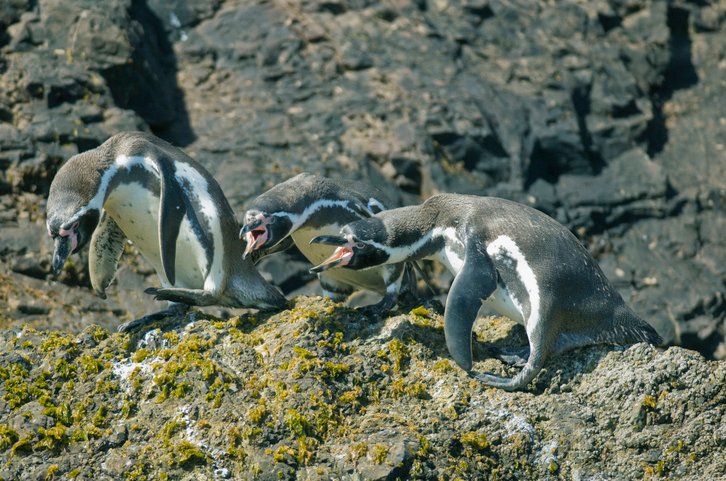
- The Humboldt penguin (Spheniscus humboldti) belongs to the genus commonly referred to as the “banded” group. This species is named after the Humboldt Current, a major oceanic upwelling known for its cold waters that define its natural habitat.
- Distribution: Humboldt penguins are native to the Pacific coasts of Chile and Peru, with about 80% of the global population found along Chile’s coastline.
- Appearance: These medium-sized penguins stand a little over 2 feet They have prominent bare skin patches around their eyes, an adaptation that helps them regulate body temperature by releasing heat, as noted by the Smithsonian Institute.
- Breeding Season: In the wild, they breed either between March and April or from September to October, depending on the location of the colony. Humboldt penguins are monogamous, recognizing their mates within the colony through unique vocal signals.
- Conservation Status:
- IUCN: Vulnerable
- CITES: Appendix I
What Is Happening to the Humboldt Penguin?
- Scientists at the Universidad de Concepción estimate that numbers have fallen from about 45,000 (late 1990s) to fewer than 20,000 today (2025).
- In response, Chile’s Environment Ministry has classified the bird as “endangered.”
Why is the Population Shrinking?
Scientists identify multiple, overlapping threats:
- Competition for Food from Commercial Fishing
- Industrial and small-scale fisheries harvest the same fish that penguins depend on.
- Less prey in the sea → penguins struggle to find enough food, especially to feed chicks.
- Habitat Loss and Disturbance
- Coastal development, human activity, and tourism can disturb nesting sites, reduce safe breeding areas, and increase stress.
- Pollution
- Oil spills, plastic waste, and chemical contaminants degrade the marine environment and directly harm seabirds.
- Bird Flu and Disease
- Outbreaks of avian influenza (bird flu) have killed many seabirds in South America in recent years, adding to the pressure.
- Climate Change
- Warming oceans and changing current patterns affect fish distribution and breeding conditions.
- More frequent extreme events (e.g., marine heatwaves, El Niño-type impacts) can sharply reduce food availability.
- Predation and Natural Threats Intensified by Human Changes
- Sea lions and predatory birds attack penguins and chicks.
- When food is scarce or habitats are disturbed, penguins become more vulnerable to such threats.
A Chilean marine biologist warned that if these threats continue over time, the species could shift from endangered to critically endangered, and then disappear completely.
How Chile Is Responding?
- Legal Status Upgraded
- The species has been formally classified as “endangered” by the Chilean government.
- This allows stronger conservation measures on paper.
- Scientific Alarm and Public Warning
- Chilean scientists are openly warning of the risk of extinction.
- They stress that the current situation is not a short-term fluctuation but a long-term decline.
- Calls for Stricter Fishing Rules
- Experts like Paulina Arce, a veterinary specialist on Humboldt Penguins, argue that:
- The species is threatened by intensive fishing, both industrial and small-scale.
- There is a need for stricter legislation on sustainable fishing to reduce competition for food.
- Conservation Discourse
- The focus is now on reducing human-driven pressures and creating policies that balance fisheries and penguin survival.
- Experts like Paulina Arce, a veterinary specialist on Humboldt Penguins, argue that:
Implications of reducing Humboldt Penguins’ population
- Biodiversity Loss
- The Humboldt Penguin is a key species in its ecosystem. Its decline signals wider stress in the Humboldt Current marine system.
- Climate Change Indicator
- The species is a visible victim of climate impacts on oceans, making it a symbol in global climate and conservation debates.
- Fisheries vs Conservation Conflict
- The case shows the classic tension between economic livelihoods (fishing) and wildlife protection.
- Similar conflicts exist in India (e.g., overfishing, coastal development affecting marine species).
- Global Responsibility
- Because Chile holds 80% of the world population, what happens there largely determines the global future of the Humboldt Penguin.
- Lessons for India’s Environmental Governance
- Importance of early warning, strong science–policy linkages, and preventive conservation rather than reacting at the brink of extinction.
Challenges & Way Forward
| Challenge | Way Forward |
| Overfishing and food competition | Introduce science-based catch limits, seasonal closures around key breeding areas, and marine protected zones |
| Habitat loss and disturbance | Protect nesting islands/coasts as no-disturbance zones, regulate tourism and coastal development |
| Pollution and disease (bird flu) | Strengthen monitoring, oil-spill response, reduce plastic, and coordinate regional disease surveillance |
| Climate change impacts | Integrate penguin needs into climate adaptation plans, maintain large, well-managed marine areas for resilience |
| Weak enforcement and fragmented policy | Build capacity for enforcement, involve local communities and fishers in co-management |
| Conflicts with fishing communities | Provide alternative incomes, promote sustainable fishing certifications and eco-tourism benefits |
| Limited global attention and funding | Use the endangered status to attract international support, research grants, and NGO partnerships |
Conclusion
The Humboldt Penguin is declining rapidly along Chile’s coast. With numbers already less than half of what they were in the 1990s, the species is now officially endangered and at risk of slipping further towards extinction. The way forward lies in integrated marine management: strict but fair fisheries regulation, strong habitat protection, community participation, and climate-smart conservation.
| EnsureIAS Mains Question
Q. Humboldt Penguins along Chile’s coast have been declared endangered, with their population sharply declining in recent decades. Discuss the major drivers of this decline and examine how the conflict between fisheries and marine conservation can be managed to protect such vulnerable marine species. (250 Words) |
| EnsureIAS Prelims Question
Q. With reference to the Humboldt Penguin, consider the following statements: 1. A large share of the world’s Humboldt Penguin population is found along the Pacific coast of Chile. 2. Major threats to the species include competition for food from commercial fishing and the impacts of climate change. 3. The species is found mainly in freshwater lakes of Antarctica. Which of the statements given above is/are correct? A. 1 and 2 only Answer: A. 1 and 2 only Explanation: Statement 1 is correct: Chile’s Pacific coast hosts about 80% of the world’s remaining Humboldt Penguins, making Chile crucial for the species’ survival. Statement 2 is correct: Scientists clearly highlight competition for food from commercial fishing and worsening climate impacts, along with habitat loss, pollution and disease, as key reasons for the penguin’s population decline. Statement 3 is incorrect: Humboldt Penguins are not freshwater or Antarctic lake species. They live along the temperate Pacific coasts of Chile and Peru, associated with the cold Humboldt Current, not inland lakes or Antarctica’s interior. |