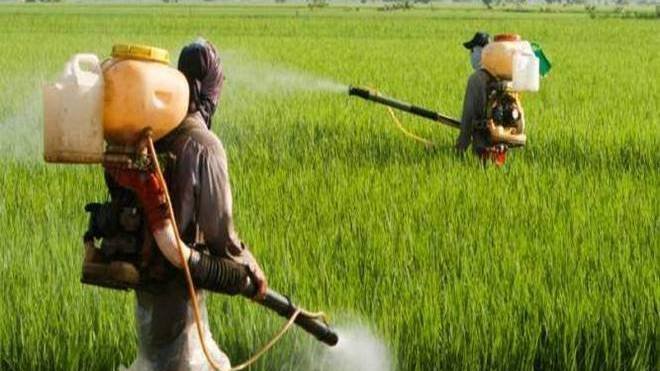
Why in the News?
- India’s crop protection chemicals market is witnessing a shift in growth from insecticides and fungicides to herbicides, driven primarily by agricultural labour shortages.
- Indian companies like Crystal Crop Protection Ltd (CCPL) are emerging as key players in the herbicide market, challenging the dominance of multinational corporations.
- The shift marks a broader transition in Indian agriculture, where labour-saving technologies are being increasingly preferred over traditional manual practices.
Key Highlights
- Structure of India’s Crop Protection Market
- The organised domestic market is worth around Rs 24,500 crore.
- It is divided into insecticides (Rs 10,700 crore), herbicides (Rs 8,200 crore), and fungicides (Rs 5,600 crore).
- Herbicides are the fastest-growing segment, with a growth rate of over 10% annually.
- Role of Multinational and Indian Companies
- MNCs dominate the market: Bayer (15%), Syngenta (12%), ADAMA (10%), Corteva (7%), and Sumitomo (6%).
- Indian players are making inroads: Dhanuka Agritech (6%) and CCPL (4%).
- CCPL has acquired herbicide rights from Bayer (Ethoxysulfuron, Sunrice) and Syngenta (Gramoxone).
- Rising Demand Due to Labour Shortage
- Manual weeding is labour-intensive (8-10 hours/acre) and needs repetition due to regrowth.
- Labour wage rates have risen (Rs 447.6/day in Dec 2024, from Rs 326.2 in 2019).
- Power weeders are faster but ineffective in dense crop areas.
- Herbicides are emerging as a labour-saving alternative, like tractors.
- Evolving Usage Patterns in Herbicides
- Earlier usage was post-emergent, i.e., after weeds appeared.
- Now, pre-emergent and early post-emergent spraying is gaining popularity for preventive weed control.
- Pre-emergent herbicides make up Rs 550 crore of the Rs 1,500 crore paddy herbicide market.
- This shift supports timely weed control amid growing labour unavailability.
- Innovation and Indian R&D Push
- CCPL, in collaboration with Battelle (USA) and Mitsui AgriScience (Japan), has developed ‘Sikosa’, a new patented paddy herbicide.
- ‘Sikosa’ uses oil-dispersion technology, controls a broad range of weeds, and reduces per-acre costs compared to manual weeding.
- The herbicide works effectively within 0–3 days after transplanting, promoting early-stage crop health.
Implications
- Changing Nature of Farm Inputs
- Herbicides are no longer just chemicals; they are becoming tools of farm mechanisation.
- This marks a shift toward input-intensive, labour-light agricultural practices.
- Market Expansion and Indian Competitiveness
- Indian companies acquiring global brands show increasing domestic capability and ambition.
- Expansion into South and Southeast Asian markets enhances export potential.
- Technological Advancements and R&D Focus
- Indian firms are entering formulation R&D, not just generic production.
- Partnerships with foreign R&D firms indicate global integration of Indian agro-chemical players.
- Labour Market and Rural Employment Dynamics
- Growing herbicide use might reduce demand for manual labour in agriculture.
- This could impact rural employment patterns, especially among landless labourers.
- Regulatory and Monopoly Concerns
- MNCs still control core active ingredients and formulations, raising monopoly issues.
- Indian players need policy and institutional support to enhance innovation and manufacturing capacity.
Challenges and Way Forward
| Challenges | Way Forward |
| Heavy dominance of multinational companies | Strengthen domestic R&D and innovation ecosystems |
| Limited access to patented active ingredients | Facilitate tech-transfer and public-private R&D partnerships |
| Labour displacement due to mechanisation and herbicides | Create alternative rural employment opportunities |
| Environmental and health concerns with herbicide overuse | Promote safe-use training and eco-friendly formulations |
| High import dependence for technical-grade chemicals | Incentivise indigenous production of technicals |
Conclusion
India’s pesticide market is undergoing a notable transformation, driven by rising labour scarcity and the growing need for time-saving solutions. Herbicides have emerged as the fastest-growing segment, becoming central to modern farm practices. While multinational firms continue to dominate, Indian companies are gradually asserting themselves through strategic acquisitions and collaborative innovation. However, long-term sustainability will depend on balancing market growth with environmental safety, employment concerns, and the need for self-reliance in agri-inputs.
| Ensure IAS Mains Question
Q. Discuss how labour shortages are driving the growth of the herbicide market in India. In your answer, highlight the role of domestic and multinational companies, changing usage patterns, and the broader implications for Indian agriculture. (250 words) |
| Ensure IAS Prelims Question
Q. Consider the following statements regarding India’s crop protection chemicals market: 1. Herbicides are now the fastest-growing segment in India’s pesticide market. 2. Manual weeding is more cost-effective than herbicide application in paddy cultivation. Which of the above statements is/are correct? a) 1 only b) 2 only c) Both 1 and 2 d) Neither 1 nor 2 Answer: a) 1 only Explanation: Statement 1 is correct: Herbicides have emerged as the fastest-growing segment in India’s crop protection market, with over 10% annual growth, primarily due to labour shortages and the need for efficient weed control. Statement 2 is incorrect: Manual weeding is not more cost-effective; it costs over Rs 2,000 per acre and is labour-intensive, whereas herbicides like ‘Sikosa’ cost around Rs 850–900 per acre and save time and effort. |