Context
Recently, the BRICS countries adopted the Guwahati Declaration to enhance collaboration in curbing illicit drug trafficking and other forms of organised transnational crime.
About Guwahati Declaration
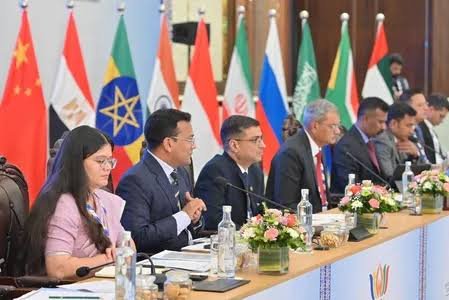
- It was adopted at the conclusion of the BRICS Heads of Anti-Drug Agencies Meeting held in Guwahati, Assam, under India’s BRICS Chairship 2026, with the theme Building for Resilience, Innovation, Cooperation and Sustainability.
- The meeting brought together representatives from Brazil, China, Ethiopia, India, Indonesia, Iran, Russia, and the United Arab Emirates to discuss coordinated strategies for strengthening international cooperation against illicit drug trafficking and related organised crime.
- The declaration calls for the timely exchange of information, intelligence, and best practices in accordance with national laws and international obligations.
- It also encourages the use of innovative technologies, digital tools, and data-driven approaches to strengthen law enforcement and regulatory mechanisms.
- It advocates evidence-based, people-centric strategies to reduce drug demand, promote healthy lifestyles, and protect vulnerable groups, particularly children and young people.
Key Facts about BRICS
- BRICS is an intergovernmental grouping of major emerging economies that promotes greater economic and geopolitical cooperation among its members.
- The term “BRIC” was coined by Jim O’Neill in 2001. The grouping initially comprised Brazil, Russia, India, and China, with South Africa joining in 2010 to form BRICS.
- The grouping expanded in 2024 with the inclusion of Egypt, Ethiopia, Iran, Saudi Arabia, and the United Arab Emirates, followed by Indonesia in 2025.
- BRICS currently comprises 11 member countries, accounting for around 49.5% of the world’s population, about 40% of global GDP, and nearly 26% of global trade.
- In 2025, Belarus, Bolivia, Cuba, Kazakhstan, Malaysia, Nigeria, Thailand, Uganda, Uzbekistan, and Vietnam joined BRICS as partner countries.