Context
Recently, the Union Minister for Commerce and Industry discussed strengthening India–Greece economic ties by enhancing cooperation in financial services, fintech, digital payments, and emerging technologies.
About Greece
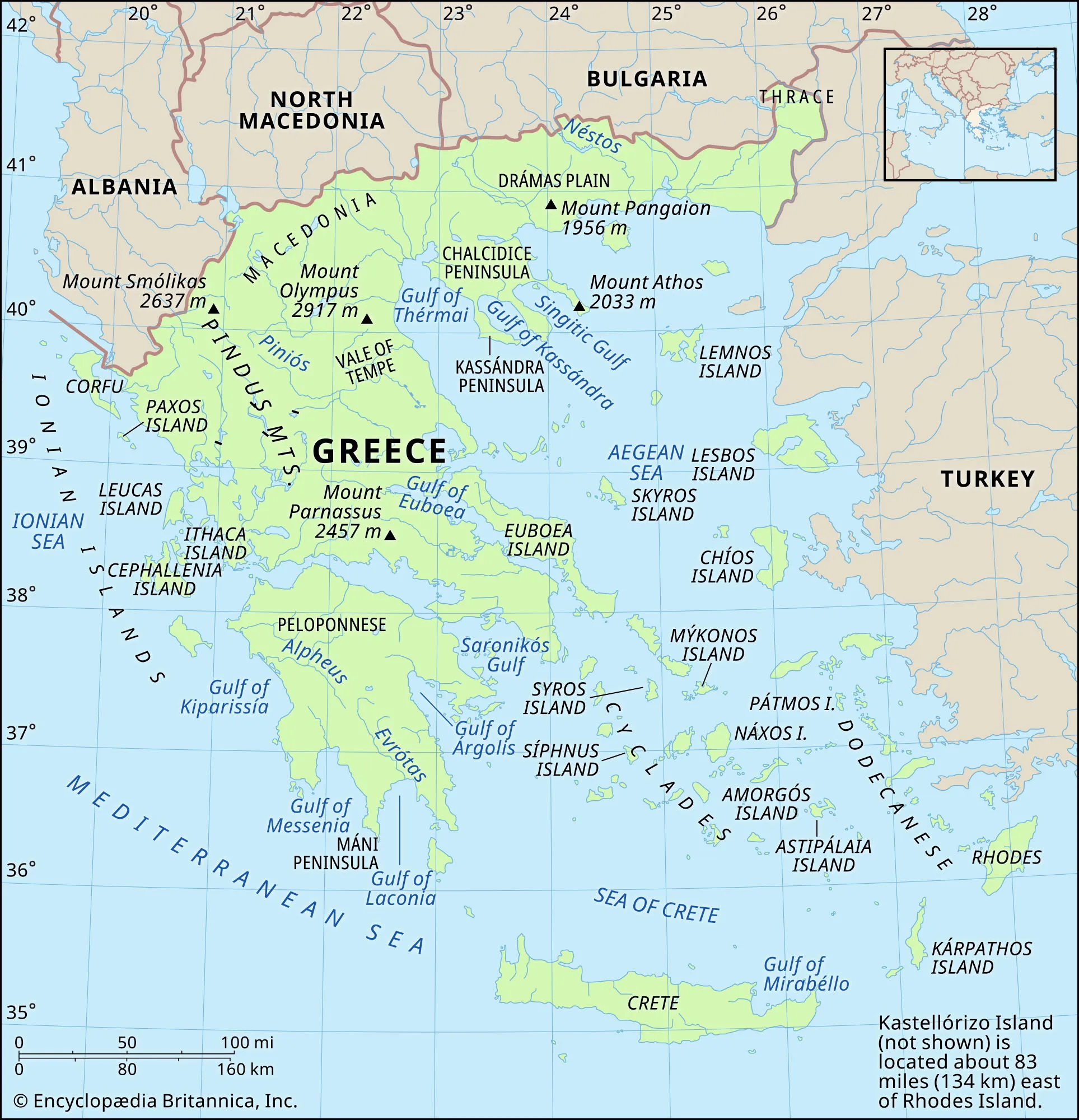
- Greece, with Athens as its capital, is situated at the southern end of the Balkan Peninsula in southeastern Europe.
- It occupies a strategic position between Europe, Asia, and the Mediterranean, giving it considerable geopolitical and maritime significance.
- The country is bordered by Albania, North Macedonia, Bulgaria, and Turkey, while the Aegean Sea, Ionian Sea, and the Mediterranean Sea surround its eastern, western, and southern coasts, respectively.
- Approximately 80% of its landscape is covered by mountains and hills, making Greece one of Europe’s most mountainous countries. It experiences a Mediterranean climate, with hot, dry summers and mild, wet winters.
- The Pindus Mountain Range forms the country’s principal mountain system and includes the Vikos Gorge, one of the deepest gorges in the world. Mount Olympus, at 2,918 metres, is Greece’s highest peak.
- Important rivers associated with Greece include the Maritsa (Evros), Struma (Strymon), and Vardar (Axios).
- Greece possesses a variety of natural resources, including petroleum, lignite, magnetite, bauxite, marble, and hydropower.