Context
New research indicates that the geological processes responsible for shaping the Giant’s Causeway unfolded over nearly 5.5 million years, revising earlier estimates and providing a clearer understanding of its volcanic evolution.
About Giant’s Causeway
- Giant’s Causeway is a renowned geological landmark located on the coast of the Antrim Plateau in Northern Ireland.
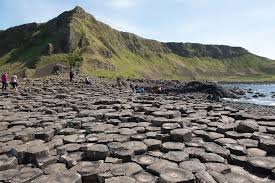
- It comprises nearly 40,000 interlocking basalt columns extending across about 6 km of coastline.
- Most columns are hexagonal or polygonal in shape, exhibiting remarkable natural symmetry.
- It was inscribed as a UNESCO World Heritage Site in 1986 for its outstanding geological significance.
- The varying heights of the columns create a distinctive step-like landscape extending from the shoreline to the cliff tops, inspiring the name “Giant’s Causeway.”
Formation
- The basalt columns were formed during the Paleogene Period, around 50–60 million years ago.
- Their origin is linked to extensive volcanic activity in the region.
- Basaltic lava rose through underlying chalk layers and spread across the surface, forming the Antrim volcanic plateau.
- As the lava cooled and contracted, a network of fractures developed within the solidifying rock.
- Progressive cooling widened these fractures, producing the characteristic vertical basalt columns seen today.