Context
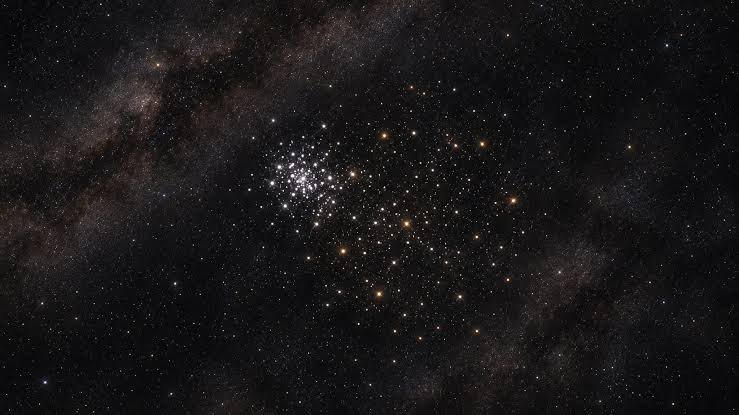
Indian astronomers using data from ESA’s Gaia mission found that UBC 63, earlier considered a single open cluster, is actually composed of UBC 63A and UBC 63B. Their recent close flyby provides a rare case for studying how gravitational encounters influence the structure and evolution of stellar clusters.
Gaia Mission: Mapping the Milky Way
- Space astrometry mission: Launched by the European Space Agency (ESA) on 19 December 2013, Gaia measured the positions, motions and astrophysical properties of nearly two billion celestial objects to build an exceptionally precise map of the Milky Way.
- 3D stellar mapping: Repeated measurements of parallax and proper motion allowed astronomers to estimate stellar distances and transverse motions, helping reconstruct the Galaxy’s three-dimensional structure and dynamics.
- Stable observing point: Gaia operated around the Sun–Earth L2 point, about 1.5 million km from Earth, where stable observing conditions supported extremely precise measurements.
- Long scientific legacy: Science observations ended in January 2025 after more than three trillion observations, but continued data processing means Gaia remains scientifically valuable even after spacecraft operations ended.
Gaia’s Observation System
- Twin telescopes: Two telescopes observed widely separated parts of the sky and projected their light onto a common focal plane, enabling highly precise relative-position measurements.
- Photometry: Blue and red photometers measured brightness and colour, from which properties such as temperature and evolutionary stage can be inferred.
- Spectroscopy: The Radial Velocity Spectrometer measured line-of-sight velocity and spectral information, complementing astrometry to reconstruct stellar motion more completely.
What is UBC 63?
- Open-cluster system: UBC 63 lies about 4,892 light-years from Earth and was earlier classified as one sparsely populated stellar cluster.
- Distinct stellar populations: Gaia data separated it into UBC 63A, about 21 million years old, and UBC 63B, about 562 million years old; their large age difference shows that they did not form together.
- Recent close encounter: Orbital reconstruction indicates that the two gravitationally unbound clusters passed within roughly 7 parsecs about six million years ago, making them a rare candidate double-cluster flyby system.
- Possible tidal effects: Their elongated structures and escaping stars may reflect disturbance from the close passage, providing evidence of how stellar encounters can reshape cluster structure.
Scientific Significance
- Cluster dynamics: The recent unbound flyby acts as a natural laboratory for studying how gravitational encounters disturb stellar distributions and influence cluster dispersal.
- Hidden structure: Gaia’s precise distance and motion measurements revealed two physically distinct populations that appeared close together in the sky, showing the limits of image-based classification alone.
- Computational astronomy: Combining Gaia DR3 data, statistical clustering and dynamical simulations shows how large astronomical datasets can reconstruct past interactions between stellar systems.
- Mission legacy: Discoveries such as UBC 63 demonstrate how archival Gaia data can continue producing new insights into Galactic structure even after observations have ended.
FAQs
Q1. Which organisation launched Gaia?
The European Space Agency (ESA).
Q2. What was Gaia’s main objective?
To produce an exceptionally precise three-dimensional map of the Milky Way.
Q3. Where did Gaia operate?
Around the Sun–Earth L2 point, about 1.5 million km from Earth.
Q4. What did astronomers discover about UBC 63?
It contains two distinct clusters, UBC 63A and UBC 63B.
Q5. Why is the UBC 63 discovery important?
It helps scientists study how close gravitational encounters affect the evolution of star clusters.