Important Questions for UPSC Prelims, Mains and Interview
|
Context
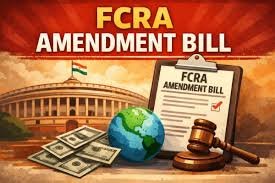
The Union government has deferred discussion on the FCRA Amendment Bill 2026 amid rising concerns over its impact on NGOs, religious institutions, and federal political dynamics.
Q1. What are the key provisions of the proposed amendments to the FCRA, and how do they aim to address existing regulatory gaps in managing foreign-funded assets?
- The amendment introduces a designated authority to manage foreign-funded assets.
- It replaces earlier provisions related to asset handling.
- The authority will take control in specific cases like cancellation of registration and expiry or non-renewal of registration.
- The amendment defines clear conditions for registration lapse. It allows return of assets if registration is restored. It provides for permanent takeover in certain situations.
- Assets may be transferred or disposed of through prescribed mechanisms.
- The aim is to remove ambiguity and ensure accountability in asset management.
Q2. Why has the FCRA Amendment Bill 2026 generated political and social controversy, particularly concerning NGOs and minority institutions?
- The Bill raises concerns about government control over NGO assets.
- Opposition parties fear misuse of regulatory powers & minority institutions may be disproportionately affected. Critics argue it could restrict civil society functioning.
- There are concerns regarding autonomy of organisations.
- Religious groups fear interference in their operations.
- The timing of the Bill adds to political sensitivity.
- It has triggered debates on rights versus regulation.
Q3. How does the introduction of a designated authority under the amendment change the regulatory framework governing foreign contributions in India?
- The designated authority centralises control over foreign-funded assets.
- It introduces a structured mechanism for asset supervision.
- The authority acts in cases of regulatory non-compliance.
- It ensures continuity in management of funds & reduces discretion at lower administrative levels
- It creates a formal process for asset transfer or disposal.
- It enhances monitoring of foreign contributions.
- It strengthens state oversight over civil society funding.
Q4. What are the historical objectives and evolution of the FCRA, and how has it adapted to changing national security and governance concerns?
- The FCRA was first enacted in 1976. Its objective was to regulate foreign influence in India.
- It aimed to protect national sovereignty and integrity.
- The Act was revised in 2010 to modernise the framework.
- Amendments have strengthened regulatory oversight with increased scrutiny of funding and enhanced compliance requirements.
- The law reflects evolving security concerns. It balances openness with regulatory control.
Q5. What are the implications of the amendment for civil society organisations, especially in terms of autonomy, compliance, and financial sustainability?
- NGOs may face stricter compliance requirements.
- Increased oversight could reduce operational flexibility.
- Risk of asset takeover may create uncertainty.
- Smaller organisations may struggle with regulatory burden.
- Dependence on foreign funding could be affected.
- Administrative costs may increase due to legal compliance and reporting requirements.
- It may impact long-term sustainability of NGOs.
Q6. How does the issue of foreign funding intersect with national security, public order, and democratic freedoms in India?
- Foreign funding can influence domestic policies.
- Regulation ensures protection of national interests.
- It prevents misuse of funds for unlawful activities.
- However, excessive control may affect democratic freedoms.
- Civil society plays a key role in governance.
- A balance is required between regulation and freedom.
- Transparent mechanisms are essential for trust.
Q7. Why has the debate around the FCRA Amendment Bill gained political significance in states like Kerala, and what factors contribute to this sensitivity?
- Kerala has a significant presence of NGOs and religious institutions.
- Minority communities form an important demographic group.
- Foreign-funded organisations are active in social sectors.
- Elections increase political sensitivity of policy decisions.
- Opposition parties have mobilised public opinion.
- Concerns about community impact have intensified debate.
- The issue has become part of electoral discourse.
- It reflects the intersection of policy and politics.
Conclusion
The FCRA Amendment Bill 2026 reflects an attempt to strengthen regulatory control over foreign funding, but its success will depend on maintaining a careful balance between national security concerns and the autonomy of civil society institutions in a democratic framework.