Context
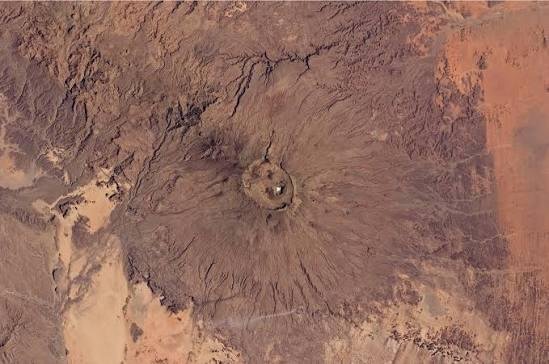
- A 2024 astronaut photograph highlighted an unusual bright-white salt deposit inside Emi Koussi, a massive volcano in northern Chad.
- The salt patch, resembling snow from space, lies within a crater surrounded by dark volcanic rocks, ancient lava flows and volcanic vents.
- The image has renewed attention on the distinctive volcanic landscape of the Tibesti Mountains in the Sahara Desert.
About Emi Koussi Volcano
- Location: Emi Koussi lies at the southeastern end of the Tibesti Mountains in northern Chad, within the central Sahara.
- Volcano type: It is a massive shield volcano, characterised by a broad structure formed largely through successive lava flows.
- Highest point: At about 3,415 metres above sea level, Emi Koussi is the highest mountain in Chad and the highest point in the Sahara.
- Summit structure: The volcano is capped by two nested calderas and contains several other volcanic landforms.
- Volcanic features: Its summit and flanks contain lava domes, cinder cones, maars, volcanic vents and lava flows, indicating a complex history of volcanic activity.
- Its dark volcanic rocks stand in sharp contrast with the surrounding tan and light-brown sandstone terrain of the Sahara.
Calderas and the White Salt Patch
- A caldera is a large volcanic depression generally formed when the surface collapses following the withdrawal or eruption of magma from an underlying magma chamber.
- Emi Koussi’s larger summit caldera measures approximately 12 × 15 km, with a smaller caldera nested within the broader summit structure.
- Within this system lies Era Kohor, a smaller crater whose floor contains conspicuous white salt deposits.
- The white material is not snow. It represents salts left behind after water collected within the enclosed volcanic depression and subsequently evaporated.
- The feature demonstrates how volcanic relief and extreme Saharan aridity can interact: volcanic depressions collect water, while intense evaporation concentrates dissolved minerals and produces salt deposits.
What is a Maar?
- A maar is a broad, relatively shallow volcanic crater produced when hot magma encounters groundwater.
- The contact rapidly converts groundwater into steam, producing an explosive magma-water interaction that excavates a crater.
- Because the crater floor may lie below the surrounding surface, groundwater or rainfall can accumulate within it, sometimes forming a shallow crater lake.
Maar vs Caldera
- Maar: Formed mainly by an explosive interaction between magma and groundwater.
- Caldera: Usually formed by collapse of the ground above a partially emptied magma chamber.
This distinction is particularly important for UPSC Prelims, where volcanic landforms are frequently differentiated by their mode of formation.
FAQs
Q1. Where is Emi Koussi located?
It lies in the Tibesti Mountains of northern Chad in the Sahara Desert.
Q2. What type of volcano is Emi Koussi?
It is a large shield volcano.
Q3. What is the geographical significance of Emi Koussi?
At about 3,415 metres, it is the highest point in Chad and the Sahara.
Q4. What causes the white patch inside Emi Koussi?
It consists of salts left behind after evaporation of water accumulated within a volcanic depression.
Q5. What is a maar?
A maar is a volcanic crater formed mainly by explosive interaction between magma and groundwater.