Context
The Department of Health Research (DHR) has released the Draft National Health Research Policy, 2026 for public consultation. The draft seeks to establish a unified, innovation-driven, and outcome-oriented framework by aligning scientific priorities with India’s disease burden, strengthening research governance, and promoting evidence-informed decision-making.
Health Research in India
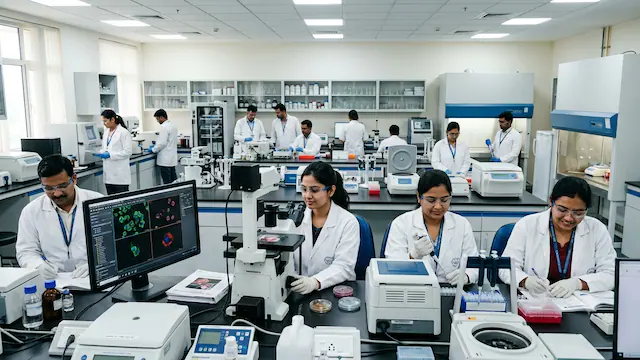
Health research generates scientific evidence to improve disease prevention, diagnosis, treatment, healthcare delivery, and public health governance. It encompasses biomedical sciences, clinical medicine, public health, epidemiology, health systems, digital health, behavioural sciences, and emerging technologies.
Its key objectives are to:
- Understand disease patterns and emerging health risks.
- Develop vaccines, diagnostics, therapeutics, and medical technologies.
- Strengthen healthcare delivery and emergency preparedness.
- Support evidence-informed policymaking.
The National Health Research Policy, 2011 provides the existing framework, which the Draft National Health Research Policy, 2026 seeks to modernise in line with emerging health challenges and national priorities.
Key Institutions
- Department of Health Research (DHR)
- Indian Council of Medical Research (ICMR)
- All India Institute of Medical Sciences (AIIMS) and other premier medical institutions.
- National Institute of Nutrition (NIN), Hyderabad
Need for Reform
- Low Investment: India spends only 0.024% of GDP on health research, significantly below the 0.27% average among high-income countries.
- Regional Disparities: Research infrastructure and expertise remain concentrated in a few institutions and states, while many medical colleges have limited research output.
- Fragmented Ecosystem: Weak coordination among government, academia, healthcare institutions, industry, and communities has resulted in duplication of efforts and inefficient use of resources.
- Mismatch with National Priorities: Existing research does not adequately reflect India’s disease burden, health system requirements, equity concerns, or emerging health threats.
- Weak Translation into Practice: Administrative and regulatory bottlenecks delay the application of scientific findings in healthcare and public policy.
Major Provisions
- Enhanced Public Investment: The policy proposes a phased increase in government expenditure on health research:
- Current: 0.024% of GDP
- By 2037: 0.072% of GDP
- By 2047: 0.15% of GDP
- National Health Research Agenda: A National Health Research Agenda will identify priority areas based on:
- Disease burden
- Emerging health threats
- Health system needs
- National priorities
- Equity
- Pandemic preparedness
- Strategic national interests
- Priority Research Areas: The policy prioritises research on-
- Tuberculosis
- Antimicrobial Resistance (AMR)
- Vector-borne diseases
- Cancer
- Non-Communicable Diseases (NCDs)
- Mental health
- Anaemia
- Child malnutrition
- Women’s health
- Maternal and neonatal mortality
- Primary and emergency healthcare
- Research Governance: The policy proposes a three-tier governance framework comprising:
- National Health Research Stewardship Committee for strategic oversight.
- Department of Health Research (DHR) as the nodal implementing agency.
- Indian Council of Medical Research (ICMR) as the scientific and technical lead.
States will also be encouraged to prepare State Health Research Agendas aligned with local health priorities.
Strengthening the Research Ecosystem
The policy aims to:
- Strengthen research capacity in medical colleges.
- Foster collaboration among government, academia, healthcare institutions, industry, and communities.
- Encourage participation by private hospitals, startups, philanthropic organisations, and Corporate Social Responsibility (CSR) initiatives.
- Shift performance assessment from publications and grants to real-world impact, including policy influence, innovation, institutional capacity, and health outcomes, through wider use of the ICMR Impact of Research and Innovation Scale (ICMR-IRIS).
Regulatory and Ethical Reforms
- Simplify ethics approval for multicentre studies.
- Establish a National Research Integrity Office (NRIO).
- Promote the responsible use of Artificial Intelligence (AI) in health research.
- Expand access to publicly funded laboratories, biobanks, and research infrastructure.
Significance
- Establishes India’s first integrated national framework for health research.
- Aligns scientific priorities with national health needs.
- Promotes indigenous innovation and evidence-informed policymaking.
- Strengthens coordination among research institutions and stakeholders.
- Expands research capacity across states and medical colleges.
- Improves preparedness for future public health emergencies.
Implementation Challenges
- Mobilising the proposed increase in public investment.
- Reducing regional disparities in research infrastructure.
- Strengthening institutional capacity across states.
- Ensuring effective coordination among multiple stakeholders.
- Accelerating the translation of research into healthcare delivery and public policy.
- Maintaining ethical standards while facilitating timely research.
Conclusion
The Draft National Health Research Policy, 2026 lays the foundation for a more integrated, innovation-driven, and outcome-oriented health research ecosystem in India. If implemented effectively, it can strengthen scientific capacity, improve health outcomes, and promote evidence-informed governance. Its success, however, will depend on adequate public investment, stronger institutional capacity, cooperative federalism, and effective implementation.