Context
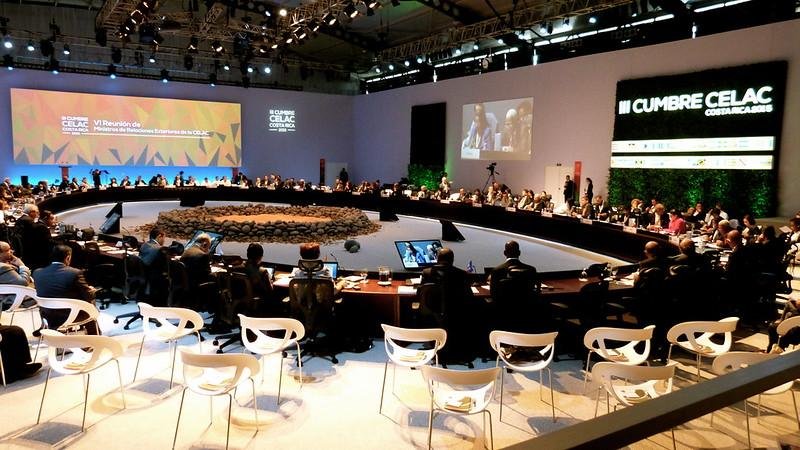
The Community of Latin American and Caribbean States (CELAC) is a regional mechanism for political dialogue, cooperation and coordination among the countries of Latin America and the Caribbean. It also provides a platform for collective engagement with external partners.
About CELAC
- CELAC comprises 33 countries of Latin America and the Caribbean.
- It was created on 23rd February 2010 at the Latin American and Caribbean Unity Summit in Playa del Carmen, Mexico.
- It was definitively constituted at the Caracas Summit in December 2011 through the Declaration of Caracas.
- CELAC succeeded the Rio Group and the Latin American and Caribbean Summit on Integration and Development.
- Its objectives include regional integration, political cooperation, sustainable development and coordination on issues of common interest.
- It provides a common regional platform while accommodating the political, economic and social diversity of its members.
Institutional Framework
CELAC functions as an intergovernmental mechanism for dialogue and political agreement, rather than a supranational organisation. Its decisions are based on consensus.
- Summit of Heads of State and Government: Provides political direction at the highest level.
- Foreign Ministers and National Coordinators: Facilitate political coordination and follow-up of agreed priorities.
- Pro Tempore Presidency (PTP): Rotates among member states and coordinates the group’s activities during its term.
- Specialised meetings: Address specific areas of regional cooperation.
India–CELAC Relations
India’s engagement with CELAC forms part of its wider outreach to Latin America and the Caribbean.
- The India–CELAC Dialogue was initiated in September 2011 on the sidelines of the UN General Assembly.
- The First India–CELAC Troika Foreign Ministers’ Meeting was held in New Delhi on 7 August 2012.
- The dialogue has addressed bilateral cooperation and regional and multilateral issues.
- It has also provided scope for expanding trade, investment and economic relations between India and the region.
Significance for India
- Regional engagement: Provides India with a region-wide channel for engaging with Latin American and Caribbean countries.
- Economic cooperation: Creates opportunities to deepen trade, investment and commercial partnerships.
- Multilateral coordination: Facilitates engagement on issues of shared interest in international forums.
- Global South cooperation: Complements India’s wider engagement with developing countries.
Conclusion
For India, CELAC provides a region-wide platform for engagement with Latin America and the Caribbean, complementing bilateral partnerships and strengthening cooperation with the wider Global South.
FAQs
- What is CELAC?
CELAC is a 33-member intergovernmental mechanism for political dialogue, cooperation and regional coordination among Latin American and Caribbean countries. - When was CELAC established?
It was created in 2010 and definitively constituted at the Caracas Summit in December 2011 through the Declaration of Caracas. - What is the institutional nature of CELAC?
CELAC operates through intergovernmental cooperation and consensus rather than supranational decision-making. Its Pro Tempore Presidency rotates among member states. - What is the India–CELAC Dialogue?
It is a mechanism for engagement between India and CELAC on bilateral, regional and multilateral issues, with the first India–CELAC Troika Foreign Ministers’ Meeting held in New Delhi in 2012.