Context
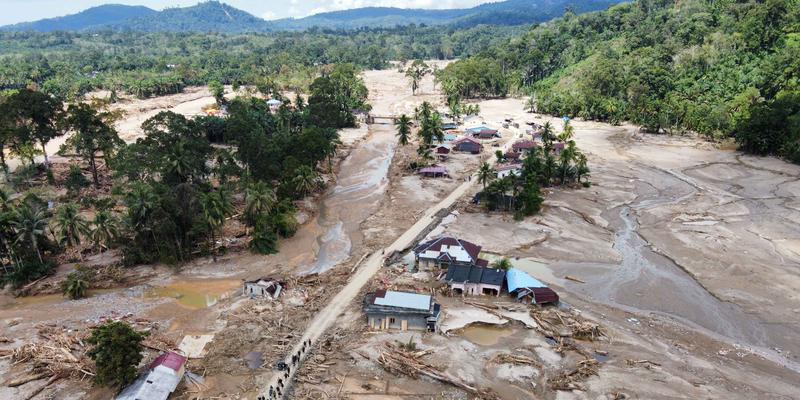
- Severe floods triggered by Cyclones Dithwa and Senyar (November 2025) caused widespread devastation in Sri Lanka, Malaysia, Indonesia and Thailand, killing around 1,600 people.
- A new scientific study by the World Weather Attribution (WWA) group, analysed the role of climate change, deforestation and rapid urbanisation in intensifying cyclone-related rainfall.
How Cyclones Cause Floods?
- Cyclones do not only bring strong winds. Their biggest danger often comes from heavy rainfall.
- Cyclones draw moisture from warm oceans.
- This moisture falls as intense rainfall over land.
- When rainfall is prolonged and heavy, rivers overflow and low-lying areas get flooded.
- In the case of Cyclones Dithwa and Senyar, rainfall — not wind — was the main cause of destruction.
Role of Climate Change in Intensifying Cyclone Rainfall
- Rising Global Temperatures
- Since the mid-1800s, global temperatures have risen by about 3°C.
- Warmer air can hold more moisture.
- For every 1°C rise, the atmosphere can hold about 7% more water vapour.
- Impact on Cyclones
- More moisture in the atmosphere leads to heavier rainfall during storms.
- Cyclones now produce longer-lasting and more intense rain than in the past.
- Sea Surface Temperatures (SSTs)
- During the cyclones, sea surface temperatures in the North Indian Ocean were 0.2°C higher than the 1991–2020 average.
- Without climate change, SSTs would have been around 1°C cooler.
- Warmer seas provide extra energy to cyclones, increasing evaporation and rainfall.
Evidence of Increased Rainfall Intensity
The study found clear evidence that climate change has increased rainfall:
- In Sri Lanka, heavy five-day rainfall events are now 28% to 160% more intense.
- In the Malacca Strait region, the probability of extreme rainfall rose from 9% to 50%.
- These changes explain why floods reached unprecedented levels.
How Deforestation Worsened Flooding?
- Forests absorb rainwater and slow down surface runoff.
- Tree roots hold soil together and reduce landslides.
- Extent of Deforestation
- Sri Lanka’s forest cover declined from 90% in 1900 to about 20% by 2002.
- In Indonesia, about 25% of forest land was converted to oil-palm plantations between 1991 and 2020.
- Impact on Floods
- With fewer trees, rainwater flows quickly over land instead of being absorbed.
- This leads to sudden floods and landslides, especially in steep regions like Sumatra.
- Deforestation removed the natural protective barrier against floods.
Impact of Rapid Urbanisation
- Expansion into High-Risk Areas
- Cities expanded into floodplains and low-lying regions.
- More people began living in high flood-risk zones.
- Infrastructure and Flood Risk
- Roads, railways, and concrete surfaces reduce water absorption.
- Natural drainage systems get blocked.
- Result
- Floodwaters spread faster.
- Human casualties and property damage increase sharply.
Human and Economic Consequences
- Human loss: Around 1,600 deaths across four countries.
- Economic damage:
- Indonesia: Losses of about $4.13 billion
- Sri Lanka: Losses of $6–7 billion, nearly 3%–5% of GDP
- Agriculture:
- Over 137,000 acres of farmland destroyed in Sri Lanka.
- Damage worsened by destruction of dams and canals.
Why This Is a Warning for the Future?
- Climate change is making extreme rainfall more frequent and intense.
- Deforestation and unplanned urbanisation are increasing vulnerability.
- Floods are no longer rare disasters but predictable outcomes of current development patterns.
Challenges and the Way Forward
| Key Challenges | Way Forward |
| Rising global temperatures | Strengthen climate mitigation efforts |
| Loss of forest cover | Protect forests and promote afforestation |
| Unplanned urban growth | Adopt flood-sensitive urban planning |
| Weak disaster preparedness | Improve early warning and evacuation systems |
| High vulnerability of poor populations | Integrate climate adaptation into development |
Conclusion
The floods caused by Cyclones Dithwa and Senyar show how climate change, deforestation, and rapid urbanisation together amplify disasters. Warmer oceans fuel heavier rainfall, deforestation removes natural protection, and urban expansion increases exposure. Addressing only one factor is insufficient. A combined approach focusing on climate action, ecological protection, and resilient development is essential to reduce future disaster risks.
| EnsureIAS Mains Question
Q. Climate change impacts are increasingly shaped by human land-use decisions. Discuss how global warming, deforestation and urbanisation together intensified cyclone-induced floods in Southeast Asia. (250 Words) |
| EnsureIAS Prelims Question
Q. Consider the following statements regarding cyclone-induced flooding in Southeast Asia: 1. Rising sea surface temperatures increase the moisture-holding capacity of the atmosphere. 2. Deforestation reduces surface runoff and mitigates flood peaks. 3. Rapid urbanisation increases exposure to flood risks. Which of the statements are correct? Answer: a) 1 and 3 only Explanation: Statement 1 is correct: Warmer sea surface temperatures increase evaporation and atmospheric moisture, which intensifies rainfall during cyclones and raises the risk of severe flooding. Statement 2 is incorrect: Deforestation reduces the land’s ability to absorb water, increases surface runoff and worsens flood peaks, especially in steep and ecologically sensitive regions. Statement 3 is correct: Rapid urbanisation expands settlements into flood-prone zones, increases impermeable surfaces and raises human and economic exposure to extreme rainfall events. |