Important questions for UPSC Pre/ Mains/ Interview:
|
Context
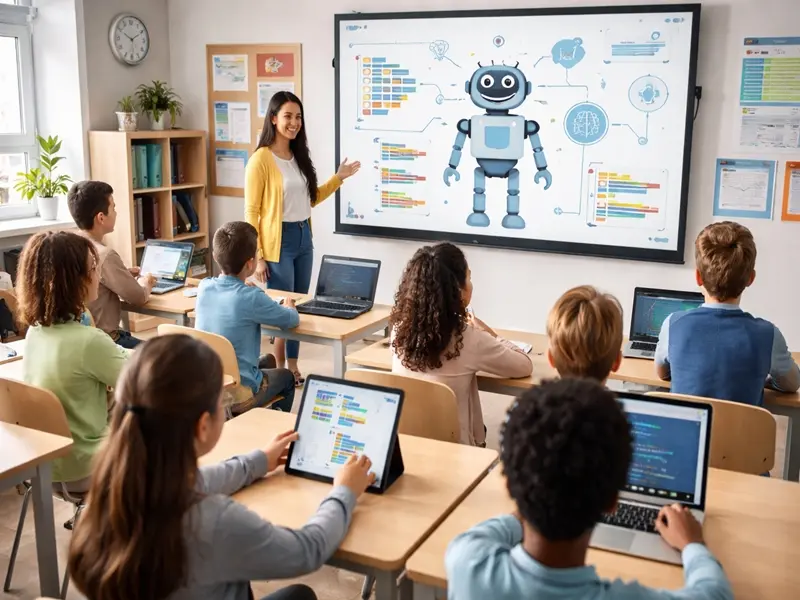
The Central Board of Secondary Education has introduced a Computational Thinking (CT) and AI curriculum for Classes 3–8, to be implemented from the 2026–27 academic session. The initiative aims to build future-ready skills, but raises concerns regarding foundational literacy readiness.
Q1. What is the CBSE AI & Computational Thinking curriculum?
- It is introduced for Classes 3 to 8.
- The focus is on logical reasoning, problem-solving and pattern recognition.
- Approach: Integrated across subjects (not standalone)
- Objective:
- Introduce AI concepts in everyday context
- Build early computational skills
Q2. Why are LSRW skills critical for CT learning?
- LSRW = Listening, Speaking, Reading, Writing
- Role: Foundation of all learning
- CT dependency: Requires:
- Reading instructions
- Interpreting problems
- Expressing solutions
- Activities: Puzzles, case studies, group tasks
- Issue: Weak literacy → CT becomes reading challenge, not thinking exercise
Q3. What do learning outcome data reveal?
- Annual Status of Education Report 2024
- 50% Class 5 students cannot read Class 2 text
- Persistent since 2006
- PARAKH 2024
- Urban private schools underperform at early grades
- Government schools perform better in some areas
- Key insight: Literacy deficit is system-wide
Q4. What is the gap between policy goals and reality?
- NIPUN Bharat Mission (2021) – Target is Foundational literacy by 2026–27
- Current status: Significant improvement, but gaps persist
- Issue: CT curriculum launched before literacy goals achieved
- Result: Policy sequencing mismatch
Q5. What does the CT curriculum assume?
- It assumes that students have basic comprehension ability.
- The focus is on higher-order thinking like analytical reasoning and problem-solving.
- From Class 6, the focus is on projects, journals and AI concepts.
- Risk: Weak literacy → early learning breakdown
- Assessment issue: Measures literacy instead of CT ability
Q6. What is the core policy dilemma?
- Two parallel priorities:
- Foundational literacy (LSRW)
- Advanced skills (CT & AI)
- Problem: Literacy gaps remain unresolved
- Result: CT may not deliver intended outcomes
- Insight: Foundation missing → superstructure weak
Q7. What is the way forward?
- Strengthen Foundations First – Achieve universal literacy (Grade 3 level)
- Phased Implementation – Introduce CT after literacy benchmarks
- Global Lessons – Countries like Finland and Singapore focus on literacy first and then on AI education.
- Curriculum Integration – Align CT with language development
- Teacher Capacity – Train teachers for dual focus (literacy + CT)
Conclusion
The CBSE AI curriculum is a forward-looking reform, but its success depends on strong foundational literacy. Without addressing LSRW gaps, the initiative risks becoming ineffective, highlighting the need for proper sequencing between basic learning and advanced skills development.