Context
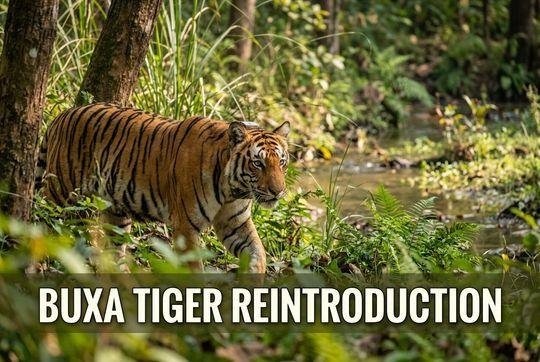
The translocation of T138, a three-year-old tigress, from Valmiki Tiger Reserve (Bihar) to Buxa Tiger Reserve (West Bengal) on 2 October 2026 marks a renewed effort to restore Buxa’s tiger population through scientific monitoring and habitat management.
About Buxa Tiger Reserve
- Location: Alipurduar subdivision, West Bengal, along the Bhutan border.
- Area: 87 sq km, comprising a 390.58 sq km core area and a 370.29 sq km buffer area.
- Establishment: Declared a tiger reserve in 1983 under Project Tiger, Buxa became India’s 15th tiger reserve. Buxa National Park (West Bengal) was established in 1992.
- Biodiversity: Its moist tropical forests support tigers, Asian elephants, leopards and diverse bird species.
- Landscape Connectivity: Along the Bhutan border, Buxa connects with Phipsoo Wildlife Sanctuary (Bhutan) and the wider landscape of Manas Tiger Reserve (Assam), Jaldapara National Park (West Bengal) and Kochugaon forests (Assam) through adjoining forest corridors, supporting wildlife movement.
Why Did Buxa Lose Its Resident Tiger Population?
- Human Pressure: Settlements, roads, and traffic increased disturbance.
- Habitat Loss and Fragmentation: Construction and land-use changes reduced habitat quality and wildlife movement.
- Declining Prey Base: Reduced prey availability limited tiger survival and breeding.
- Land-use Pressure: Agriculture and tea estates further affected the surrounding habitat.
Why Was Valmiki Tiger Reserve Selected?
- Habitat Suitability: Valmiki Tiger Reserve (Bihar), part of the Terai Arc Landscape, has forest and terrain conditions more comparable to Buxa than the mangrove habitat of the Sundarbans.
- Tiger Selection: Health, age and physical condition are assessed to determine an animal’s suitability for translocation.
- Site Compatibility: Habitat quality, prey availability and ecological conditions must support survival and breeding at the release site.
Significance of Tiger Reintroduction
- Ecological Balance: As apex predators, tigers help regulate prey populations and maintain ecosystem balance.
- Historical Range Recovery: Restores tiger populations in suitable parts of their former range.
- Landscape Connectivity: Supports wildlife movement and gene flow between connected habitats.
- Metapopulation Conservation: Connects separate tiger populations, reducing the risk of local extinction.
- Biodiversity Conservation: Restored habitats and improved prey availability support other wildlife species.
India’s Experience with Tiger Reintroduction
- Sariska Tiger Reserve (Rajasthan): Reintroduction began in 2008 using tigers from Ranthambore Tiger Reserve (Rajasthan), followed by population recovery.
- Panna Tiger Reserve (Madhya Pradesh): Reintroduction began in 2009 using tigers from Kanha and Bandhavgarh tiger reserves (Madhya Pradesh); the population recovered and breeding resumed.
- Satkosia Tiger Reserve (Odisha): The programme faced human–tiger conflict and limited community support.
- Institutional Support: The National Tiger Conservation Authority (NTCA), state governments, and the Wildlife Institute of India (WII) support site assessment, tiger selection, translocation, and post-release monitoring.
- Key Lesson: Successful reintroduction requires suitable habitat, adequate prey, community participation, effective protection, and long-term monitoring.
Measures Taken to Restore Buxa’s Tiger Population
Under the West Bengal government’s tiger recovery programme, supported by the National Tiger Conservation Authority (NTCA) and the Wildlife Institute of India (WII):
- Prey-base Improvement: Released over 800 chital to increase prey availability.
- Grassland Restoration: Restored or converted around 380 hectares of grassland to improve habitat conditions.
- Tiger Monitoring: Used camera traps to record tiger presence in 2021, 2023, and 2026 and track movement across the landscape.
- Community Participation: Engaged 64 Eco-Development Committees and Joint Forest Management Committees in conservation efforts.
Major Challenges
- Human–Tiger Conflict: Livestock losses and encounters with people can create safety concerns and reduce community support.
- Habitat and Prey Adequacy: Insufficient habitat, prey, or space can hinder tiger survival and breeding.
- Infrastructure Barriers: Roads and railway lines fragment habitats, restrict wildlife movement, and increase accident risks.
- Livelihood Concerns: Competing land-use needs and restrictions on resource use can affect local communities.
- Long-term Protection: Inadequate staffing, anti-poaching measures, or funding can weaken conservation efforts.
- Post-release Adaptation: Translocated tigers may struggle to adapt to unfamiliar habitats and establish territories.
Way Forward
- Scientific Assessment: Assess habitat quality, prey density, carrying capacity, and corridor connectivity before further translocations.
- Habitat and Prey Recovery: Restore degraded habitats, protect prey species, and maintain wildlife corridors.
- Community Engagement: Involve local residents in conservation decisions and provide timely compensation for verified losses.
- Conflict Mitigation: Strengthen early-warning systems, rapid-response teams, and coordination between communities and forest officials.
- Planned Translocation: Select suitable tigers based on health, age, sex, and breeding potential, and phase releases according to monitoring results.
- Continuous Monitoring: Use camera traps, radio telemetry, and field observations to track tiger movement, health, adaptation, and breeding.
- Landscape-level Cooperation: Coordinate conservation across adjoining forests, neighbouring states, and Bhutan to support wildlife movement.
FAQs
Q1. Why are tigers being reintroduced into Buxa Tiger Reserve?
Ans. To restore a stable resident tiger population and strengthen landscape-level conservation.
Q2. Which organisations are involved in tiger reintroduction in India?
Ans. The National Tiger Conservation Authority (NTCA), state governments and the Wildlife Institute of India (WII).
Q3. What is a metapopulation?
Ans. A group of separate populations of the same species connected by movement between habitat patches.