Context
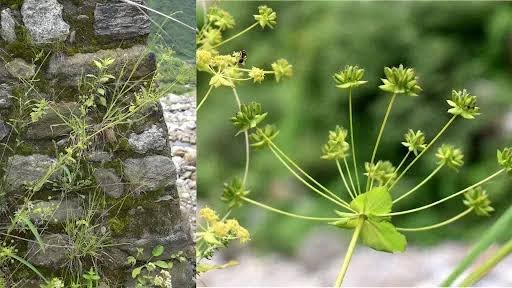
Botanists from the Botanical Survey of India (BSI) have discovered and described a new plant species named Bupleurum oslaense in the Western Himalayas of Uttarakhand. The species has been assessed as Critically Endangered under the International Union for Conservation of Nature (IUCN) guidelines.
About Bupleurum oslaense
- It belongs to the family Apiaceae, which includes flowering plants such as coriander, carrot and parsley.
- It was discovered in the temperate forests of Govind Pashu Vihar National Park and Sanctuary in Uttarakhand.
- It was found at an elevation of approximately 2,550 metres.
- It shares genetic and structural similarities with Bupleurum petiolulatum, a related species native to China.
Key Features
- Plant height: It can grow up to 80 centimetres tall and has a sturdy structure.
- Leaves: It has narrower lower leaves and broader upper leaves with distinct red-tinged margins.
- Bracts: It has three to five relatively large bracts.
- Flowers: Its flower clusters, known as umbellules, contain around 10–20 flowers each.
Conservation Status
- Bupleurum oslaense has been assessed as Critically Endangered (CR) under the IUCN Red List criteria.
- This classification indicates that the species faces an extremely high risk of extinction in the wild.
FAQs
Q1. Which organisation discovered Bupleurum oslaense?
Ans: Botanists from the Botanical Survey of India discovered and described the species.
Q2. To which plant family does it belong?
Ans: It belongs to the family Apiaceae.
Q3. Where was the species discovered?
Ans: It was discovered in the temperate forests of Govind Pashu Vihar National Park and Sanctuary in Uttarakhand.
Q4. At what altitude was it found?
Ans: It was found at an elevation of approximately 2,550 metres.
Q5. What is its conservation status?
Ans: It has been assessed as Critically Endangered under IUCN guidelines.
Q6. Which species is it closely related to?
Ans: It shares genetic and structural similarities with Bupleurum petiolulatum, a species native to China.
Q7. What are its distinguishing features?
Ans: It has narrower lower leaves, broader upper leaves with red-tinged margins, three to five bracts and flower clusters containing 10–20 flowers.