Context
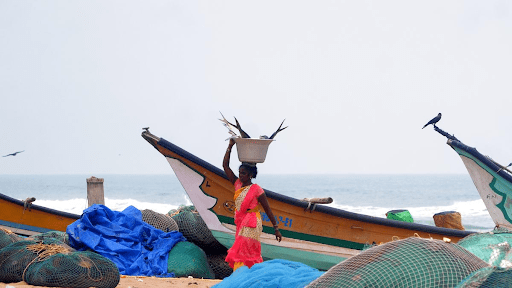
India’s fisheries sector is gaining policy attention as a sunrise sector, with the 2025 Exclusive Economic Zone (EEZ) fisheries rules and Access Pass system promoting sustainable and regulated deep-sea and high-sea fishing to unlock its economic potential.
India’s Fisheries Potential
- India is the world’s 2nd-largest fish producer, accounting for ~8% of global production; output rose from 95.79 lakh tonnes (2013-14) to 197.75 lakh tonnes (2024-25).
- The sector supports nearly 3 crore fishers and fish farmers and allied jobs.
- India has a 11,098.81 km coastline, ~24 lakh sq km EEZ, and an estimated fisheries potential of 53.1 lakh tonnes.
Why the Blue Revolution Matters
- Food and nutritional security: Provides protein and essential micronutrients.
- Employment: Supports coastal and rural livelihoods across the fisheries value chain.
- Exports: Generates foreign exchange through seafood exports.
- Blue Economy: Enables sustainable use of marine resources while protecting ecosystems.
- Inclusive growth: Cooperatives and producer organisations can help small fishers access markets and value addition.
Shift Towards Deep-Sea Fisheries
- Indian fishing is largely concentrated in nearshore waters, leaving deeper parts of the EEZ under-utilised.
- Deep-sea fishing can:
-
- Reduce pressure on heavily exploited coastal waters.
- Expand access to high-value species such as tuna and tuna-like species.
- Increase export opportunities.
- Generate employment in processing, cold chains, logistics and marketing.
- Andaman & Nicobar Islands and Lakshadweep together account for nearly 49% of India’s EEZ, giving them major fisheries potential.
Recent Policy Measures
- Sustainable Harnessing of Fisheries in EEZ Rules, 2025
- Notified on 4 November 2025 under the Maritime Zones Act, 1976, providing a framework for sustainable EEZ fishing.
- Prioritises Fisheries Cooperatives and Fish Farmer Producer Organisations (FFPOs) for deep-sea fishing activities; promotes traceability, certification, technology and value addition.
- Digital Access Passes through the ReALCraft portal regulate EEZ fishing. As of 5 March 2026, 707 Access Passes had been issued.
- Pradhan Mantri Matsya Sampada Yojana (PMMSY)
- Launched in 2020 to improve production, productivity, technology, post-harvest infrastructure, marketing and traceability.
- It promotes modern technologies such as:
- Recirculatory Aquaculture System (RAS): Filters and reuses water in fish farming.
- Bio-floc technology: Uses beneficial microbes to convert organic waste into nutrients/feed while improving water quality.
- Supports cold storage, fish transport, markets and value-added enterprises to strengthen the fisheries value chain.
Major Challenges
- Overfishing & IUU Fishing: Excessive and Illegal, Unreported and Unregulated (IUU) fishing threatens fish stocks and marine resources.
- Ecological damage: Bottom trawling damages seabed habitats and causes bycatch of non-target species.
- Small-scale fisher vulnerability: Limited access to modern vessels, equipment, finance and bargaining power.
- Climate change: Rising sea temperatures, shifting fish distribution and frequent cyclones/extreme events affect fisheries and fisher safety.
- Weak post-harvest infrastructure: Inadequate cold chains, storage and processing increase losses and reduce export quality.
- Technology and skill gaps: Limited access to navigation, communication, tracking, safety equipment and skilled crews.
- Low value addition: Limited processing and value addition reduce income and export potential.
Way Forward
- Develop the full value chain: Shift from production to processing, cold chains, logistics, branding and exports to increase value addition.
- Promote sustainable deep-sea fishing: Reduce pressure on coastal resources through modern and sustainable fishing practices.
- Empower small-scale fishers: Strengthen cooperatives and FFPOs for better bargaining power, finance and technology access.
- Improve infrastructure and technology: Expand cold chains, processing facilities, digital traceability, vessel tracking and certification.
- Build climate resilience: Develop cyclone-resistant infrastructure, early-warning systems and fisher safety equipment.
- Strengthen sustainable governance: Use science-based stock assessment, act against IUU fishing, and promote a Blue Circular Economy through sustainable seaweed, algae and aquatic-waste utilisation.
Conclusion
India’s Blue Revolution can advance food security, employment, exports and sustainable maritime development by balancing deep-sea fisheries, ecological safeguards and livelihood protection, ensuring inclusive benefits for small-scale fishers and the wider Blue Economy in the spirit of “Sabka Saath, Sabka Vikas, Sabka Vishwas, Sabka Prayas.”
Additional Information: Exclusive Economic Zone (EEZ)
- Definition: The EEZ is a maritime zone extending up to 200 nautical miles from a country’s baseline.
- Rights of India: India has sovereign rights to explore, exploit, conserve and manage living and non-living resources in its EEZ.
- Not Territorial Sea: Unlike the territorial sea (up to 12 nautical miles), the EEZ is not part of India’s sovereign territory; other States retain freedoms such as navigation and overflight.
- Legal Basis: Governed domestically by the Territorial Waters, Continental Shelf, Exclusive Economic Zone and Other Maritime Zones Act, 1976, while United Nations Convention on the Law of the Sea (UNCLOS) provides the international legal framework.
- India’s EEZ: India has an EEZ of about 2.37 million sq. km, providing significant resources for fisheries, hydrocarbons and other marine activities.
| Maritime Zone | Extent | Key Rights/Jurisdiction |
| Territorial Sea | Up to 12 nautical miles | India exercises sovereignty; coastal States regulate fisheries subject to applicable law. |
| Contiguous Zone | Up to 24 nautical miles | India can enforce laws relating to customs, immigration, sanitation and fiscal matters. |
| EEZ | Up to 200 nautical miles | India has sovereign rights over natural resources, including fisheries, oil and gas. |
| High Seas | Beyond EEZ | Not under any State’s sovereignty; governed by international law and UNCLOS. |
FAQs
Q1. Why is fisheries considered a sunrise sector in India?
Ans. It has significant potential for employment, food security, exports and value addition. Its large untapped marine resources further provide scope for future growth.
Q2. What is the Blue Revolution?
It aims to enhance fish production, productivity, livelihoods, exports and sustainable use of aquatic resources.
Q3. Why is India shifting towards deep-sea fisheries?
To reduce pressure on coastal waters, utilise the EEZ, access high-value species and expand exports.
Q4. Why is India focusing on deep-sea fishing?
Ans. Fishing is heavily concentrated in nearshore waters. Deep-sea fishing can reduce pressure on coastal resources and provide access to high-value species such as tuna.
Q5. What is Bio-floc technology?
Ans. It is an aquaculture technique in which beneficial microbes convert organic waste into useful nutrients, helping improve water quality and fish production.