Context
- Astronomers from Aryabhatta Research Institute of Observational Sciences (ARIES), Nainital, studied X-ray emissions from four highly energetic TeV blazars.
- Using NASA’s NICER and NuSTAR space telescopes, researchers analysed 13 X-ray observations to understand the sources of radiation in these energetic objects.
- The study found that when a blazar’s powerful jet becomes relatively weak, X-rays from the accretion flow around its supermassive black hole may become detectable.
About Blazars
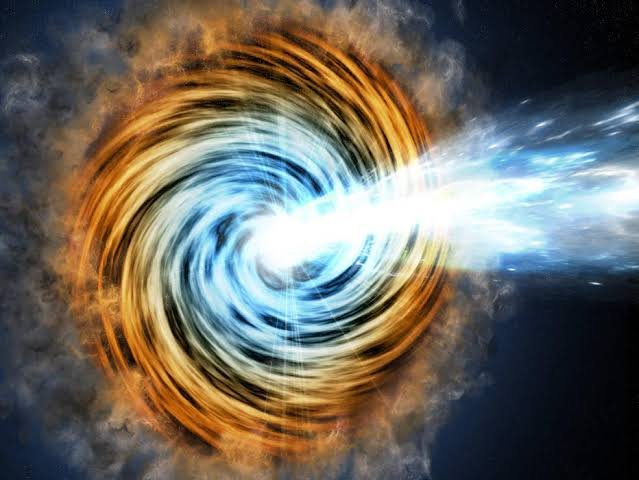
- A blazar is a highly energetic type of Active Galactic Nucleus (AGN) powered by a supermassive black hole (SMBH) at the centre of a galaxy.
- An AGN is the extremely bright central region of a galaxy where matter falling towards a supermassive black hole releases enormous energy.
- Falling matter forms an accretion disk around the black hole, while some material is expelled through narrow relativistic jets travelling close to the speed of light.
- What makes a blazar distinctive is its orientation—one of its relativistic jets points almost directly towards Earth, making it appear exceptionally bright.
- Blazars are mainly classified into BL Lacertae objects (BL Lacs) and Flat-Spectrum Radio Quasars (FSRQs).
What are TeV Blazars?
- TeV blazars are blazars capable of producing very-high-energy gamma rays reaching the tera-electron volt (TeV) energy range.
- They serve as natural laboratories for studying extreme-energy particles, relativistic jets and the environment around supermassive black holes.
What Did the Recent Study Find?
Researchers studied four TeV blazars—Mrk 421, Mrk 501, PG 1553+113 and PKS 2155-304.
- Jet-dominated X-rays: Most observations were explained by radiation produced by energetic particles within the blazar’s jet.
- Accretion-flow contribution: During relatively low activity, Mrk 421 and Mrk 501 showed an additional low-energy X-ray component, suggesting radiation from material around the black hole.
- New finding: Similar evidence was already known for Mrk 421, but the study provides the first indication of such a contribution in Mrk 501. Further observations are required for confirmation.
Why Is Accretion-Disk Emission Difficult to Detect?
- Since the relativistic jet points nearly towards Earth, its powerful radiation generally outshines weaker radiation from other regions.
- When the jet becomes less active, radiation associated with the accretion flow can become easier to detect.
Thus, observing blazars during both active and quieter phases helps separate different sources of X-ray emission.
Significance
- Black-hole physics: Helps understand how matter behaves and releases energy around supermassive black holes.
- Jet–disk connection: Provides clues about the relationship between accreting matter and relativistic jets.
- Active galaxies: Improves understanding of how some of the Universe’s most energetic active galactic nuclei produce high-energy radiation.
About ARIES
- ARIES, located in Nainital, Uttarakhand, is an autonomous research institute under the Department of Science and Technology (DST), Government of India.
- It conducts research in astronomy, astrophysics and atmospheric sciences.
FAQs
Q1. What is a blazar?
It is an AGN whose relativistic jet is directed close to Earth’s line of sight.
Q2. What powers a blazar?
Accretion of matter onto a supermassive black hole powers its active galactic nucleus.
Q3. What are TeV blazars?
They are blazars producing gamma rays reaching tera-electron volt energies.
Q4. Which Indian institution conducted the recent study?
ARIES, Nainital, an autonomous institute under DST.
Q5. Which telescopes were used in the study?
NASA’s NICER and NuSTAR X-ray space telescopes.