Why in the News?
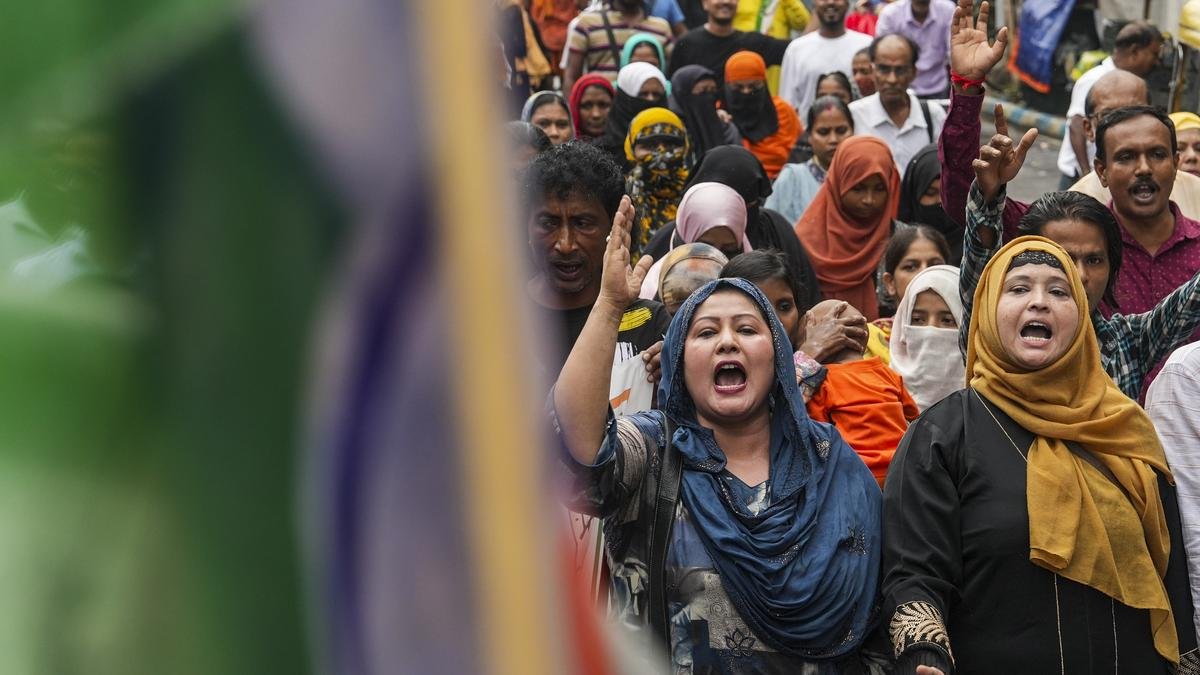
- The harassment and deportation of Bengali-speaking migrant workers from West Bengal, accused of being illegal migrants from Bangladesh, have triggered political and social debates.
- The issue highlights deeper structural contradictions in defining national identity and belonging in India.
- It raises concerns over the growing scrutiny of communities perceived as having “hyphenated nationalities” and its implications for citizenship and social harmony.
Key Highlights
- Historical Continuity of Identity Crisis
- The question of hyphenated nationality (e.g., Indian-Muslim, Indian-Nepali) is not new in India.
- Communities like Muslims, Sri Lankan Tamils, and Indian Nepalis have historically faced suspicion and exclusion despite legal citizenship.
- Structural Logic of Nationality
- According to French philosopher, Etienne Balibar, modern nationality is based on the idea that each nation must preserve and carry forward its ancestors’ sacred heritage.
- This gives it both assimilating and civilising power, but also leads to domination and exclusion.
- True or “genuine” nationality expects complete loyalty and is tied to a civilisational core within fixed territorial boundaries.
- This logic creates hyphenated communities— people like Muslims, Nepalis, Sinhalese, Tamils, Lhotshampas, Madhesis, Muhajirs, or Bengalis are always associated with their ethnic homelands, even when those homelands were shaped by post-colonial politics.
- As a result, identities like a Muslim in India get linked to Pakistan, Sri Lankan Tamils to Sri Lanka, Nepalis to Nepal; similarly, Madhesis in Nepal to India, Lhotshampas in Bhutan to Nepal, Tamils in Sri Lanka to India, and now Bengalis in India to Bangladesh.
- Paradox of the Nation-State Model
- The 1648 Westphalian model created the “one nation = one state” formula.
- Nation-states require diversity for cultural and economic vitality but demand homogeneity for political unity.
- This creates an irreconcilable paradox where the state produces inclusion and exclusion simultaneously.
- Legal Identity vs. Social Perception
- Legal citizenship depends on documents and juridical recognition.
- Social legitimacy depends on cultural markers and primordial identification with the motherland.
- Bengali workers with valid documents were still harassed because performative identity (speaking Bengali) overrode legal proof.
Nation State
- A nation-state is a sovereign state where the citizens share a common identity based on factors like culture, language, history, or ethnicity.
- It is characterized by a defined territory, a centralized government, and a sense of national identity among its people.
Legal frameworks to protect citizens against social prejudice
- Constitutional Framework
- Article 14 – Guarantees equality before the law and equal protection of the laws.
- Article 15 – Prohibits discrimination on grounds of religion, race, caste, sex, or place of birth.
- Article 17 – Abolishes untouchability and forbids its practice in any form.
- Article 21 – Ensures protection of life and personal liberty, interpreted to include dignity and equality.
- Article 29 & 30 – Protect cultural and educational rights of minorities.
- Directive Principles (Articles 38, 46) – Direct the State to promote social justice and protect weaker sections.
- Statutory Laws
- Protection of Civil Rights Act, 1955 – Penalises untouchability and discrimination.
- Protection of Human Rights Act, 1993 – Provides for the NHRC and State Commissions to address rights violations.
- The Representation of the People Act, 1951 – Disqualifies candidates promoting enmity or hatred.
- Indian Penal Code (Sections 153A, 295A) – Criminalises promoting hatred between communities.
Implications
- For Internal Migration and Labour Mobility
- Fear of harassment could deter internal migration, affecting labour supply in various sectors.
- Creates insecurity among interstate migrant workers.
- For Social Cohesion and National Integration
- Widening suspicion among communities undermines the unity-in-diversity principle.
- Risk of deepening linguistic and ethnic divisions within the country.
- For Federal Relations
- Targeting migrants from other states can strain inter-state relations and increase political tensions.
- May trigger reciprocal discrimination in other states.
- For Citizenship and Governance
- Raises questions about the adequacy of legal frameworks in protecting citizens against social prejudice.
- Puts pressure on mechanisms like NRC, Census, and documentation processes, making them politically sensitive.
- For the Nation-State Model in Globalised Era
- Demonstrates inherent limitations of a rigid nation-state model in a world of mobility and interconnectedness.
- Highlights the contradiction between economic globalization (free flow of goods and capital) and restrictive identity politics.
Challenges and Way Forward
| Challenges | Way Forward |
| Persistent identity-based discrimination | Promote inclusive narratives through education and media. |
| Weak enforcement of migrant protection laws | Strengthen legal safeguards and grievance redressal for migrant workers. |
| Politicization of citizenship issues | Depoliticize identity verification; adopt a rights-based approach. |
| Lack of clarity in migration and citizenship policies | Implement comprehensive internal migration policy with portability of rights. |
| Tension between legal and social identity | Foster intercultural understanding and civic nationalism over ethnic nationalism. |
Conclusion
The harassment of Bengali migrant workers is not an isolated political issue but a manifestation of the deep structural paradox within the modern nation-state framework. By conflating ethnicity, territory, and political identity, the nation-state model inherently creates insiders and outsiders. Unless India adopts inclusive policies and redefines belonging beyond rigid identities, such exclusionary practices will continue to challenge the idea of citizenship, unity, and social justice in a diverse democracy.
| EnsureIAS Mains Question
Q. Examine the structural contradictions of modern nationality in the context of India, particularly with reference to the treatment of hyphenated communities and migrant workers. How can legal and policy frameworks address the tension between legal citizenship and social perception? (250 Words) |
| EnsureIAS Prelims Question Q. Which of the following best explains the concept of “hyphenated communities” as discussed in the context of modern nationality?a. Communities that share dual legal citizenship of two different countries b. Communities identified by their ethnic or cultural homeland despite living as citizens in another nation c. Communities that voluntarily associate with multiple cultural identities for social mobility d. Communities formed by recent immigrants holding temporary residency status Answer: b. |