Context
The Bab el-Mandeb Strait has returned to the geopolitical spotlight after Yemen’s Iran-backed Houthi movement announced a maritime blockade against Saudi Arabia.
About Bab el-Mandeb Strait
- The Bab el-Mandeb Strait, meaning “Gate of Tears” in Arabic, derives its name from the numerous shipwrecks historically associated with the region.
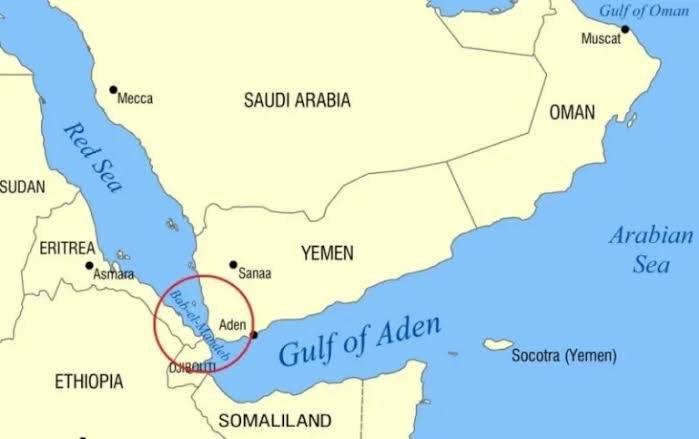
- It is a narrow natural strait located at the southern entrance of the Red Sea.
Location and Connectivity
- The strait is situated between Yemen and the Horn of Africa.
- It connects the Red Sea with the Gulf of Aden, providing access to the Indian Ocean.
- It separates the Arabian Peninsula in the northeast from the African continent in the southwest.
- Through the Red Sea and the Suez Canal, it provides a vital maritime link between the Indian Ocean and the Mediterranean Sea.
Geographical Features
- The strait is approximately 30 km wide.
- Perim Island (Yemen) divides it into two navigation channels:
- Eastern Channel: Alexander’s Strait.
- Western Channel: Dact-el-Mayun Channel.
FAQs
Q1. Which two water bodies does the Bab el-Mandeb Strait connect?
Ans: The Bab el-Mandeb Strait connects the Red Sea with the Gulf of Aden, providing access to the Indian Ocean.
Q2. Why is the Bab el-Mandeb Strait known as the “Gate of Tears”?
Ans: The name comes from the Arabic expression referring to the numerous shipwrecks that have historically occurred in the region.
Q3. Where is the Bab el-Mandeb Strait located?
Ans: It is situated at the southern entrance of the Red Sea, between Yemen and the Horn of Africa, separating the Arabian Peninsula from the African continent.
Q4. What is the significance of Perim Island in the Bab el-Mandeb Strait?
Ans: Perim Island divides the strait into two navigation channels: Alexander’s Strait in the east and the Dact-el-Mayun Channel in the west.
Q5. Why is the Bab el-Mandeb Strait strategically important?
Ans: It is a major maritime chokepoint linking the Indian Ocean and the Mediterranean Sea through the Red Sea and the Suez Canal, making it vital for global trade and energy transportation.
Q6. Which major trade route passes through the Bab el-Mandeb Strait?
Ans: Ships carrying goods between Europe and Asia, as well as Middle Eastern oil bound for Europe and North America, use this route through the Suez Canal.
Q7. How can disruptions in the Bab el-Mandeb Strait affect global trade?
Ans: Disruptions can delay maritime transport, increase shipping costs, affect energy supplies, and disrupt global trade and supply chains.