Context
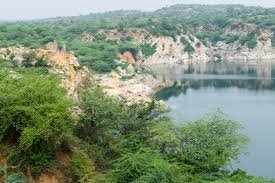
Recent studies found that abandoned mining areas in Asola-Bhatti Wildlife Sanctuary support high bird diversity. Former quarries have developed a mix of scrubland, grassland, rocky terrain and water bodies, creating suitable habitats for several bird species.
About Asola-Bhatti Wildlife Sanctuary
- Location: Located in South Delhi along the Delhi–Haryana border, on the Southern Ridge of the Aravalli Range.
- Legal Status: Notified under the Wildlife (Protection) Act, 1972 in phases—Asola, Sahurpur and Maidan Garhi in 1986, followed by Bhatti in 1991.
- Landscape: Features rocky hills, valleys, grasslands, thorny scrub and seasonal streams, representing the semi-arid Northern Aravallis.
Flora and Fauna
- Vegetation: Mainly tropical dry thorn forest, with native species such as Dhau, Palash and Senegalia, along with grasslands.
- Invasive Plants: Prosopis juliflora, Lantana camara and Parthenium hysterophorus pose ecological challenges.
- Mammals: Supports Indian leopard, Nilgai, golden jackal and Indian porcupine.
- Birds: Over 200 species occur, including Indian peafowl and Indian eagle-owl; Neeli Jheel attracts migratory birds in winter.
- Reptiles: Includes Bengal monitor lizard, Indian cobra and Indian rock python.
Ecological Significance
- Aravalli Conservation: Protects a vital remnant of the Aravalli ecosystem in urban Delhi.
- Climate Regulation: Vegetation helps reduce local aridity and regulate the microclimate.
- Groundwater Recharge: Rocky and porous terrain supports water infiltration and groundwater recharge.
- Urban Biodiversity: Provides an important wildlife habitat within a densely populated city.
FAQs
Q1. Where is Asola-Bhatti Wildlife Sanctuary located?
Ans: It is located in South Delhi, along the Delhi–Haryana border, on the Southern Ridge of the Aravalli Range.
Q2. Under which law is Asola-Bhatti Wildlife Sanctuary protected?
Ans: It was notified under the Wildlife (Protection) Act, 1972.
Q3. What type of vegetation occurs in Asola-Bhatti?
Ans: It mainly contains tropical dry thorn vegetation.