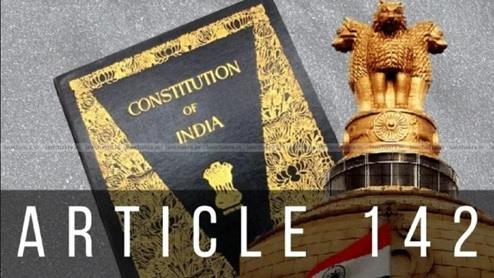
Context
The Supreme Court recently invoked Article 142 in In Re: Phalodi Accident vs. NHAI and Others (2025) after taking suo motu cognisance of two fatal road accidents in November 2025. Recognising safe travel on National Highways as part of Article 21, the Court issued several directions to strengthen road safety measures. The judgment has revived debate regarding the scope and limits of Article 142.
Road Safety and Judicial Intervention
- National Highways constitute nearly 2% of India’s road network but account for around 30% of road fatalities.
- Approximately 26,770 deaths were reported on National Highways during the first half of 2025.
- India aims to reduce road accidents by 50% by 2030 through the “4E approach”:
- Education
- Engineering
- Enforcement
- Emergency Medical Services
The Court viewed recurring road fatalities as a serious challenge to the constitutional right to life and safety.
Article 142: Meaning and Nature
Article 142 empowers the Supreme Court to pass any order necessary for doing “complete justice” in matters before it.
It is an extraordinary constitutional power invoked when:
- existing laws are inadequate,
- procedural limitations hinder justice, or
- exceptional circumstances require judicial intervention.
The provision acts as a constitutional safeguard to ensure that technicalities do not defeat substantive justice.
Key Features
- It is residuary and discretionary in nature.
- The power flows directly from the Constitution and not from statutory law.
- It enables the Court to protect constitutional values and prevent miscarriage of justice.
- The provision is generally exercised in exceptional situations where ordinary remedies are insufficient.
Judicial Interpretation of Article 142
- Delhi Judicial Service Association vs. State of Gujarat (1991): The Supreme Court held that powers under Article 142 are constitutional in nature and cannot be curtailed by ordinary statutory provisions.
- Canara Bank vs. Debasis Das (2003): The Court emphasised that substantive justice and principles of natural justice must prevail where rigid procedural rules fail.
- Hitesh Bhatnagar vs. Deepa Bhatnagar (2011): The judgment highlighted that Article 142 is an exceptional power that must be exercised with caution and restraint.
Need for the Doctrine of Complete Justice
Laws may not always keep pace with changing social, technological, and constitutional realities. In such situations, strict adherence to procedural law may hinder justice.
Article 142 enables the Supreme Court to:
- bridge gaps in law,
- uphold constitutional morality,
- protect fundamental rights, and
- ensure effective delivery of justice.
Thus, the provision strengthens the judiciary’s role as the guardian of the Constitution.
Powers of High Courts
- In Anil Kumar Jain vs. Maya Jain (2009), the Supreme Court clarified that High Courts do not possess powers equivalent to Article 142.
- However, High Courts can still grant equitable relief under Article 226 within their constitutional jurisdiction.
Challenges and Way Forward
| Challenges | Way Forward | ||
| Possibility of judicial overreach | Exercise Article 142 with restraint and only in exceptional cases | ||
| Lack of clearly defined limits |
|
||
| Risk of subjective interpretation | Ensure transparency and reasoned judicial decisions | ||
| Concerns regarding separation of powers | Promote institutional balance and cooperative constitutionalism | ||
| Increasing dependence on judiciary | Strengthen legislative responsiveness and administrative efficiency |
Conclusion
Article 142 is a unique constitutional provision that empowers the Supreme Court to deliver complete justice where ordinary legal mechanisms prove inadequate. However, its legitimacy depends upon careful and restrained use that balances judicial activism with constitutional accountability and institutional harmony.