Important questions for UPSC Pre/ Mains/ Interview:
|
Context
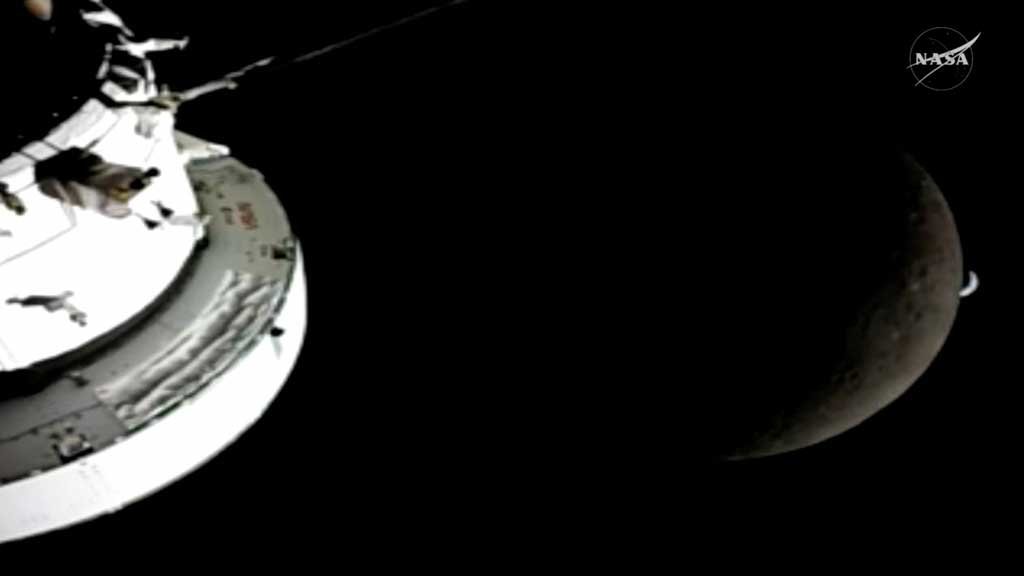
The Artemis II set a new milestone as astronauts travelled about 406,771 km from Earth, making it the farthest human spaceflight. This surpassed the earlier record of Apollo 13, though in Artemis II the distance is part of a planned trajectory, not an emergency deviation.
Q1. What is Artemis II and its mission objective?
- Artemis II is a crewed lunar flyby mission, not a landing mission.
- It uses the Orion spacecraft.
- The main aim is to test life-support systems and spacecraft performance in deep space.
- The record distance achieved is a result of its mission path, not the primary goal.
Q2. What is the Free-Return Trajectory used in Artemis II?
- Artemis II follows an elliptical free-return trajectory, unlike earlier missions (e.g., Apollo 8) that used circular lunar orbits.
- This path uses the Moon’s gravity to automatically bring the spacecraft back to Earth.
- It reduces dependence on engine burns, making the mission safer and more efficient.
Q3. How does the Artemis II trajectory work?
- High Earth Orbit Phase
- Orion first enters an elliptical Earth orbit reaching ~74,000 km.
- A ~42-hour testing window allows astronauts to check critical systems (life support, environment).
- If issues arise, the mission can be aborted safely within Earth’s gravity.
- Translunar Slingshot Phase
- After system checks, Orion travels toward the Moon, reaching about 10,300 km beyond its far side.
- The Moon’s gravity slingshots the spacecraft back toward Earth, without additional propulsion.
Q4. Why is the Free-Return Trajectory important?
- Built-in safety: Ensures return to Earth even if engines fail.
- Fuel efficiency: Avoids heavy braking and acceleration needed for lunar orbit.
- Lower launch weight: Less fuel requirement reduces payload burden.
- Emergency readiness: Saves fuel for contingencies.
Q5. What are the next steps in the Artemis programme?
- Artemis II is a 10-day mission focused on validating crew safety and deep-space capability.
- It will generate critical data on:
- Life-support systems
- Spacecraft performance
- These findings will support future missions aimed at:
- Human return to the Moon
- Establishing a long-term lunar base
Conclusion
Artemis II demonstrates a safe and fuel-efficient deep-space mission design, marking a key step toward sustainable human exploration of the Moon and beyond.