Context
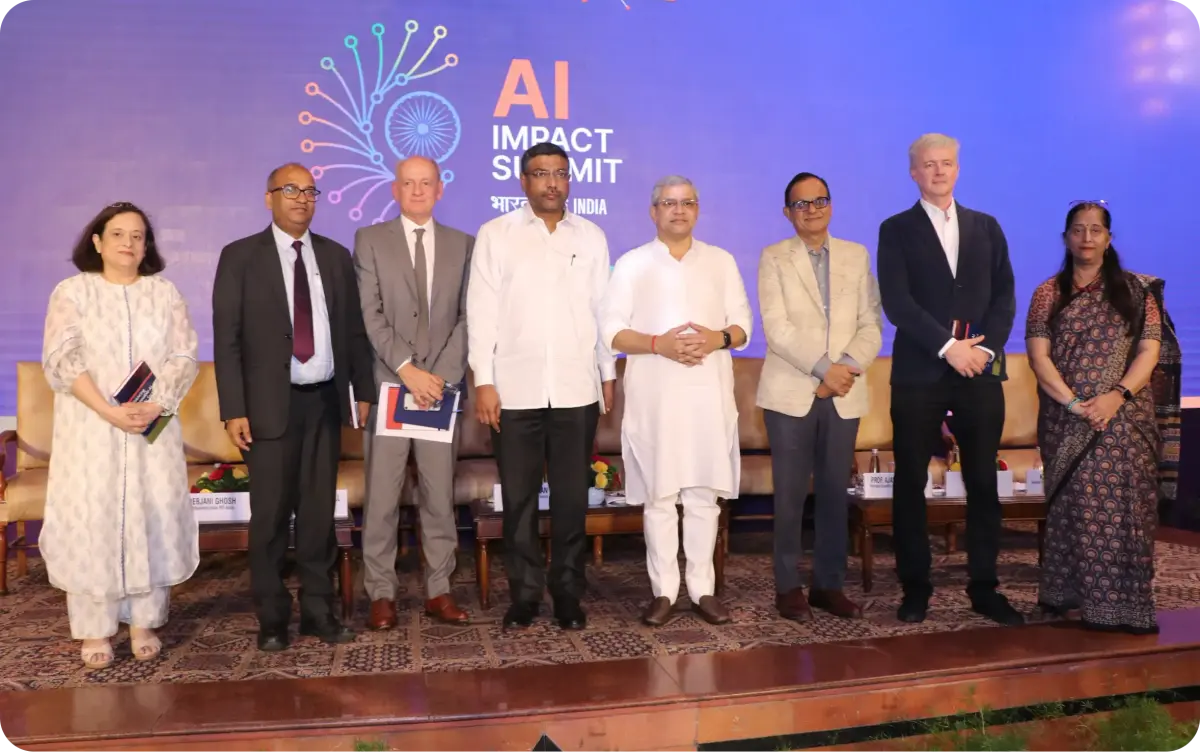
- The AI Impact Summit 2026 has begun today. It is being held at Bharat Mandapam, New Delhi, from 16–20 February 2026.
- This is the first global AI summit hosted in the Global South, with participation from:
- Global technology companies
- Leaders from G20 countries
- Representatives from over 100 nations
What are the “Seven AI Chakras” and the Three Core Principles guiding India’s AI vision?
India has proposed a unique ethical framework to ensure AI acts as a tool for empowerment rather than inequality.
- The Three Core Principles:
- People: Human-centric AI that protects privacy and ensures equitable access.
- Planet: Environment-friendly AI focusing on energy-efficient systems and climate action.
- Progress: Inclusive growth through capacity building and a future-ready workforce.
- The Seven AI Chakras: These are the pillars of India’s responsible AI framework, covering Human Capital, Social Empowerment, Safe and Trusted AI, Resilience, Innovation, Scientific Research, and the Democratization of Resources.
How is AI driving socio-economic transformation in India’s core sectors?
- Agriculture (The Rural Backbone): Bharat-VISTAAR: Launched in Budget 2026, this platform integrates AgriStack with AI to provide location-specific advisories.
- Mausam GPT: Used by the IMD for hybrid forecasting of lightning, fog, and rainfall to assist farmers in disaster risk reduction.
- Healthcare: AI medical imaging is now enabling faster detection of Tuberculosis and Cancer, while predictive analytics forecast disease outbreaks, making healthcare preventive rather than just curative.
- Language and Inclusion: The Bhashini Platform now supports 36 text and 22 voice languages with over 350 AI modules. This allows a farmer to receive PM-Kisan benefits and advice in their own regional dialect.
- Education: Through DIKSHA, AI-powered adaptive learning personalizes content based on a student’s capability, moving away from “one-size-fits-all” schooling.
What are the key technical and institutional pillars of the IndiaAI Mission?
- Compute Sovereignty: Under the IndiaAI Mission, the government is establishing secure GPU clusters with approximately 3,000 next-gen GPUs.
- CPUs handle sequential tasks, while GPUs are designed for parallel processing, making them essential for AI. TPUs (Tensor Processing Units) are further specialized for training large AI models.
- India AI Safety Institute: This body develops standards, tests models for algorithmic bias, and advises regulators to ensure “Safe and Trusted AI.”
- Human Capital: India leads the global AI talent acquisition with a 33% annual hiring growth. Initiatives like the India AI Future Skills Programme aim to introduce AI training as early as Classes 11–12.
- Research & Innovation: India has jumped to the 38th rank in the Global Innovation Index. While R&D spending has doubled, the summit highlights the need to push this closer to 2% of GDP.
What is the strategic significance of hosting this summit in New Delhi?
The AI Impact Summit 2026 is a diplomatic tool to assert the voice of the Global South.
- Setting Global Norms: India is moving from being a “tech-taker” to a “tech-shaper,” ensuring that global AI regulations don’t just favor developed nations but also address the needs of developing economies.
- Digital Public Infrastructure (DPI): By showcasing Bhashini and AgriStack, India is presenting a “Plug-and-Play” model of AI-enabled governance that other nations can adopt.
- Economic Growth: With major investments from Google and Amazon in domestic data centers and AI hubs, the summit aims to generate mass employment and strengthen the “Atmanirbhar” AI ecosystem.