| Important Questions for UPSC Prelims / Mains / Interview
1. What is the Biopharma SHAKTI initiative announced in the Union Budget, and why is it important for India? 2. What are biologics and biosimilars, and why are they strategically important for healthcare and industry? 3. What are the key components and institutional pillars of the Biopharma SHAKTI strategy? 4. How will Biopharma SHAKTI strengthen India’s clinical trials and regulatory ecosystem? 5. What role will capacity building and skill development play under Biopharma SHAKTI? 6. How can Biopharma SHAKTI catalyse investment, innovation, and advanced manufacturing? 7. How does Biopharma SHAKTI fit into India’s broader bioeconomy growth story? 8. What is the overall significance of Biopharma SHAKTI for India’s health security and economic future? |
Context
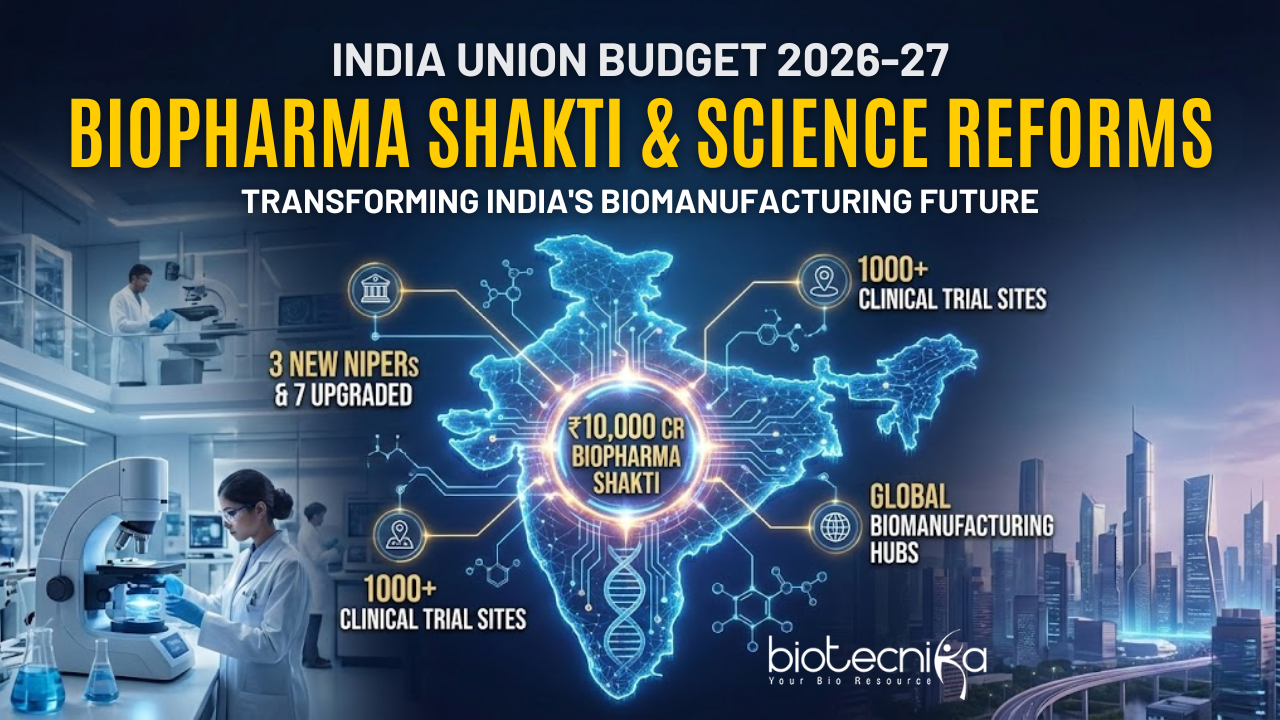
In the Union Budget, the Finance Minister announced Biopharma SHAKTI (Strategy for Healthcare Advancement through Knowledge, Technology & Innovation) with an outlay of ₹10,000 crore over five years.
The initiative aims to transform India into a global biopharmaceutical manufacturing hub, especially in biologics and biosimilars, while strengthening regulation, research, clinical trials, and skilled manpower. It builds on India’s rapidly expanding bioeconomy and growing global role in affordable healthcare.
Q1. What is the Biopharma SHAKTI initiative announced in the Union Budget, and why is it important for India?
- Biopharma SHAKTI is a national strategy to develop India as a global hub for biopharmaceutical manufacturing.
- It focuses on strengthening domestic production of biologics and biosimilars, which are high-value medicines.
- The initiative addresses India’s dependence on imports for advanced therapies.
- It aims to improve health security by ensuring reliable access to critical medicines.
- The scheme aligns healthcare goals with industrial and innovation policy.
- A dedicated funding of ₹10,000 crore provides long-term policy certainty.
- It positions India to move up the pharmaceutical value chain globally.
Q2. What are biologics and biosimilars, and why are they strategically important for healthcare and industry?
- Biologics are medicines derived from living organisms such as cells, proteins, or microorganisms.
- They include vaccines, blood products, monoclonal antibodies, gene therapies, and recombinant proteins.
- Biosimilars are highly similar versions of approved biologics with no meaningful clinical differences.
- Biologics are crucial for treating cancer, autoimmune diseases, rare disorders, and chronic conditions.
- They are expensive and technologically complex, making domestic capability strategically vital.
- Biosimilars help reduce treatment costs and expand access to life-saving therapies.
- Global demand for biologics is growing faster than for conventional chemical drugs.
Q3. What are the key components and institutional pillars of the Biopharma SHAKTI strategy?
- The strategy proposes a biopharma-focused academic and research network.
- Three new National Institute of Pharmaceutical Education and Research (NIPERs) will be established.
- Seven existing NIPERs will be upgraded to specialise in biopharmaceutical sciences.
- A nationwide network of over 1,000 accredited clinical trial sites will be created.
- Regulatory systems will be strengthened to meet global approval standards.
- Industry–academia collaboration will be actively promoted.
- The approach integrates education, regulation, research, and manufacturing.
Q4. How will Biopharma SHAKTI strengthen India’s clinical trials and regulatory ecosystem?
- India currently has strong scientific talent but limited global credibility in clinical trials.
- Biopharma SHAKTI aims to create over 1,000 accredited clinical trial sites across the country.
- This will improve geographical coverage and patient diversity in trials.
- Regulatory capacity of Central Drugs Standard Control Organisation (CDSCO) will be strengthened.
- A dedicated scientific review cadre and specialist workforce will be created.
- Faster and predictable approval timelines will align India with global regulators.
- Overall, this will increase trust in India-based clinical research.
Q5. What role will capacity building and skill development play under Biopharma SHAKTI
- Biopharmaceutical manufacturing requires specialised and interdisciplinary skills.
- Expanded NIPER capacity will produce trained researchers, regulators, and industry professionals.
- Curricula will focus on biologics, biosimilars, regulatory science, and clinical research.
- Industry–academia partnerships will provide practical exposure and innovation pathways.
- Skilled manpower will reduce dependence on foreign expertise.
- Workforce development will support both public and private sector growth.
- This creates a sustainable talent pipeline for next-generation therapies.
Q6. How can Biopharma SHAKTI catalyse investment, innovation, and advanced manufacturing?
- High upfront costs have limited private investment in biomanufacturing.
- Government funding reduces risk and encourages long-term capital investment.
- Improved regulatory certainty increases investor confidence.
- Innovation in gene therapy, cell therapy, and precision medicine will be promoted.
- Domestic manufacturing will expand from formulations to complex biologics.
- India can integrate into global biopharma supply chains.
- This strengthens India’s position as a trusted healthcare producer.
Q7. How does Biopharma SHAKTI fit into India’s broader bioeconomy growth story?
- India’s bioeconomy uses renewable biological resources for economic value creation.
- It has grown from USD 10 billion in 2014 to USD 165.7 billion in 2024.
- The target is USD 300 billion by 2030.
- BioPharma already contributes about 35% of the bioeconomy.
- Biopharma SHAKTI strengthens this high-value segment further.
- It complements the BioIndustrial, BioAgri, and BioResearch sectors.
- Together, these sectors contribute over 4% to India’s GDP.
Q8. What is the overall significance of Biopharma SHAKTI for India’s health security and economic future?
- Biopharma SHAKTI links healthcare security with economic growth.
- It enables India to move from volume-based to value-based pharmaceutical leadership.
- Affordable access to advanced medicines will improve public health outcomes.
- Regulatory credibility will enhance India’s global standing.
- Skilled jobs and innovation will support long-term growth.
- Reduced import dependence strengthens national resilience.
- The initiative positions India as a global leader in next-generation healthcare.
Conclusion
Biopharma SHAKTI marks a strategic shift from generic dominance to innovation-led biopharmaceutical leadership. By investing in institutions, regulation, skills, and clinical research, India is laying the foundation for a globally competitive, innovation-driven bioeconomy.
If implemented effectively, the initiative can simultaneously enhance health security, industrial growth, and global credibility, making it one of the most transformative healthcare–industrial policies of the decade.