Context
Recent satellite-based observations suggest that methane emissions from Waste in India are significantly under-estimated in official inventories. At several major landfill sites, actual emissions are found to be many times higher than model-based estimates, raising concerns for climate action and waste management policy.
What is Methane and Why Does It Matter?
- Methane (CH₄) is a greenhouse gas released during the decomposition of organic matter in oxygen-poor conditions, such as landfills.
- Key features:
- It is 84 times more potent than carbon dioxide over a 20-year period.
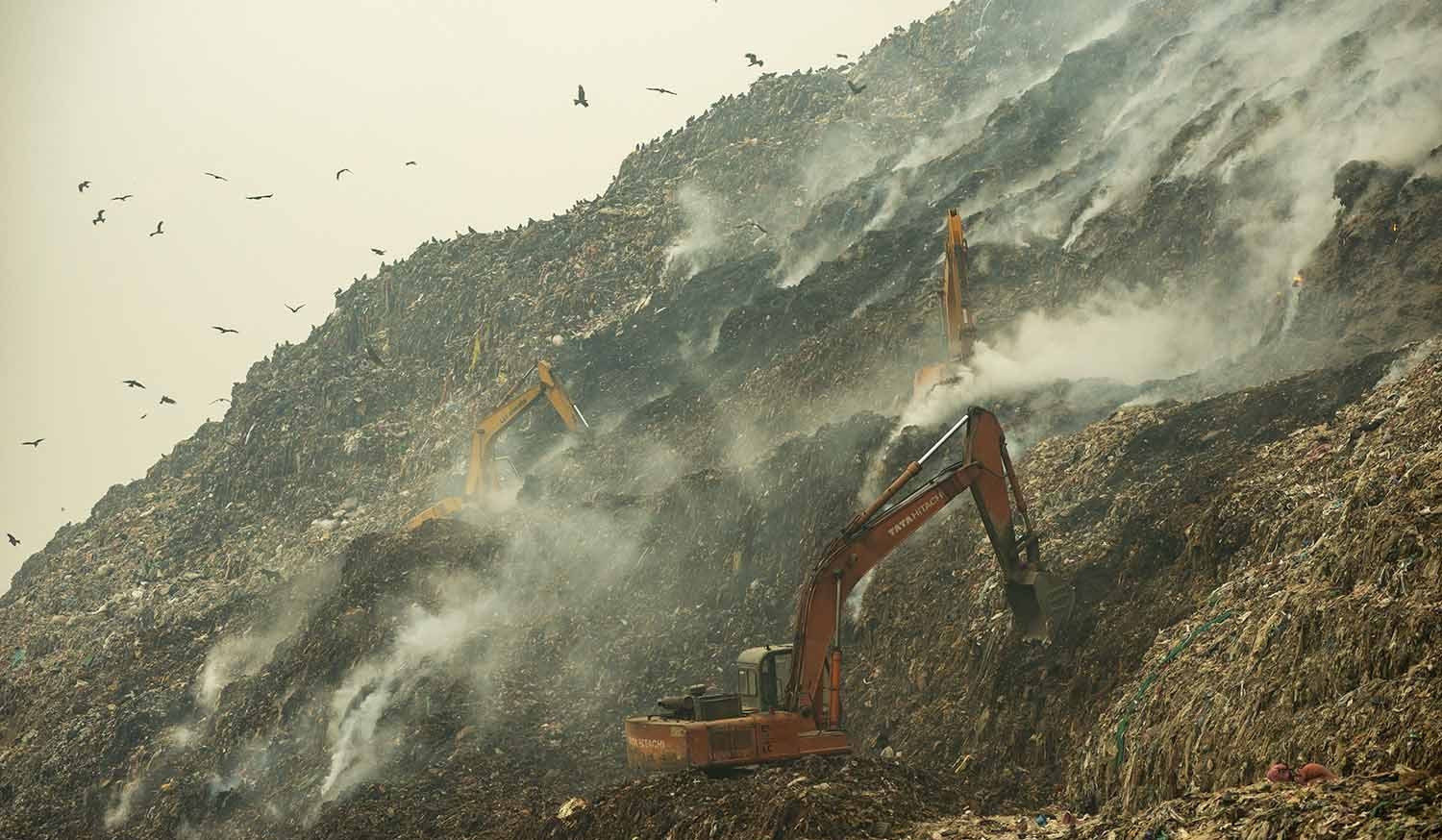
- It contributes to landfill fires, air pollution, and climate change.
- It can also be captured and used as fuel for cooking, vehicles, and power generation.
- In India:
- About 15% of methane emissions come from the waste sector.
- Unlike agriculture or energy, waste-sector methane can be reduced quickly through targeted interventions.
Why Waste-Sector Methane Is a Key Opportunity for India?
- Waste management offers immediate climate gains, unlike long-term energy transitions.
- National frameworks like the Swachh Bharat Mission already exist.
- Reducing landfill methane improves urban safety, public health, and climate outcomes.
- However, effective action requires accurate identification of emission hotspots.
How Methane Emissions Are Traditionally Estimated?
- Historically, India has relied on model-based estimates, which:
- Use incoming waste volumes
- Apply standard emission factors
- Depend on aggregated, infrequently updated data
- Limitations:
- Lack of granular, site-specific information
- Difficulty in identifying individual high-emission landfills
- Especially unreliable in developing country contexts
- Ground-based monitoring is also difficult due to:
- High costs
- Maintenance requirements
- Limited scalability in large cities
How Satellite Monitoring Changes the Picture?
- Advances in satellite technology now allow direct observation of methane emissions.
- Two types of satellite data:
- Regional monitoring: Tracks broad trends over large areas
- High-resolution monitoring: Pinpoints emission hotspots down to specific landfill sites
- India’s progress:
- ISRO-led research (2023 data) mapped anthropogenic methane emissions
- Identified major landfill hotspots in Ahmedabad, Mumbai, and Delhi
- Findings triggered National Green Tribunal (NGT) action for ground verification
- Global platforms such as ClimateTRACE and WasteMAP combine satellite data with traditional models to improve accuracy.
What the New Data Reveal (Key Discrepancies)
- Satellite observations show that:
- Actual landfill methane emissions can be 8 times higher globally than model estimates
- In India, discrepancies are even sharper due to outdated State-level data (mostly from 2018)
- Illustrative patterns:
- In some cities, one or two landfills emit almost as much methane as the entire city’s estimated waste sector
- Engineered landfills assumed to be efficient are sometimes emitting far more than expected
- This suggests leakages, system failures, or faster methane generation
- These gaps indicate that India does not yet know the true scale or location of its methane problem.
Why Are These Findings Important?
- Hidden methane emissions mean missed climate mitigation opportunities.
- Policies may target the wrong sites or underestimate urgency.
- Without accurate data, hazards remain unaddressed simply because they are invisible.
- Satellite data now makes it possible to:
- Measure the true magnitude of emissions
- Identify exact leakage points
- Design targeted, cost-effective solutions
How Satellite and Ground Action Must Work Together?
- Satellite data alone is not sufficient due to:
- Cloud cover
- Weather interference
- Urban complexity
- The solution lies in a feedback loop:
- Satellites detect methane hotspots
- Ground teams investigate causes (poor waste cover, gas system failure, illegal dumping)
- Ground data improves satellite accuracy
- Refined data guides further action
- Different landfill types need different data:
- Open dumps: Track dumping and reclamation patterns
- Engineered landfills: Assess gas collection infrastructure
- Cities with advanced waste systems, like Bengaluru, can integrate these datasets effectively.
Institutional and Policy Integration Needed
- Current challenges:
- Urban Local Bodies (ULBs) and State Pollution Control Boards work in silos
- Lack of standardised national data-sharing systems
- Opportunities:
- Revised municipal waste rules already propose a centralised data portal
- This can be expanded for methane tracking
- Bodies like CAQM (NCR) can oversee regional monitoring
- Swachh Bharat Mission can integrate methane reduction targets
- Schemes like GOBARdhan show methane’s potential as an energy resource (e.g., Bio-CNG plants)
Implications
- Stronger alignment with India’s climate commitments
- Improved urban safety and air quality
- Better utilisation of methane as a clean energy resource
- Data-driven governance replacing assumptions
- Faster, cheaper climate mitigation compared to energy-sector reforms
Challenges and Way Forward
| Challenges | Way Forward |
| Underestimation of landfill methane | Expand satellite-based monitoring nationwide |
| Lack of site-specific data | Combine satellite detection with ground validation |
| Fragmented institutional oversight | Integrate ULBs, SPCBs, and central agencies |
| Technical limits of satellites alone | Build feedback loops with on-ground teams |
| Poor waste handling practices | Strengthen landfill management and gas capture |
| Missed energy potential | Scale Bio-CNG and waste-to-energy projects |
Conclusion
Methane from waste is one of India’s most underestimated climate challenges. By combining satellite monitoring with ground-level action and institutional coordination, India can turn invisible emissions into measurable, manageable, and economically useful climate solutions.
| Ensure IAS Mains Question
Q. Explain why methane emissions from the waste sector are often underestimated in India. How can satellite-based monitoring improve climate action and urban waste management? (250 words) |
| Ensure IAS Prelims Question
Q. Consider the following statements regarding methane emissions from waste: 1. Methane is a greenhouse gas far more potent than carbon dioxide in the short term. 2. Satellite monitoring allows identification of landfill-level methane hotspots. 3. India’s waste-sector methane emissions require only long-term structural reforms. Which of the statements are correct? a) 1 and 2 only b) 2 and 3 only c) 1 and 3 only d) 1, 2 and 3 Answer: a) 1 and 2 only Explanation Statement 1 is correct: Methane is around 84 times more potent than carbon dioxide over a 20-year period, making it a critical short-term climate pollutant. Statement 2 is correct: High-resolution satellite data can pinpoint specific landfill methane hotspots, enabling targeted mitigation. Statement 3 is incorrect: Unlike energy or agriculture, waste-sector methane can be reduced quickly through targeted and immediate actions. |