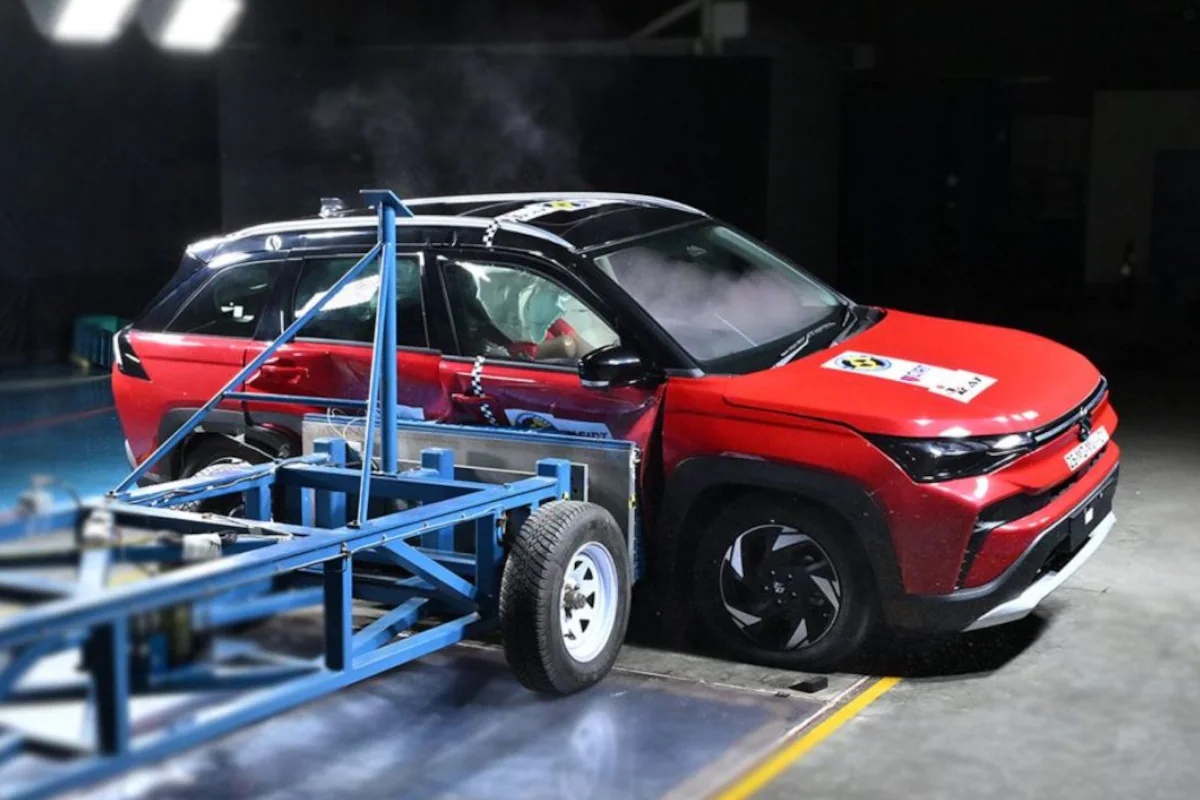
Why in the News?
The Ministry of Road Transport and Highways (MoRTH) released revised draft norms for Bharat NCAP 2.0 (2025). Bharat NCAP was first implemented in October 2023, and its validity ends in September 2027.
What is Bharat NCAP?
- Bharat NCAP (Bharat New Car Assessment Programme) provides star ratings (1 to 5 stars) based on crashworthiness of vehicles.
- Crashworthiness is the car’s ability to protect occupants during accidents, going beyond normal “roadworthiness” rules.
- It is voluntary for manufacturers but widely used for consumer awareness and marketing.
- Testing and rating are conducted by Central Institute of Road Transport (CIRT), Pune.
- Inspired by Global NCAP, but tailored to Indian road conditions, crash patterns, and vehicle designs.
Why is Bharat NCAP Important?
- India has one of the world’s highest road fatalities (~1.68 lakh deaths/year).
- In India, 20%+ road accident deaths are pedestrians.
- Bharat NCAP encourages safer car design, better structural strength, and advanced safety technologies.
- Addresses India-specific crash scenarios, especially with pedestrians and two-wheelers.
- Pushes manufacturers to improve structural strength, crumple zones, airbag coverage, and active safety systems.
- Bridges the gap between vehicle affordability and global safety norms.
- Provides transparency for customers.
What did Bharat NCAP 2023 cover?
- Three verticals:
- Adult Occupant Protection (AOP)
- Child Occupant Protection (COP)
- Safety Assist Technologies (SAT)
- Three crash tests at:
- Frontal impact: 64 km/h
- Side impact: 50 km/h
- Oblique side impact: 29 km/h
What’s New in Bharat NCAP 2.0 (2025 Draft)?
- Expanded Assessment Areas (5 verticals now)
| Assessment Area | Weightage |
| Safe Driving | 10% |
| Accident Avoidance | 10% |
| Crash Protection | 55% |
| Vulnerable Road User Protection | 20% |
| Post-Crash Safety | 5% |
This is a major shift — moving from only crash tests to the entire accident cycle: before, during, and after a crash.
- More Mandatory Crash Tests (From 3 to 5)
- New tests under Crash Protection (55% weight) include:
- Frontal impact (64 km/h, deformable barrier)
- Lateral impact (50 km/h, mobile deformable barrier)
- New tests under Crash Protection (55% weight) include:
- Oblique side pole test (32 km/h) (New)
- Frontal full-width rigid barrier test (50 km/h) (New)
- Rear impact test (50 km/h) (New)
- Crash tests use Anthropomorphic Test Devices (ATDs) to measure injuries to:
- Driver
- Front passenger
- Rear adult passengers
- Child occupants
- Exclusive Focus on Vulnerable Road Users (VRUs)
- Weightage: 20%
- Mandatory VRU Tests:
- Pedestrian legform impact (bumper)
- Adult headform impact (bonnet/windscreen)
- Child headform impact (bonnet/windscreen)
- Optional tests include:
- Autonomous Emergency Braking System (AEBS) for:
- Child pedestrians
- Adult pedestrians
- Car-to-motorcycle rear-end scenarios
- India becomes one of the few countries to integrate VRU protection in star ratings.
- Safety Tech for Accident Avoidance (10%)
- Focuses on technologies that prevent crashes:
- Mandatory:
- Electronic Stability Control (ESC) → pre-condition for star eligibility.
- Optional:
- Autonomous Emergency Braking System (AEBS)
- Other advanced driver-assistance systems (ADAS)
- Post-Crash Safety (5%)
- Ensures survival after crash:
- Protection from fire hazards
- Protection from electrical shock (important for EVs)
- Ensures survival after crash:
- Autonomous Emergency Braking System (AEBS) for:
- Door opening force and seatbelt buckle release for safe exit
Star Rating Changes
Updated Score Requirements:
| Stars | Points Required |
| 1 ★ | 30 |
| 2 ★ | 40 |
| 3 ★ | 50 |
| 4 ★ | 65 (higher than earlier 60) |
| 5 ★ | 80 (higher than earlier 70) |
New Conditions:
- To get 3 stars or above, AOP must be ≥55% of crash protection score.
- A 5-star car cannot score zero in any assessment area.
- No crash test result should show red-zone injury levels for adults or children.
India’s 5-Star Rated Cars So Far
- Examples include:
- Tata Harrier, Safari, Nexon
- Mahindra XUV 3XO
- Citroen C3 Aircross
- Maruti Invicto
- Toyota Innova Hycross
- Hyundai Tucson
Conclusion
Bharat NCAP 2.0 marks a major leap in India’s vehicle safety architecture by expanding testing to accident avoidance, VRU safety, and post-crash survival. It aligns Indian cars with global safety expectations while addressing India’s unique road risks. As the system evolves, Bharat NCAP can significantly reduce fatalities and push Indian manufacturers towards world-class engineering.
| EnsureIAS Mains Question
Q. Discuss the significance of Bharat NCAP 2.0 in strengthening India’s road safety ecosystem. How does the revised framework address the limitations of earlier versions and align vehicle safety with India’s traffic realities? (250 Words) |
| EnsureIAS Prelims Question
With reference to Bharat NCAP, consider the following statements: 1. Bharat NCAP is a voluntary programme designed to rate cars based on crashworthiness. 2. Electronic Stability Control (ESC) is mandatory for a car to be eligible for star rating under Bharat NCAP 2.0. 3. Bharat NCAP 2.0 includes impact tests for pedestrian and child headform under the Vulnerable Road Users vertical. 4. A car can receive a 5-star rating even if one of its assessment verticals scores zero. Which of the statements above are correct? Answer: (a) 1, 2 and 3 only Explanation: Statement 1 is Correct: Bharat NCAP remains voluntary. Statement 2 is Correct: ESC is mandatory for star eligibility. Statement 3 is Correct: VRU protection includes adult/child headform and legform tests. Statement 4 is Incorrect: A 5-star vehicle cannot have zero in any vertical. |