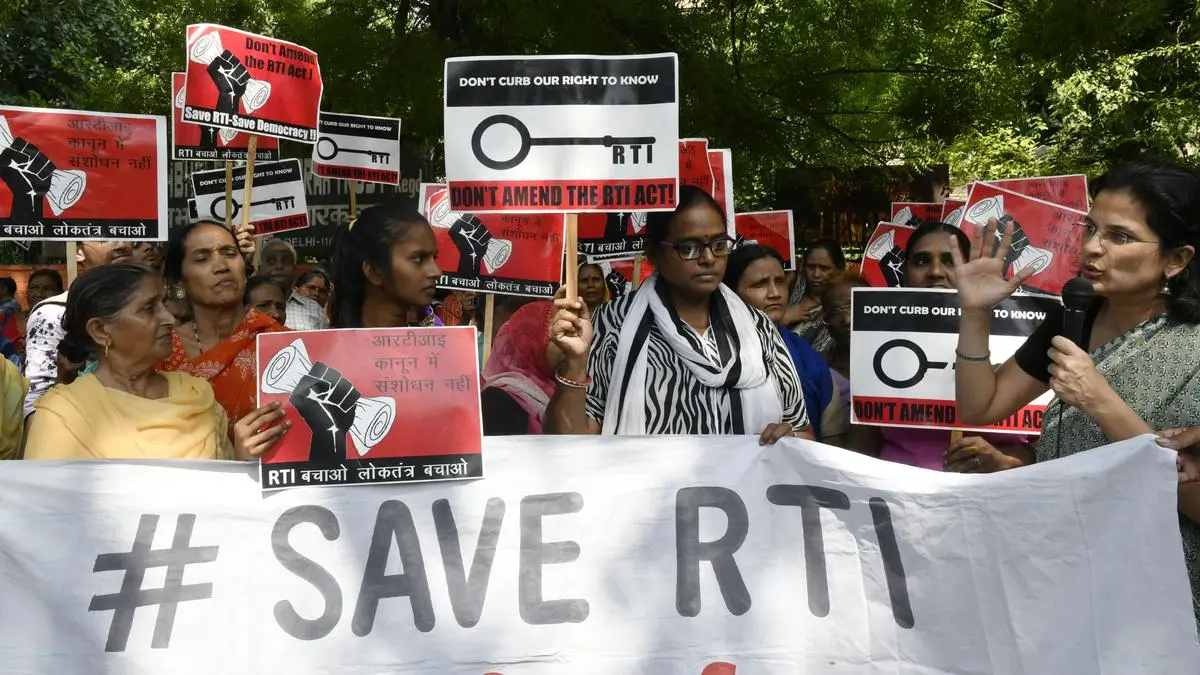
Why in the News?
- The Digital Personal Data Protection (DPDP) Act, 2023 has amended Section 8(1)(j) of the Right to Information (RTI) Act, 2005, significantly changing how personal information is treated.
- Experts and activists have raised concerns that these amendments may allow the government to deny citizens access to critical information, undermining transparency.
- The changes are seen as a potential setback for democratic governance, as the RTI has been a key tool for public accountability and anti-corruption.
Key Highlights
- RTI Act: The Foundation of Democracy
- The Right to Information (RTI) Act is based on the principle that India is a democracy, which is defined as “rule of the people, by the people, for the people.”
- In this framework, all information held by the government belongs to citizens, and the government acts only as a custodian.
- Citizens elect representatives, and these representatives guide the bureaucracy.
- This chain ensures that citizens can hold the government accountable.
- Original Section 8(1)(j) of RTI: Balancing Privacy and Transparency
- Section 8(1)(j) allowed the government to withhold personal information only if it was not related to public activity or if its disclosure would constitute an unwarranted invasion of privacy.
- A “proviso” ensured that if information could not be denied to Parliament or a State Legislature, it could not be denied to ordinary citizens either.
- This “proviso” acted as a guiding principle for Public Information Officers (PIOs) to determine what could be disclosed without violating privacy.
- Amendment Under the DPDP Act: Ambiguity and Risk
- What changed in Section 8(1)(j)?
- Originally, Section 8(1)(j) of the RTI Act clearly explained when personal information could be withheld. It was detailed and specific, guiding PIOs on what could be shared and what should be kept private.
- After the DPDP Act amendment, this section was shortened to just six words. This makes it very easy for PIOs to deny information, because there are no clear guidelines anymore.
- Different ways to understand “personal information”
- Natural Person Interpretation: Some people think “personal information” refers only to ordinary citizens. For example, your marksheet, medical records, or bank details.
- DPDP Bill Definition: The DPDP Act defines “personal information” much more broadly. It includes:
- Individuals (like citizens)
- Hindu Undivided Families (HUFs)
- Companies, firms, and associations
- The State itself
- Implication of this broad definition
- If the DPDP definition is used, almost everything can be considered personal information.
- This gives PIOs a legal reason to deny access to most documents, even if the information is important for public scrutiny or accountability.
- What changed in Section 8(1)(j)?
- Essentially, it can weaken the RTI Act, because citizens may not be able to access information that was previously available.
- Impact on Transparency
- PIOs may fear heavy penalties, which can reach up to ₹250 crore for wrongful disclosure under the DPDP Act.
- This fear will likely encourage over-caution and denial of information.
- Routine information collected by the government in the normal course of work may be withheld even if it is in the public interest.
- This transforms the RTI from a “Right to Information” into a “Right to Deny Information”, undermining citizens’ ability to monitor the government.
- Effect on Public Accountability and Corruption
- Denying citizens access to information will reduce public monitoring, which is one of the most effective tools against corruption.
- Even simple or routine information, such as a citizen’s corrected marksheet or pension details, could be denied.
- Government schemes to detect ghost employees or misuse of funds, like in Rajasthan, may no longer be possible.
- While the “larger public interest” clause still exists, its practical application is extremely limited and complex for PIOs to implement.
| What is a “proviso”?
1. Definition: A “proviso” is a special clause or condition added to a law that provides an exception to the main rule. 2. Function: It tells you: “the main rule applies, except in this particular case.” It acts like a safeguard or special instruction. 3. Example in RTI: Section 8(1)(j) says personal information can be withheld, but the “proviso” says: if information cannot be denied to Parliament or State Legislature, it cannot be denied to ordinary citizens either. 4. Importance: A “proviso” protects rights and ensures that exceptions are fair and clearly defined, preventing misuse of the main rule. |
Implications
- Threat to Democratic Principles
- The amendments undermine the fundamental right to information, which is a cornerstone of democratic governance.
- Without access to information, checks and balances are weakened, reducing government accountability.
- Loss of Citizen Oversight
- Citizens are the primary monitors of government corruption.
- Denial of information limits their ability to verify and question government actions.
- Transparency as a tool to ensure good governance will be significantly weakened.
- Increase in Corruption
- Information related to fraudulent schemes, ghost employees, and corruption cases may be classified as personal and withheld.
- Officials may exploit the ambiguity to hide wrongdoing, leading to increased opportunities for unaccountable corruption.
- Legal Confusion and Fear
- Conflicting definitions of personal information create confusion for PIOs.
- Fear of severe penalties discourages officers from disclosing even information that is clearly in the public interest.
- Erosion of Public Trust
- Citizens may lose confidence in the government, bureaucracy, and democratic institutions.
- The media and civil society will face greater challenges in enforcing transparency and accountability.
Challenges and Way Forward
| Challenges | Way Forward |
| Ambiguous definition of personal information | Clearly define “personal information” in RTI, separating sensitive private data from routine public information |
| Fear of penalties for PIOs | Provide legal protection for disclosures made in good faith under RTI |
| Reduced transparency and accountability | Run nationwide awareness campaigns to educate citizens about RTI rights |
| Difficulty applying larger public interest clause | Issue clear guidelines for its application to help PIOs make balanced decisions |
| Risk of covering corruption | Introduce judicial oversight and allow independent monitoring by citizens and civil society |
Conclusion
The amendment of Section 8(1)(j) under the DPDP Act threatens the spirit of the RTI Act, weakening transparency and public accountability. Citizens’ ability to monitor government action may be curtailed, and corruption could flourish unchecked. Active engagement by citizens, political parties, and media is essential to protect the fundamental right to information and uphold democratic governance.
| Ensure IAS Mains Question
Q. “Examine the impact of the DPDP Act’s amendments to Section 8(1)(j) on transparency, public accountability, and anti-corruption mechanisms in India. Suggest measures to restore the RTI’s effectiveness.” (250 words) |
| Ensure IAS Prelims Question
Q. With reference to the Right to Information (RTI) Act, consider the following statements: 1. The “proviso” in Section 8(1)(j) ensures that information accessible to Parliament or State Legislatures must also be accessible to citizens. 2. Section 8(1)(j) allows denial of personal information only when it is unrelated to public activity or constitutes an unwarranted invasion of privacy. Which of the statements given above is/are correct? a) 1 only b) 2 only c) Both 1 and 2 d) Neither 1 nor 2 Answer: c) Both 1 and 2 Explanation: Statement 1 is correct: The “proviso” is a special clause in Section 8(1)(j) that acts as an exception to the main rule. While the main rule allows denial of personal information, the “proviso” ensures that information which cannot be denied to Parliament or State Legislatures must also be shared with citizens. This acts as a safeguard for public access to information, maintaining democratic accountability. Without this “proviso”, PIOs could deny information arbitrarily, even if it is already accessible to legislative bodies, thereby weakening citizen oversight and transparency in governance. Statement 2 is correct: Section 8(1)(j) of the RTI Act clearly specifies that personal information can be withheld only if it is unrelated to public activity or constitutes an unwarranted invasion of privacy. This ensures a balance between individual privacy and the public’s right to know. Information collected in the normal course of government functioning, which does not affect privacy, must be disclosed. Therefore, the law protects both citizens’ access to information and individual privacy, guiding PIOs on making disclosure decisions in a fair and transparent manner. |
|
Also Read |
|
| UPSC Foundation Course | UPSC Daily Current Affairs |
| UPSC Monthly Magazine | CSAT Foundation Course |
| Free MCQs for UPSC Prelims | UPSC Test Series |
| ENSURE IAS NOTES | Our Booklist |