Why in the News?
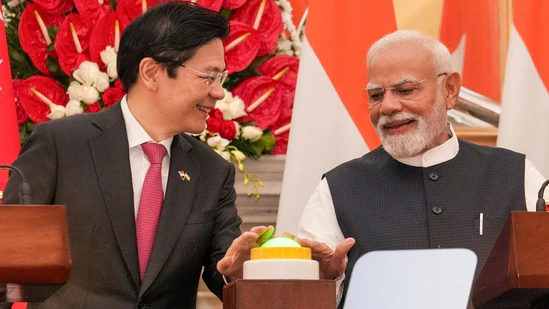
- Prime Minister Narendra Modi and Singaporean Prime Minister Lawrence Wong met in New Delhi to unveil a forward-looking roadmap for bilateral relations.
- The leaders agreed to deepen cooperation across eight major areas, including economy, skills development, digitalisation, sustainability, defence, healthcare, connectivity, and cultural exchanges.
- The joint statement highlighted India’s interest in joining Malacca Straits patrolling, along with a strong focus on critical technologies and semiconductor collaboration.
Key Highlights
- Comprehensive Strategic Partnership and Roadmap
- Relations elevated to a Comprehensive Strategic Partnership in 2024.
- A detailed roadmap now prepared to cover traditional as well as new areas: advanced manufacturing, urban water management, green shipping, and civil nuclear cooperation.
- Economic and Trade Cooperation
- Review of Comprehensive Economic Cooperation Agreement (CECA) and FTA with ASEAN in a time-bound manner.
- Bilateral trade facilitation through digital platforms like UPI-PayNow (expanded to 13 new Indian banks).
- Inauguration of Bharat Mumbai Container Terminal Phase-2 at JNPort, developed with Singapore’s PSA International.
- Technology and Semiconductor Partnership
- Semiconductor Ecosystem Partnership: joint R&D, supply chain resilience, workforce development, and industry linkages.
- Cooperation in AI, quantum computing, automation, unmanned vessels and digital technologies.
- Establishment of a National Centre of Excellence for Skilling in Chennai in advanced manufacturing.
- Defence, Security and Maritime Cooperation
- Strengthening of maritime security and submarine rescue cooperation.
- Singapore acknowledged India’s interest in Malacca Straits Patrol.
- Enhanced counter-terrorism cooperation with zero tolerance for cross-border terrorism, through FATF and bilateral treaties.
- Sustainability, Connectivity and People-to-People Exchanges
- Agreement on Green and Digital Shipping Corridors to strengthen supply chains of green fuels and digital clearance at ports.
- Cooperation in aviation and aerospace MRO sectors with upskilling opportunities.
- Expansion of cultural exchanges and joint projects in healthcare, education, and space research.
Implications
- Strategic and Security Dimension
- India’s participation in Malacca Straits patrol enhances its role in Indo-Pacific maritime security.
- Strengthens deterrence against piracy, terrorism, and regional instability.
- Economic and Trade Gains
- Review of CECA and ASEAN FTA could lead to higher trade flows and investment.
- Digital payments linkages improve financial inclusion and remittance ease.
- Technological Edge
- India gains access to Singapore’s expertise in semiconductors, AI, and quantum computing.
- Encourages self-reliance in chip manufacturing while reducing dependence on global supply chains.
- Sustainability and Infrastructure Development
- Green shipping corridors and port development help India meet climate goals while boosting maritime competitiveness.
- Collaboration in urban water management and clean fuels strengthens India’s sustainability agenda.
- Societal and Capacity Building Impact
- Skilling programs and educational exchanges help build a future-ready workforce.
- Healthcare and cultural cooperation promote stronger people-to-people bonds.
Challenges and Way Forward
| Challenges | Way Forward |
| Dependence on global semiconductor supply chains may limit India’s capacity-building. | Strengthen domestic manufacturing with targeted incentives and long-term Singaporean investment. |
| Geopolitical tensions in the Indo-Pacific may complicate maritime cooperation. | Enhance regional diplomacy through ASEAN and Quad partnerships. |
| CECA/FTA review may face negotiation hurdles on tariffs and market access. | Adopt a phased negotiation approach with focus on priority sectors like digital trade and services. |
| Technology transfer gaps in AI, quantum computing, and defence automation. | Establish joint research centres and encourage public-private partnerships. |
| Balancing sustainability goals with rapid industrialisation and shipping demands. | Develop green technology funds and align projects with India’s climate commitments. |
Conclusion
The India-Singapore partnership has moved from being sector-specific to becoming multi-dimensional and future-oriented. By focusing on semiconductors, AI, green shipping, and maritime security, the two nations are aligning their cooperation with emerging global challenges. While issues of supply chain resilience, trade negotiations, and regional security remain, a structured roadmap and strong political will provide a solid foundation. The partnership reflects a shared vision for an inclusive, secure, and sustainable Indo-Pacific.
| Ensure IAS Mains Question
Q. India-Singapore relations have transformed from traditional economic cooperation to a multi-dimensional strategic partnership. Discuss the major areas of cooperation highlighted in the recent bilateral roadmap and analyse their implications for India’s economy, technology, and security. (250 words) |
| Ensure IAS Prelims Question
Q. Consider the following statements regarding recent India-Singapore cooperation: 1. India has shown interest in joining the Malacca Straits Patrol for maritime security. 2. A Semiconductor Ecosystem Partnership has been established to strengthen research, workforce development, and supply chain resilience. 3. The Bharat Mumbai Container Terminal (Phase-2) was developed jointly by India’s JNPort Authority and Japan’s Mitsui Group. Which of the above statements is/are correct? a) 1 and 2 only b) 2 and 3 only c) 1 and 3 only d) 1, 2 and 3 Answer: a) 1 and 2 only Explanation: Statement 1 is correct: India expressed its interest in joining the Malacca Straits Patrol, an important maritime security initiative in the Indo-Pacific. Statement 2 is correct: A Semiconductor Ecosystem Partnership was established covering R&D, workforce development, supply chain resilience, and business cooperation. Statement 3 is incorrect: The Bharat Mumbai Container Terminal (BMCT) Phase-2 was developed by Singapore’s PSA International, not Japan’s Mitsui Group. |
|
Also Read |
|
| UPSC Foundation Course | UPSC Daily Current Affairs |
| UPSC Monthly Magazine | CSAT Foundation Course |
| Free MCQs for UPSC Prelims | UPSC Test Series |
| ENSURE IAS NOTES | Our Booklist |