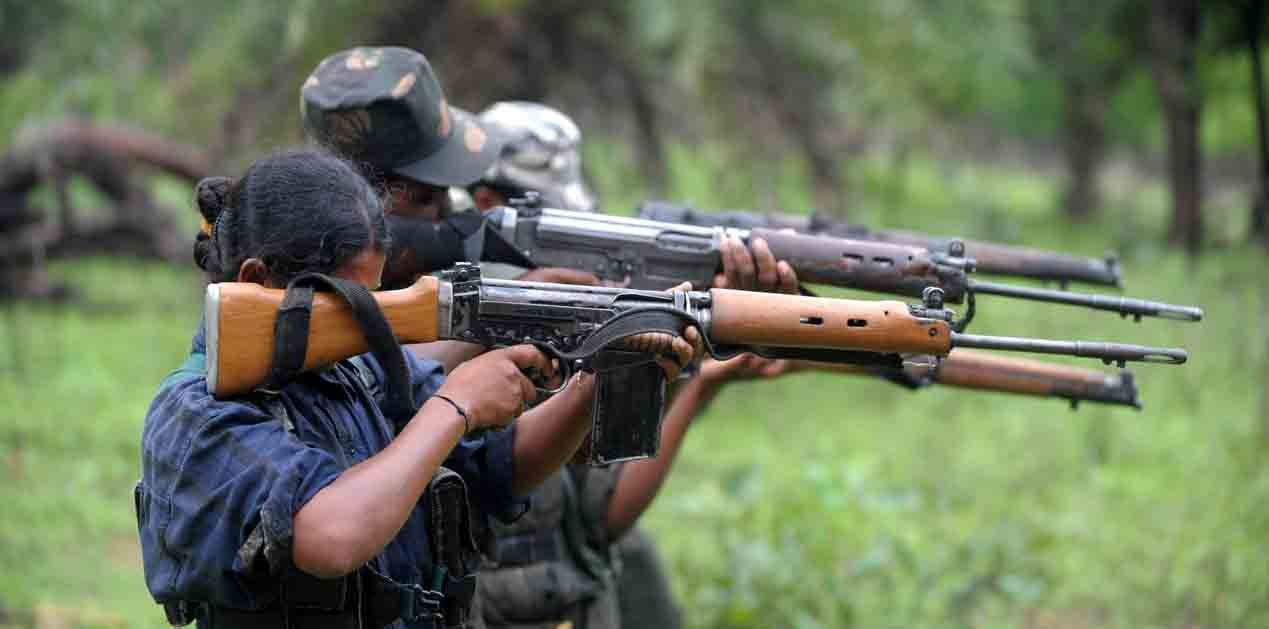
Why in the News?
- Predictions about the end of Naxalism in India have gained attention after the Union Home Minister indicated that mid-2026 could mark the final demise of Naxalite violence.
- This discussion comes against the backdrop of global concerns about rising terrorism threats, including the possible use of AI-enabled attacks and bioweapons, while India is witnessing a declining curve in ideologically driven militancy.
Key Highlights
- Global Concerns About Terrorism
- Persistent Threat: Even after 25 years of the 9/11 attacks, terrorism remains a serious global issue.
- Rise of Lone-Wolf Attacks: Instances of copycat killings and Islamic State (IS)-inspired attacks, such as vehicle rammings in the U.S. and Europe, are increasing.
- AI Factor: Experts warn that terrorists could exploit AI for planning and execution, and even develop bio-weapons, leading to large-scale harm.
- Declining Naxalism in India
- Current Trend: India is experiencing a decline in Naxalite violence, marking a significant shift from earlier decades.
- Government Statement: Union Home Minister stated that Naxalism could end by 2026, an official assertion never made before.
- Historical Background of the Naxalite Movement
- Left Wing Extremism (LWE), often referred to as Naxalism, is one of India’s most serious internal security challenges.
- Rooted in socio-economic inequalities and fueled by Maoist ideology, LWE has historically affected some of the most remote, underdeveloped, and tribal-dominated regions of the country.
- The movement has aimed to undermine the Indian state through armed rebellion and parallel governance structures, particularly targeting security forces, public infrastructure, and democratic institutions.
- Origins: Naxalbari movement of 1967 in West Bengal
- It spread primarily across the “Red Corridor,” affecting states like Chhattisgarh, Jharkhand, Odisha, Maharashtra, Kerala, West Bengal, Madhya Pradesh, and parts of Andhra Pradesh and Telangana.
- The Maoist insurgents claim to fight for the rights of the marginalized, particularly tribal communities, but their methods include armed violence, extortion, destruction of infrastructure, and recruitment of children and civilians.
- Promise of Revolution: Initially attracted intellectuals and youth with slogans like “China’s Chairman is our Chairman.”
- Recent Counter-Naxalite Campaign
- Offensive Since 2024: A nationwide, sustained offensive was launched to eliminate Naxalite groups.
- Casualty Figures: CPI (Maoist) admitted that 357 cadres, including a large number of women, were killed in encounters in the past year.
- Shrinking Influence: Epicentre of violence remains Dandakaranya, but internal conflicts and leadership crises have weakened the movement.
- Misuse of the Term ‘Urban Naxals’
- Original vs Present: The original Naxalite movement had a structured ideology, while current so-called ‘urban naxals’ are loosely connected intellectuals opposing government policies.
- Risk of Misclassification: Wrong classification could lead to flawed policies and unintended consequences.
- Constitutional Provisions
- Emergency and Security Provisions
- Article 355: Duty of the Union to protect states against internal disturbances and ensure governance as per the Constitution.
- Article 356: President’s Rule in case of breakdown of constitutional machinery due to extremist violence.
- Emergency and Security Provisions
- Article 352: Allows National Emergency if armed rebellion (includes large-scale internal insurgency) occurs.
- Fundamental Rights & Restrictions
- Article 19(2) & 19(4): Reasonable restrictions on freedom of speech and association in the interest of sovereignty, security, and public order (used to curb Maoist propaganda and organizations).
- Article 21: Protects citizens from arbitrary state action, but also justifies counter-insurgency operations under legal process.
- Preventive Detention Provisions
- Article 22: Allows preventive detention for reasons of security and public order; basis for laws like UAPA (Unlawful Activities Prevention Act) and NSA (National Security Act).
| Initial Ideology of the Naxalite movement
The ideology of the Naxalite movement was rooted in Marxism-Leninism-Maoism, and its core beliefs can be explained as follows: 1. Marxist-Leninist Principles a. Belief in class struggle between the proletariat (working class) and bourgeoisie (capitalist class). b. Goal was to overthrow the existing state structure, which was seen as serving feudal landlords and capitalists. 2. Maoist Influence a. Inspired by Mao Zedong’s strategy of protracted people’s war. b. Advocated armed struggle starting from rural areas (villages and forests) and gradually encircling and capturing urban centers. c. Focused on mobilizing peasants, tribals, and landless laborers as the vanguard of the revolution. 3. Agrarian Revolution a. Primary objective was to seize land from landlords and redistribute it to landless farmers and poor peasants. b. Slogan: “Power flows from the barrel of a gun.” 4. Anti-Imperialism and Anti-Feudalism a. Strong opposition to imperialist forces, especially the influence of the United States and capitalist globalization. b. Viewed the Indian state as semi-feudal and semi-colonial. 5. Vision of a Classless Society a. Ultimate aim was to establish a people’s democratic state leading towards socialism and then communism. |
Implications
- For Internal Security
- Decline in Naxalism strengthens India’s internal security architecture.
- Security forces can now shift focus from counter-insurgency to other pressing challenges.
- For Policy and Governance
- The official announcement of the end of Naxalism signals policy success, boosting government credibility.
- Risk of overconfidence could result in ignoring residual threats in remote areas.
- For Global Terrorism Discourse
- India’s progress contrasts with rising global fears of AI-enabled terrorism.
- Shows the importance of continuous adaptation in counter-terrorism strategies.
- For Social and Political Stability
- Reduction in ideological violence will improve governance in tribal and rural areas.
- Could promote development in previously conflict-ridden regions.
- For Future Security Risks
- Mislabeling dissenters as ‘urban naxals’ may lead to erosion of democratic spaces.
- Lack of nuanced understanding can create policy blind spots and alienate civil society.
Schemes and Initiatives aimed at addressing Left Wing Extremism (LWE)/Naxalism in India:
- Security and Police Modernization
- Security Related Expenditure (SRE) Scheme (2014–2025): Supports LWE-affected districts by reimbursing costs for:
- Training and operations of security forces
- Ex-gratia payments to families of victims
- Security Related Expenditure (SRE) Scheme (2014–2025): Supports LWE-affected districts by reimbursing costs for:
- Rehabilitation of surrendered LWE cadres
- Community policing and village defence committees
- Publicity materials
- Assistance to Central Agencies for LWE Management (2014–2025): Provides funds to CAPFs and IAF for infrastructure and helicopter hiring.
- Civic Action Programme (CAP) (2014–2025): Aims to build trust between security forces and locals through welfare activities.
- Special Infrastructure Scheme (SIS): Enhances capabilities of State Intelligence Branches, Special Forces, and District Police.
- Scheme of Fortified Police Stations: Total of 612 fortified stations constructed over the last decade (up from 66 in 2014).
- Infrastructure Development
- Special Central Assistance (SCA) (Approved in 2017): Fills critical gaps in public infrastructure and services in LWE districts.
- Road Requirement Plan-I (RRP-I) & Road Connectivity Project for LWE Areas (RCPLWE): Improve road access in 9 LWE-affected states. Supports both security operations and socio-economic development.
- Telecom Connectivity Projects: Includes Phase-I & II Mobile Connectivity, 4G services in Aspirational Districts, and saturation of 4G coverage. Full mobile coverage expected by December 1, 2025.
- Media and Public Awareness
- Media Plan (Since 2017–18): Counters Maoist propaganda and promotes democratic values. Activities include Tribal Youth Exchange, radio jingles, documentaries, and pamphlets.
- Socio-Economic Development
- Aspirational Districts Programme: Ministry of Home Affairs monitors development in 35 LWE-affected districts.
- Financial Inclusion (Since April 2015):
- 1,007 bank branches and 937 ATMs opened in 30 key districts.
- 5,731 new post offices were established.
- 37,850 Banking Correspondents made operational.
- Skill Development and Education:
- 48 Industrial Training Institutes (ITIs) and 61 Skill Development Centres (SDCs) functional.
- 178 Eklavya Model Residential Schools (EMRSs) operational in tribal blocks.
- Skill Development Scheme covers all 48 LWE districts.
- 1,143 tribal youths recruited into security forces.
- A dedicated vertical of the National Investigation Agency (NIA) created.
Challenges and Way Forward
| Challenges | Way Forward |
| Residual Pockets of Naxalism in remote forest areas | Continue focused operations with development initiatives in affected regions. |
| Risk of Misclassification (Urban Naxal narrative) | Frame clear definitions; avoid politicization of security terminology. |
| AI-enabled and Bio-weapon Terror Threats globally | Develop robust AI governance, cybersecurity, and biosecurity measures. |
| Socio-economic Grievances of Tribal Communities | Ensure inclusive growth, land rights protection, and better governance. |
| Overconfidence in Declining Trend | Maintain vigilance and intelligence gathering to prevent resurgence. |
Conclusion
India’s campaign against Naxalism marks a major milestone in counter-insurgency, with the possibility of eliminating a decades-old ideological movement by 2026. However, this success should not lead to complacency. While global terrorism threats evolve with technology like AI and bio-weapons, India must continue balancing security measures with democratic values, addressing socio-economic grievances, and avoiding policy missteps such as the misuse of terms like ‘urban naxals’. Sustained vigilance and adaptive strategies remain crucial to ensuring long-term internal security and stability.
| EnsureIAS Mains Question
Q. The recent decline in Naxalite violence in India marks a significant shift in internal security dynamics, but the global rise of AI-enabled terrorism poses new challenges. Critically examine the factors behind the decline of Naxalism and discuss how India should prepare for emerging security threats. (250 words) |
| EnsureIAS Prelims Question Q. With reference to the Naxalite movement in India, consider the following statements:1. The Naxalite movement originated in the 1960s as an ideologically driven movement inspired by Maoist principles. 2. The epicentre of Naxalite violence in recent years has been the Dandakaranya region. 3. The term ‘urban naxals’ historically referred to the original leaders of the Naxalite movement in the 1960s and 1970s. Which of the statements given above is/are correct? a. 1 and 2 only Answer: a. 1 and 2 only |