Why in the News?
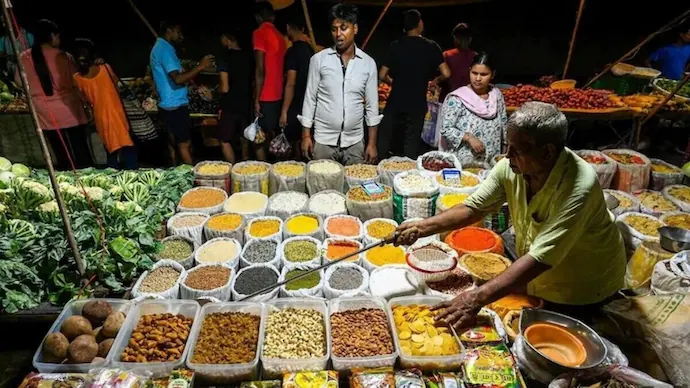
- Retail inflation in India eased to 55% in July 2025, marking its lowest level since June 2017, largely owing to a fall in food prices.
- This remains below the Reserve Bank of India’s comfort band of 2%–6%.
| Retail Inflation
1. Retail inflation refers to the rise in the prices of goods and services at the consumer level, measured by the Consumer Price Index (CPI). 2. It affects the cost of living for households and indicates changes in purchasing power. 3. It is calculated monthly by comparing current CPI values to a base year. |
Key Highlights
- Inflation Trend since 2017:
- As per the data published by Ministry of Statistics and Programme Implementation (MoSPI), the year-on year inflation rate from July 2017 to July 2025 is as follows:
| Timeline | Inflation Rate |
| July 2017 | 2.36% |
| July 2018 | 4.17% |
| July 2019 | 3.15% |
| July 2020 | 6.73% |
| July 2021 | 5.59% |
| July 2022 | 6.71% |
| July 2023 | 7.44% |
| July 2024 | 3.6% |
| July 2025 | 1.55% |
- The Consumer Price Index (CPI), released by the MoSPI in August 2025, showed that inflation has been easing for nine consecutive months.
- Inflation Trends in Food and Beverages Category
- The inflation rate in the food and beverages category stood at -0.8% in July 2025, lower than -0.2% in June 2025 and 1% in July 2024.
- Deflation was observed in essential food items such as vegetables, pulses, spices, and meat.
- Vegetable and pulses inflation contracted by 21% and 14% respectively, due to a high base price (2024) and falling prices (2025).
- Favourable monsoon progress, sufficient reservoir levels, and strong kharif sowing are some reasons that supported agricultural output and food price stability.
- Core Inflation and Other CPI categories
- Core inflation, which excludes food and fuel components, declined to 1% in July 2025, down from 4.4% in June 2025, aligning closely with the RBI’s target of 4%.
- Other major CPI categories remained largely stable compared to the previous month.
- Inflation in the paan, tobacco, and intoxicants category held steady at 4% in July 2025, showing no month-on-month change.
- Inflation in the clothing and footwear category eased marginally in July 2025 compared to the previous month.
- Housing inflation remained unchanged at 2% in July 2025, while fuel and light inflation rose to 2.7% in July 2025, up from 2.5% in June 2025.
- Statistical High Base Effect:
- The statistical high base effect is expected to suppress inflation rates between September and December 2025, making year-on-year comparisons appear lower.
- A high base refers to elevated price levels in the same period of the previous year, which mathematically lowers the current year’s inflation rate even if prices remain stable.
- This leads to a technical moderation in inflation figures, without necessarily reflecting a real-time drop in consumer prices.
- Example: If vegetable prices were ₹100/kg in September 2024 and ₹90/kg in September 2025, the inflation rate would show a -10% deflation, even though ₹90/kg may still be considered high by historical standards.
- Global and Geopolitical Context
- The current disinflationary cycle is working in India’s favour, especially as tariff-driven inflation remains a central concern in global economic discourse.
- Global growth risks are expected to exert downward pressure on international commodity prices, helping contain imported inflation.
- This trend is likely to partially offset the inflationary impact of elevated tariff rates, providing relief to domestic price levels.
- However, India must remain vigilant in case it is compelled to halt Russian oil imports in response to the U.S. President Donald Trump’s demand, linked to punitive tariff threats and geopolitical pressure.
- In this case, India may diversify its sourcing towards Kuwait and Iraq, both of which offer competitive pricing, logistical compatibility, and refining-grade suitability for Indian oil infrastructure.
| Inflation
1. It means sustained rise in the general price level of goods and services over time. 2. It reduces the purchasing power of money. 3. It is measured using indices like CPI or WPI. Deflation 1. It refers to persistent fall in the general price level of goods and services. 2. It increases the purchasing power of money but may signal weak demand and economic slowdown. 3. It is often linked to reduced consumer spending or excess production capacity. Core vs Headline Inflation 1. Headline Inflation: Total inflation figure, including all items such as food and fuel (more volatile). 2. Core Inflation: Excludes volatile items like food and fuel to show underlying, long-term inflation trends. 3. Purpose: Core inflation helps policymakers focus on persistent price changes unaffected by short-term shocks. Consumer Price Index (CPI) 1. It measures the average change in prices of a fixed basket of goods and services that households typically consume. 2. It reflects changes in the purchasing power of money due to inflation. 3. Components of CPI: a. Food and Beverages – Includes cereals, pulses, vegetables, milk, meat, beverages, etc. b. Housing – Rent paid or imputed rent for self-occupied houses. c. Clothing and Footwear – Costs of garments, footwear, and related items. d. Fuel and Light – LPG, kerosene, firewood, electricity, etc. e. Miscellaneous – Education, healthcare, transport, communication, recreation, and other services. 4. Publishing Authority: Compiled and released by the Ministry of Statistics and Programme Implementation (MoSPI). 5. Types of CPI in India: a. CPI for Industrial Workers (CPI-IW) i. Tracks price changes for industrial workers. ii. Base Year: 2016. iii. Used for wage adjustments in the organised labour sector. b. CPI for Agricultural Labourers (CPI-AL) and CPI for Rural Labourers (CPI-RL) i. Measures inflation for rural and agricultural labourers. ii. Base Year: 1986–87. c. CPI (Urban), CPI (Rural), and CPI Combined i. Measures retail inflation at the national level. ii. Base Year: 2012 iii. CPI Combined is the official retail inflation rate used in India. 6. Formula used for calculation: a. CPI = [Cost of the basket in current year ÷ Cost of the basket in base year] x 100 b. Basket of goods/services: Represents typical household consumption. c. Base year: Serves as reference for comparison (currently 2012). 7. Purpose of CPI: a. Tracking Inflation: Monitors the rate of price changes. b. Policy Formulation: RBI uses CPI for inflation targeting (4% ± 2%). c. Wage & Pension Adjustments: Used to revise salaries and pensions, especially in government sectors. d. Economic Analysis: Provides insights into consumption trends and economic health. |
Implications
- Monetary Policy Flexibility: RBI gets more room to maintain an accommodative stance and interest rates are unlikely to rise in the short term.
- Consumer Purchasing Power: Lower inflation boosts real income and consumer confidence. This is likely to increase the demand for the goods and services.
- Agricultural Stability: Good monsoon ensures stable agricultural output. This helps the rural economy through better farm incomes and lower food price volatility.
- Industrial & Services Growth: Low inflation reduces input cost pressures for industries. It encourages private investment and manufacturing expansion.
- External Sector Impact: Stable domestic prices will strengthen the export competitiveness in the foreign market. Also, lower fuel prices will help India to reduce the current account deficit.
Challenges and way forward
| Challenges | Way Forward |
| Dependence on monsoon for food price stability | Diversify cropping patterns & improve irrigation infrastructure |
| Risk of global oil price volatility due to geopolitical tensions | Strategic diversification of oil import sources |
| Statistical base effect may wear off by early 2026 | Strengthen supply chains to keep inflation stable |
| Tariff-related inflation risks globally | Negotiate trade terms and manage import costs efficiently |
| Possible disruption in Russian oil supply | Secure long–term contracts with alternative suppliers |
Conclusion
India’s retail inflation touching an 8-year low in July 2025 is a significant relief for policymakers, consumers, and industries alike. While favorable domestic conditions, good monsoon performance, and easing global commodity prices have contributed to the drop, vulnerabilities remain in the form of external shocks and supply-side disruptions. A sustained low-inflation environment will require proactive policy measures in agriculture, energy security, and trade management.
| Ensure IAS Mains Question
Q. “India’s retail inflation in July 2025 fell to its lowest in eight years due to multiple domestic and global factors.” Discuss the key domestic drivers behind this fall and analyse how global geopolitical and trade developments could influence India’s inflation trajectory in the coming months. (150 words) |
| Ensure IAS Prelims Question
Q. With reference to India’s Consumer Price Index (CPI) and July 2025 inflation trends, consider the following statements: 1. Core inflation includes food and fuel price movements. 2. The food and beverages category in July 2025 recorded deflation. 3. The statistical high base effect can make inflation rates appear lower even when prices remain high compared to historical averages. Which of the statements given above is/are correct? a) 1 only b) 2 and 3 only c) 1 and 3 only d) 1, 2 and 3 Answer: b) 2 and 3 only Explanation: Statement 1 is incorrect: Core inflation excludes food and fuel price movements because these items are highly volatile and can distort the underlying inflation trend. It mainly measures inflation in items like housing, healthcare, education, and personal care. Statement 2 is correct: In July 2025, the food and beverages category did not contribute to inflation; instead, it recorded deflation, meaning prices were lower compared to the same period last year. This could be due to seasonal factors, good harvests, or government interventions in the supply chain. Statement 3 is correct: The statistical high base effect occurs when the previous year’s inflation rate was unusually high, making the current year’s inflation rate appear lower even if prices remain high in absolute terms. For example, if tomato prices were very high last year, a smaller increase (or even a small drop) this year would still mean prices are costly, but the rate of inflation appears subdued. |