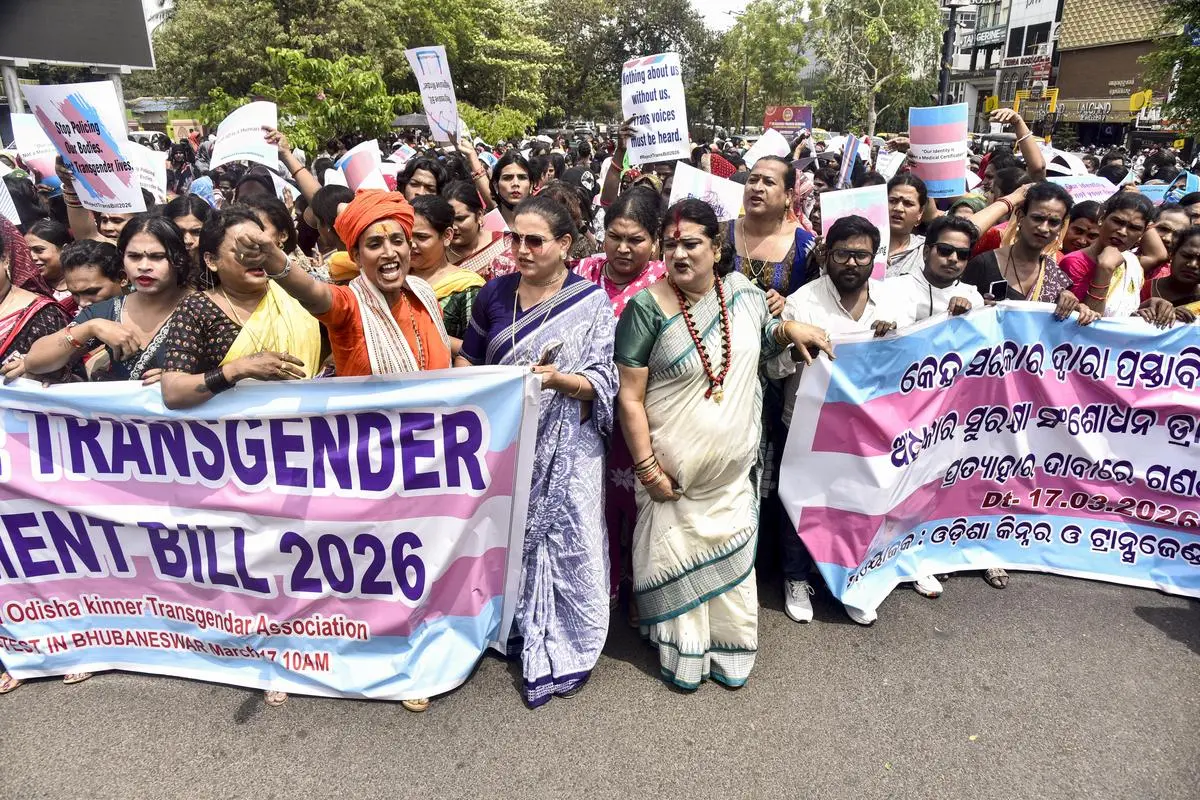
Context
The Supreme Court is examining the constitutional validity of the Transgender Persons (Protection of Rights) Amendment Act, 2026, while conflicting High Court rulings on the applicability of women-specific criminal laws to transgender women have raised concerns over gender identity, dignity and equal protection of laws.
Core Issue & Contrasting High Court Rulings
Core Legal Question: Whether protection under women-specific criminal laws depends on sex assigned at birth, gender-affirming surgery, or self-identified gender.
| High Court & Case (2026) | Key Ruling & Statutory Context |
| Bombay High Court (Vishal Sunil Ingle v. State of Maharashtra, 2026) | Held that a transgender woman could seek protection under Section 75, BNS (Bharatiya Nyaya Sanhita) even without undergoing gender-affirming surgery. |
| Allahabad High Court (Mohd Saakir v. State of Uttar Pradesh, 2026) | Held at the bail stage that Section 69, BNS did not apply to a transgender complainant, despite gender-affirming surgery. |
Procedural & Statutory Distinction: The Bombay High Court rejected a plea to drop charges (discharge application under Section 75, BNS), whereas the Allahabad High Court granted bail (under Section 69, BNS), involving different legal provisions and stages of criminal proceedings.
Constitutional & Statutory Framework
- Article 14: Guarantees equality before law and equal protection of laws to every person.
- Articles 15 & 16: Bar discrimination on specified grounds, including sex, which the Supreme Court has read to include gender identity.
- Article 21: Protects life, dignity, privacy, personal liberty, and individual autonomy.
- NALSA v. Union of India (2014): Recognised the right to self-identify gender and affirmed the fundamental rights of transgender persons.
- Transgender Persons (Protection of Rights) Act, 2019: Prohibits discrimination in education, employment, healthcare, and public services; its original Section 7(1) allowed people undergoing gender-affirming surgery to apply for a revised certificate of identity.
- Transgender Persons (Protection of Rights) Amendment Act, 2026: Changes to the gender-recognition framework has raised concerns over self-identification, equality, and dignity, and face judicial scrutiny.
Key Criminal-Law Provisions
| Provision | Key Features |
| Section 2(35), BNS, 2023 | Defines a woman as a female human being of any age. |
| Section 63, BNS | Defines rape through gender-specific provisions. |
| Section 69, BNS | Punishes sexual intercourse with a woman through deceitful means (including a false promise of marriage) where the act does not amount to rape. |
| Section 74, BNS | Punishes assault or criminal force against a woman intended to outrage her modesty. |
| Section 75, BNS | Punishes sexual harassment. |
| Section 18(d), Transgender Persons Act, 2019 (original framework) | Prescribed 6 months to 2 years’ imprisonment and a fine for specified forms of abuse against transgender persons. |
Significance & Need for Inclusive Protection
- Substantive Equality: Legal protection should address real-world vulnerabilities and disadvantages faced by transgender persons.
- Dignity & Bodily Autonomy: Linking legal protection to surgical transition can undermine bodily autonomy and personal dignity.
- Identity-Based Harm: Violence can stem from gender identity or expression, regardless of biological traits.
- Focus on Core Criminal Elements: Criminal liability should centre on consent, nature of harm, and statutory ingredients of the offence.
Challenges
- Punishment & Protection Gap: The original 2019 Act carried lower punishments for certain abuses than comparable offences under the BNS.
- Judicial Inconsistency: Conflicting rulings create legal uncertainty and hurdles to justice for victims.
- Statutory Ambiguity: Differing readings of gender-specific terms in penal laws leave coverage and applicability unclear across courts.
- Procedural & Evidentiary Hurdles: Different stages of criminal cases (such as bail vs. discharge) and identity document mismatches can complicate how complaints are registered and examined.
- Social Stigma & Underreporting: Fear of discrimination, secondary trauma, or insensitive handling discourages many transgender victims from reporting offences.
- Tension Between Rights & Penal Precision: Courts must weigh constitutional equality and dignity against strict interpretation of criminal statutes, which can slow uniform relief.
Way Forward
- Legislative Clarity: Clearly define how gender-specific penal provisions apply to transgender persons.
- Gender-Neutral Safeguards: Consider inclusive sexual-offence laws that protect victims regardless of gender identity.
- Balanced Constitutional Reading: Balance statutory text with equality, dignity, and autonomy, while respecting the principle of legality in criminal law.
- Stronger Penal Remedies: Strengthen protection against aggravated violence, exploitation, and gender-based crimes.
- Institutional Sensitisation: Train police, judges, and healthcare staff on transgender-specific needs and rights.
- Better Access to Justice: Expand legal aid, victim compensation, rehabilitation, and grievance redressal.
FAQs
Q1. What does Section 69 of the Bharatiya Nyaya Sanhita provide?
Ans. It criminalises sexual intercourse with a woman through deceitful means, including a false promise of marriage, where the act does not constitute rape.
Q2. What is the difference between formal equality and substantive equality?
Ans. Formal equality ensures equal treatment, while substantive equality addresses existing disadvantages and structural discrimination.
Q3. Which provision of the original Transgender Persons Act, 2019 penalises sexual abuse?
Ans. Section 18(d) penalises physical, sexual, verbal, emotional and economic abuse against transgender persons.