Preparing for the UPSC Civil Services Examination requires a combination of conceptual understanding, current affairs awareness, analytical thinking and consistent revision. While newspapers and standard reference books form the foundation of preparation, government sources also play an important role in helping aspirants understand policies, schemes, initiatives and national developments.
One such important source is the Press Information Bureau (PIB).
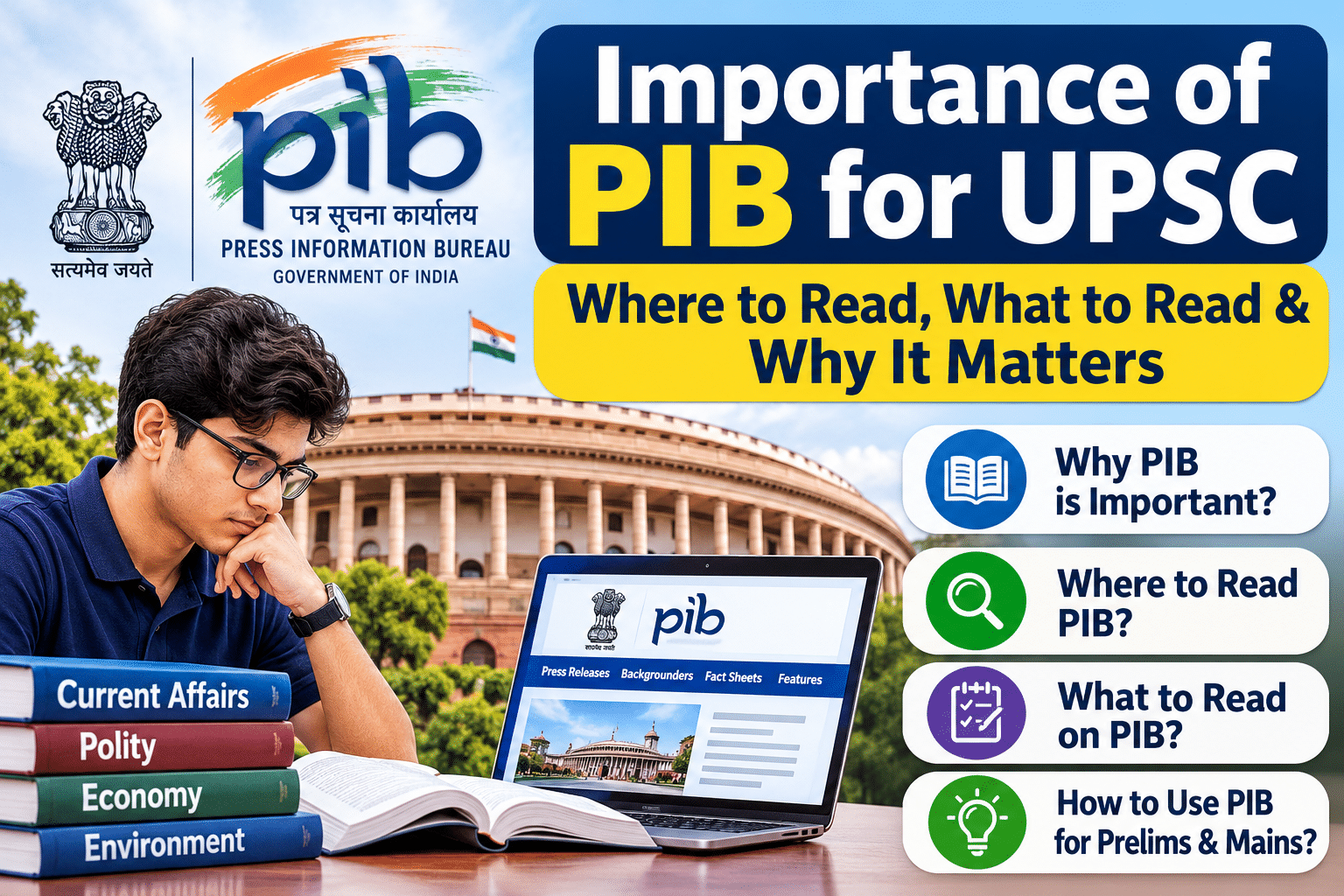
PIB is the official communication agency of the Government of India that disseminates information about government policies, programmes, initiatives and achievements. For UPSC aspirants, it provides access to official information, policy explanations, factsheets, backgrounders and updates from various ministries.
However, reading every PIB press release is neither necessary nor practical. The real challenge is identifying relevant information, connecting it with the UPSC syllabus and converting it into useful examination notes.
This article explains the importance of PIB for UPSC preparation, where to access it, what to read, what to avoid and how to use it effectively for Prelims and Mains.
1. What is PIB (Press Information Bureau)?
The Press Information Bureau (PIB) is the nodal agency of the Government of India responsible for disseminating information to the print, electronic and digital media about government policies, programmes, initiatives and achievements.
It functions under the Ministry of Information and Broadcasting and acts as an important communication link between the Government and the media.
PIB publishes information through different formats, including:
- Press Releases
- Press Notes
- Backgrounders
- Fact Sheets
- Explainers
- Features and Articles
- Frequently Asked Questions (FAQs)
- Photographs, Videos and Infographics
- Government Policy and Programme Updates
These publications cover a wide range of subjects, including the Indian economy, agriculture, education, health, environment, science and technology, defence, international relations and governance.
For UPSC aspirants, PIB is particularly useful because it provides information directly from official government sources.
Official Website: https://pib.gov.in/
2. Why is PIB Important for UPSC Preparation?
PIB is an important supplementary resource for UPSC preparation because it helps candidates understand government policies, public initiatives and developments across different sectors.
Its relevance becomes clearer when connected with the UPSC syllabus.
A. Official Information About Government Schemes
Government schemes and welfare programmes are frequently relevant to UPSC Prelims and Mains.
PIB provides official updates about the objectives, beneficiaries, implementing ministries, features and progress of various government initiatives.
For example, aspirants may encounter information related to:
- Pradhan Mantri Jan Dhan Yojana
- Ayushman Bharat
- PM-KISAN
- Jal Jeevan Mission
- PM Awas Yojana
- National Education Policy
- Digital India
- National Green Hydrogen Mission
Understanding these initiatives helps candidates prepare factual questions for Prelims and analytical answers for Mains.
B. Understanding Government Policies and Decisions
UPSC does not simply test knowledge of government announcements. It also evaluates candidates’ understanding of public policy, governance and their implications.
PIB releases can help aspirants understand:
- The purpose behind a government policy.
- The ministry responsible for implementation.
- The target beneficiaries.
- The challenges addressed by the initiative.
- Its expected outcomes.
- Its relevance to national development.
This information can be used to develop balanced answers in General Studies Paper II and Paper III.
C. Improving Current Affairs Preparation
The UPSC syllabus explicitly includes current events of national and international importance.
PIB helps aspirants follow developments related to government decisions, national programmes, economic initiatives, scientific developments, environmental policies and international engagements.
Instead of collecting isolated news facts, candidates can use PIB to understand the background and official objectives of important developments.
D. Useful for GS Paper II: Governance and Social Justice
GS Paper II covers governance, Constitution, public policy, social justice, government interventions and welfare schemes.
PIB provides relevant information about:
- Government policies and interventions.
- Welfare schemes for vulnerable sections.
- Health and education initiatives.
- Transparency and accountability.
- Digital governance.
- Administrative reforms.
- Citizen-centric service delivery.
This makes selected PIB backgrounders, features and releases useful for Mains preparation.
E. Useful for GS Paper III: Economy, Environment and Science & Technology
PIB regularly publishes information about economic policies, infrastructure projects, agriculture, environmental initiatives and technological developments.
Relevant areas include:
- Economic reforms and industrial development.
- Agriculture and food security.
- Renewable energy.
- Climate change and biodiversity.
- Space technology.
- Artificial Intelligence.
- Biotechnology.
- Defence research and innovation.
These topics are useful for building examples, understanding policy interventions and enriching analytical answers.
F. Provides Government Data and Policy Context
PIB factsheets and backgrounders can help candidates identify important government initiatives, institutional developments, programme objectives and sector-specific information.
However, aspirants should distinguish between official government claims, independently verified outcomes and broader policy assessments. PIB is an official communication source, not a substitute for independent critical analysis.
3. Where to Read PIB for UPSC Preparation?
The official PIB website contains several sections. Aspirants should understand the purpose of each section instead of randomly browsing the homepage.
Website: https://pib.gov.in/
The following sections deserve particular attention.
1. Press Releases
This section contains official announcements and updates issued by various ministries and government departments.
It is useful for understanding:
- New government schemes and initiatives.
- Important policy decisions.
- Cabinet approvals.
- Major national developments.
- International agreements and collaborations.
- Important economic and administrative announcements.
UPSC Relevance: Prelims and GS Paper II and III.
2. Backgrounders
Backgrounders explain important subjects in greater detail by providing historical context, policy objectives, institutional information and sector-specific developments.
They are particularly useful when an aspirant wants to understand an issue beyond a short news announcement.
For example, backgrounders related to India’s energy transition, agriculture, healthcare, digital infrastructure and environmental conservation can help build conceptual understanding.
UPSC Relevance: Mainly Mains, with selected factual information useful for Prelims.
3. Fact Sheets
Fact Sheets present important information in a concise and structured format.
They may include:
- Government programme details.
- Important statistics.
- Sector-wise achievements.
- Institutional information.
- Programme implementation details.
- Key policy features.
Aspirants can use relevant factsheets to collect verified official figures and examples.
UPSC Relevance: Prelims and Mains.
4. Features
The Features section contains articles and explanatory content covering important national developments, government initiatives and sector-specific subjects.
These articles can help candidates understand the broader context of policies and developments.
UPSC Relevance: Particularly useful for Mains-oriented preparation.
5. Explainers and FAQs
Explainers and Frequently Asked Questions provide simplified explanations of selected topics and government initiatives.
They are useful for understanding complex subjects in a more accessible format.
Candidates can use them to clarify concepts and identify important factual details.
UPSC Relevance: Prelims and Mains.
6. Year-End Reviews
Year-End Reviews provide an overview of important activities, initiatives and developments undertaken by different ministries during a particular year.
They are useful for consolidating information about:
- Major government schemes.
- Sectoral achievements.
- Important policy developments.
- New initiatives.
- Institutional and infrastructure developments.
These reviews can be especially useful during the revision phase.
UPSC Relevance: Prelims and Mains.
4. What Should UPSC Aspirants Read on PIB?
Not every PIB update is relevant to the Civil Services Examination. Aspirants should focus on topics that have a direct or indirect connection with the official syllabus.
The following subject-wise approach can help.
| Subject | Important PIB Topics |
|---|---|
| Indian Polity and Governance | Constitutional developments, governance reforms, e-governance, public administration |
| Indian Economy | Budget, economic reforms, infrastructure, banking, financial inclusion |
| Agriculture | MSP, agricultural technology, irrigation, food security, farmer welfare |
| Environment | Climate change, biodiversity, conservation, renewable energy |
| Science and Technology | Space missions, AI, biotechnology, defence technology |
| International Relations | Bilateral agreements, international cooperation, global summits |
| Social Justice | Education, healthcare, women empowerment, child welfare |
| Internal Security | Cybersecurity, border management, defence developments |
Important Areas to Prioritise
1. Government Schemes and Programmes
Understand the objectives, nodal ministries, beneficiaries and important features of major schemes.
2. Cabinet Decisions
Focus on decisions related to important policies, economic reforms, infrastructure and national development.
3. Reports and Indices
Read important government reports and official statistical releases when they are relevant to the UPSC syllabus.
4. International Agreements
Pay attention to important agreements, conventions, partnerships and India’s participation in international organisations.
5. Science and Technology Developments
Focus on the applications, significance and societal implications of important scientific developments.
6. Environmental Initiatives
Prioritise climate commitments, biodiversity conservation, renewable energy and environmental governance.
5. How to Read PIB for UPSC Prelims?
Prelims preparation requires factual clarity, conceptual understanding and the ability to eliminate incorrect options.
PIB can help aspirants collect information about important government schemes, institutions, initiatives, policies and developments.
While reading a relevant PIB release, focus on:
- Name of the scheme or initiative.
- Launching ministry or department.
- Main objective.
- Target beneficiaries.
- Important features.
- Implementing agency.
- Relevant constitutional or legal provisions, wherever applicable.
- Important locations, institutions or international organisations.
Example:
Suppose PIB publishes an update about a government initiative related to renewable energy.
Aspirants should identify:
- The ministry responsible for the initiative.
- Its primary objective.
- The technology or energy source involved.
- The intended beneficiaries.
- Its connection with India’s climate commitments.
- Relevant institutions or international agreements.
This approach helps transform a simple current affairs update into useful Prelims notes.
6. How to Use PIB for UPSC Mains Answer Writing?
For Mains, simply memorising government schemes or press releases is not enough. Aspirants must understand how a policy addresses a particular issue and evaluate its implementation and implications.
PIB can provide official information and examples that strengthen the factual foundation of Mains answers.
GS Paper II: Governance and Social Justice
Use PIB information to support answers on:
- Government welfare programmes.
- Healthcare and education reforms.
- Women and child development.
- Digital governance.
- Transparency and accountability.
- Public service delivery.
GS Paper III: Economy, Environment and Technology
Use relevant information for answers on:
- Economic development.
- Infrastructure.
- Agricultural reforms.
- Renewable energy.
- Climate change.
- Scientific innovation.
- Cybersecurity and emerging technologies.
GS Paper IV: Ethics, Integrity and Aptitude
Selected government initiatives can provide examples of:
- Transparency.
- Accountability.
- Citizen-centric administration.
- Inclusive governance.
- Public service delivery.
- Ethical use of technology.
Example of PIB-Based Answer Enrichment
Question: Discuss the role of digital governance in improving public service delivery in India.
Aspirants can use relevant PIB information about digital public infrastructure, online service delivery, digital inclusion and government initiatives.
An effective answer should go beyond listing schemes and explain:
- How digital platforms improve accessibility.
- How technology can reduce administrative delays.
- How digital records improve transparency.
- Challenges such as the digital divide and data privacy.
- Measures required for inclusive and accountable digital governance.
This approach converts current affairs information into analytical Mains content.
7. What Should You Avoid Reading on PIB?
One of the biggest mistakes UPSC aspirants make is attempting to read every press release published on PIB.
This can consume considerable preparation time without improving examination readiness.
Avoid spending excessive time on:
- Routine political statements.
- Ceremonial events without broader relevance.
- Routine appointments and transfers.
- Repetitive announcements.
- Promotional content without syllabus relevance.
- Minor administrative updates.
- Technical details that do not have a reasonable connection with the examination.
You should also avoid memorising every number or achievement mentioned in government publicity material.
Remember: The objective is not to read more PIB articles. It is to extract relevant information and understand its connection with the UPSC syllabus.
8. PIB vs Newspaper: Which Is More Important for UPSC?
Both newspapers and PIB serve different purposes in current affairs preparation. They should be treated as complementary resources rather than alternatives.
| Parameter | Newspaper | PIB |
|---|---|---|
| Main Focus | News, developments and diverse perspectives | Official government information |
| Government Schemes | Reports and analysis | Official features and details |
| Policy Background | Different viewpoints and expert opinions | Government’s stated objectives and position |
| Editorial Analysis | Generally available | Not its primary purpose |
| Facts and Announcements | Reported information | Official announcements and updates |
| UPSC Use | Broad current affairs understanding | Government initiatives and official policy context |
Which One Should You Prioritise?
Aspirants should use a reliable newspaper as a regular source for understanding current events, different perspectives and policy challenges.
PIB should be used selectively to obtain official information about important government initiatives and policy developments.
An effective strategy is to read the newspaper for the issue and PIB for relevant official information about the government’s response.
9. How Much Time Should You Spend Reading PIB Daily?
PIB should not become a time-consuming activity that affects static subject preparation, revision or answer writing.
Aspirants can begin with approximately 15–20 minutes daily, depending on the number of relevant updates.
A practical approach is:
- Identify important updates from the official website.
- Read only syllabus-related releases.
- Focus on schemes, policies and major developments.
- Prepare short notes.
- Revise important information periodically.
The time requirement may vary depending on the examination stage and the volume of relevant developments.
A Simple PIB Reading Checklist
Before making notes from any PIB article, ask yourself:
- Is this topic relevant to the UPSC syllabus?
- Does it relate to an important national issue?
- Is there a government scheme, policy or institutional development involved?
- Can this information be useful for Prelims or Mains?
- Does it add something new to my existing notes?
If the information does not add meaningful value, there is no need to make detailed notes.
10. How to Make Effective PIB Notes for UPSC?
Making lengthy notes from every PIB article can create unnecessary information overload.
Instead, follow a syllabus-oriented note-making method.
Recommended Note-Making Format
For every important government initiative or policy, organise your notes under these headings:
| Heading | Information to Include |
|---|---|
| Topic | Name of the policy, scheme or development |
| Ministry | Concerned ministry or department |
| Objective | Main purpose |
| Features | Important provisions and components |
| Beneficiaries | Target population or sector |
| Significance | Economic, social or administrative relevance |
| Challenges | Implementation and structural concerns |
| Way Forward | Possible improvements |
| UPSC Linkage | Relevant Prelims or Mains syllabus area |
This structure helps aspirants revise information quickly and use it effectively in answer writing.
Maintain Subject-Wise Notes
Instead of maintaining one large notebook for all PIB updates, organise information under different subjects:
- Polity and Governance.
- Economy.
- Environment and Ecology.
- Science and Technology.
- Agriculture.
- International Relations.
- Social Justice.
- Internal Security.
This makes revision easier and reduces duplication of information.
11. How to Integrate PIB with the UPSC Syllabus?
The most effective way to use PIB is to connect every relevant update with an existing syllabus topic.
For example:
| PIB Development | UPSC Syllabus Connection |
|---|---|
| New healthcare initiative | GS Paper II – Health and Social Justice |
| Renewable energy programme | GS Paper III – Environment and Energy |
| Digital governance initiative | GS Paper II – Governance |
| Agricultural policy announcement | GS Paper III – Agriculture |
| Space technology development | GS Paper III – Science and Technology |
| International partnership | GS Paper II – International Relations |
This integration ensures that current affairs preparation strengthens static subject knowledge rather than becoming a separate and disconnected activity.
12. Common Mistakes to Avoid While Using PIB
1. Reading Every Press Release
Not every government announcement is relevant to the examination.
Solution: Follow syllabus-based filtering.
2. Memorising Every Statistic
Remembering too many numbers can create unnecessary information overload.
Solution: Retain only important and relevant statistics, preferably with their source and reporting period.
3. Ignoring the Static Syllabus
Current affairs cannot replace conceptual understanding.
Solution: Connect every important update with standard books and static topics.
4. Making Lengthy Notes
Detailed copying of press releases reduces revision efficiency.
Solution: Prepare concise notes in your own words.
5. Treating PIB as Independent Policy Analysis
PIB communicates the government’s official position. It does not necessarily provide a complete evaluation of policy outcomes or implementation challenges.
Solution: Complement PIB information with newspaper analysis, reports and independent perspectives.
6. Not Revising Collected Information
Collecting notes without revising them offers limited benefit.
Solution: Schedule weekly and monthly revision.
13. Best Strategy to Use PIB for UPSC Preparation
Aspirants can follow a simple and sustainable process:
Step 1: Read the Official UPSC Syllabus
Identify the major areas where current affairs are relevant.
Step 2: Read a Reliable Newspaper
Identify important national developments, policy issues and government decisions.
Step 3: Visit the PIB Website
Search for official information related to the selected issues.
Step 4: Filter Relevant Content
Focus on government schemes, policy developments, factsheets, backgrounders and important sectoral updates.
Step 5: Prepare Short Notes
Organise information according to the subject and syllabus.
Step 6: Use the Information in Practice
Incorporate relevant examples and policy information into Prelims MCQs and Mains answer-writing exercises.
Step 7: Revise Regularly
Revise the collected information weekly and consolidate it monthly.
This approach ensures that PIB remains a supporting resource rather than an additional burden.
14. Final Words: Is PIB Necessary for UPSC Preparation?
PIB is a valuable supplementary resource for UPSC aspirants because it provides access to official government announcements, policy information, scheme details, backgrounders and sector-specific developments.
However, it should not be treated as a compulsory daily reading exercise or a replacement for newspapers, standard books and the official UPSC syllabus.
The most effective strategy is to read PIB selectively, understand the relevance of each development, connect it with static subjects and prepare concise notes for revision.
Remember these five principles:
- Read PIB selectively rather than exhaustively.
- Prioritise information connected with the UPSC syllabus.
- Focus on important schemes, policies and government initiatives.
- Use official information to enrich Mains answers.
- Revise regularly and avoid unnecessary information collection.
UPSC preparation is not about collecting the maximum amount of information. It is about understanding relevant information and applying it effectively in the examination.
15. Frequently Asked Questions (FAQs)
Q1. What is PIB in UPSC preparation?
PIB stands for Press Information Bureau. It is the Government of India’s official communication agency and provides information about government policies, schemes, initiatives and achievements.
Q2. Is PIB important for UPSC Prelims?
Yes. PIB is useful for preparing questions related to government schemes, ministries, policies, important initiatives, science and technology, environment and national developments.
Q3. Is PIB useful for UPSC Mains?
Yes. PIB provides official information, policy objectives, scheme details and examples that can enrich answers in GS Paper II and GS Paper III.
Q4. Where can I read PIB for UPSC preparation?
Aspirants can access PIB through its official website, https://pib.gov.in/. Important sections include Press Releases, Backgrounders, Fact Sheets, Features, Explainers and Year-End Reviews.
Q5. Should I read every PIB press release?
No. Reading every press release is unnecessary. Focus on information relevant to the UPSC syllabus, particularly government schemes, policies, economic developments, environment and science and technology.
Q6. How much time should I spend reading PIB daily?
Approximately 15–20 minutes can be sufficient for selective reading. The time required depends on the number of relevant developments.
Q7. Is PIB better than newspapers for UPSC?
No single source can replace the other. Newspapers provide broader coverage, analysis and different perspectives, while PIB provides official government information. Both can complement each other.
Q8. Which PIB sections are most useful for UPSC?
Press Releases, Backgrounders, Fact Sheets, Features, Explainers, FAQs and Year-End Reviews are particularly useful when selected according to the UPSC syllabus.
Q9. Can PIB help in GS Paper II and GS Paper III?
Yes. GS Paper II topics such as governance, welfare schemes and public policy, and GS Paper III topics such as economy, agriculture, environment and science and technology can benefit from relevant PIB information.
Q10. How should I make PIB notes for UPSC?
Prepare concise, subject-wise notes covering the topic, concerned ministry, objectives, important features, beneficiaries, significance and UPSC syllabus linkage.