Preparing for the Union Public Service Commission (UPSC) Civil Services Examination requires more than simply reading books and memorising facts. It demands a structured approach, conceptual clarity, consistent revision, analytical thinking and effective examination strategies.
For beginners and college students, starting UPSC preparation early can provide a significant advantage. A well-planned 24-month preparation strategy allows aspirants to build a strong foundation in General Studies (GS), develop CSAT problem-solving skills, understand the evolving examination pattern and gradually prepare for both Prelims and Mains.
An integrated IAS GS + CSAT Foundation Course can help aspirants organise their preparation through systematic classroom learning, practice sessions, current affairs coverage, assessments and regular mentorship.
This article explains how aspirants can use a two-year roadmap to prepare comprehensively for the UPSC Civil Services Examination.
1. Understanding the UPSC Civil Services Examination
Before beginning preparation, aspirants must understand the examination structure and the role of each subject.
The UPSC Civil Services Examination consists of three successive stages:
-
Preliminary Examination: An objective screening examination consisting of General Studies Paper I and CSAT (Paper II).
-
Main Examination: A descriptive written examination that evaluates conceptual understanding, analytical ability, critical thinking and answer-writing skills.
-
Personality Test (Interview): An assessment of the candidate’s personality, judgement, communication skills, awareness and suitability for public service.
UPSC Prelims: General Studies and CSAT
| Paper | Subject | Marks | Nature |
|---|---|---|---|
| Paper I | General Studies | 200 | Merit-based for Prelims cutoff |
| Paper II | CSAT | 200 | Qualifying (33%) |
Both papers are compulsory. Candidates must secure the prescribed qualifying marks in CSAT, while the Prelims cutoff is determined by General Studies Paper I.
General Studies (GS) Syllabus
General Studies Paper I covers:
-
Current Affairs: National and international events.
-
History: Ancient, Medieval and Modern Indian History and the National Movement.
-
Geography: Indian and World Geography.
-
Indian Polity: Constitution, governance, political system and public policy.
-
Economy: Economic development, poverty, inclusion and demographics.
-
Environment: Ecology, biodiversity and climate change.
-
General Science: Scientific developments and their applications.
CSAT Syllabus
CSAT evaluates aptitude, comprehension and logical reasoning. Its major areas include:
-
Reading Comprehension
-
Logical Reasoning and Analytical Ability
-
Decision-Making and Problem-Solving
-
General Mental Ability
-
Basic Numeracy
-
Data Interpretation
Although CSAT is qualifying in nature, aspirants should not underestimate it. Candidates who neglect regular CSAT practice may struggle to achieve the minimum qualifying marks.
English_Final_csp26+1
2. Why Choose a 24-Month UPSC Foundation Preparation Strategy?
UPSC preparation is a gradual process. Attempting to cover the entire syllabus within a few months can result in superficial understanding, incomplete revision and inadequate answer-writing practice.
A 24-month preparation plan provides sufficient time to develop the knowledge and skills required for the examination.
Key advantages of a two-year preparation strategy:
1. Strong Conceptual Foundation
NCERTs and basic reference books help aspirants understand fundamental concepts before moving towards advanced topics.
2. Systematic Syllabus Coverage
Dividing the syllabus into manageable phases ensures that subjects receive adequate attention without unnecessary repetition.
3. Integrated GS and CSAT Preparation
Preparing both papers simultaneously prevents last-minute pressure and helps candidates develop aptitude alongside General Studies knowledge.
4. Regular Revision
A two-year schedule provides opportunities for multiple revisions, improving retention and conceptual clarity.
5. Early Answer-Writing Practice
Starting Mains-oriented preparation alongside GS classes helps aspirants develop structured writing skills well before the examination.
6. Consistent Performance Evaluation
Regular tests help identify weak areas, measure improvement and modify preparation strategies.
3. The Complete 24-Month UPSC Preparation Roadmap
A successful preparation strategy should follow a logical progression, beginning with fundamental concepts and gradually moving towards advanced learning, practice and examination-oriented revision.
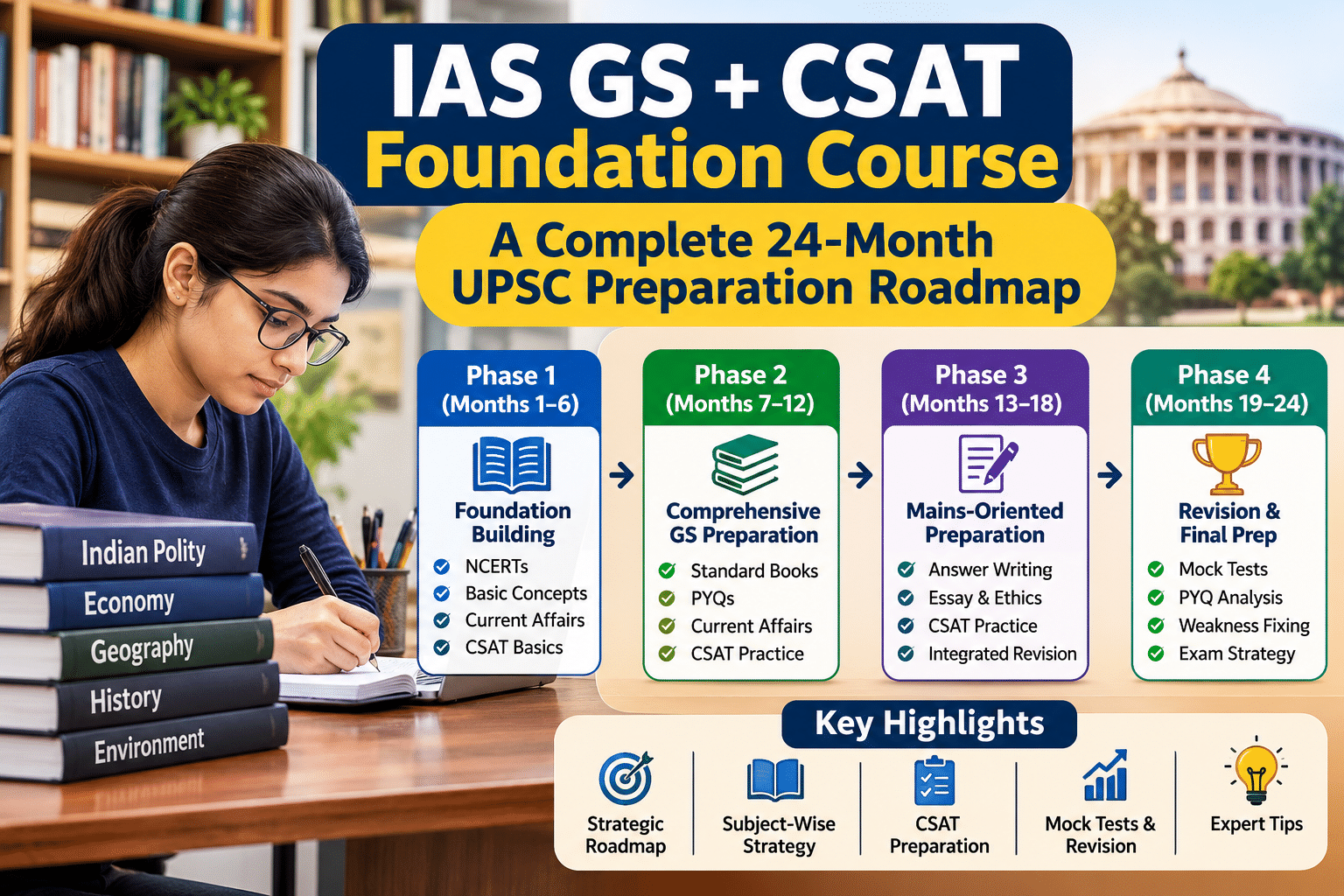
The following roadmap divides the preparation journey into four major phases.
24-month preparation timeline
-
Phase 1: Months 1–6
Foundation buildingNCERTs, basic concepts, introductory GS subjects, newspaper reading and CSAT fundamentals.
-
Phase 2: Months 7–12
Comprehensive GS coverageStandard reference books, detailed syllabus coverage, current affairs integration and PYQs.
-
Phase 3: Months 13–18
Mains-oriented preparationAnswer writing, Essay, Ethics, sectional tests, CSAT practice and integrated revision.
-
Phase 4: Months 19–24
Examination preparationFull-length mock tests, Prelims revision, CSAT qualification practice and targeted Mains preparation.
Phase 1: Months 1–6 – Building a Strong Foundation
The first six months should focus on developing a clear understanding of basic subjects. Beginners should avoid collecting too many books or studying advanced material without understanding the fundamentals.
Major areas of focus:
-
NCERT History, Geography, Polity, Economics and Science.
-
Basic understanding of the Indian Constitution.
-
Introduction to Indian Economy and Geography.
-
Fundamental concepts of Environment and Ecology.
-
Newspaper reading and current affairs note-making.
-
Basic quantitative aptitude and logical reasoning for CSAT.
Recommended approach:
Begin with NCERT textbooks and gradually introduce standard reference materials. Prepare concise notes, understand important concepts and solve basic practice questions after completing each topic.
For CSAT, start with percentages, ratios, averages, number systems, basic reasoning and reading comprehension.
Target: Complete the essential NCERT foundation and develop a consistent daily study routine.
Phase 2: Months 7–12 – Comprehensive General Studies Preparation
Once the foundation is established, aspirants should move towards detailed syllabus coverage.
This phase focuses on standard books, conceptual understanding and connecting static subjects with contemporary developments.
Major areas of focus:
| Subject | Preparation Focus |
|---|---|
| Indian Polity | Constitution, Parliament, Judiciary, Executive, Federalism and Governance |
| History | Ancient, Medieval, Modern India and Freedom Struggle |
| Geography | Physical, Indian and World Geography |
| Economy | Banking, Inflation, Fiscal Policy, Monetary Policy and Economic Development |
| Environment | Biodiversity, Climate Change, Ecology and Environmental Laws |
| Science & Technology | Space, Biotechnology, IT and Emerging Technologies |
| Current Affairs | National, International and Government Initiatives |
Importance of Previous Year Questions (PYQs)
Previous Year Questions help aspirants understand the examination’s demand, question framing and the application of concepts.
Rather than simply memorising answers, candidates should analyse:
-
Why a particular topic was asked.
-
Which syllabus area the question represents.
-
How UPSC frames conceptual and analytical questions.
-
Which static concepts are connected with current developments.
CSAT preparation during this phase:
Practise comprehension passages, logical reasoning, analytical questions, data interpretation and mathematical aptitude regularly.
Target: Complete the first comprehensive coverage of major GS subjects and develop familiarity with UPSC-level questions.
Phase 3: Months 13–18 – Mains Preparation and Answer Writing
This is the stage where preparation should shift from acquiring information to applying knowledge.
The UPSC Mains Examination requires candidates to present well-structured, balanced and analytical answers within a limited time.
Major areas of focus:
-
GS Paper I: Indian Heritage, History, Society and Geography.
-
GS Paper II: Constitution, Governance, Social Justice and International Relations.
-
GS Paper III: Economy, Agriculture, Science and Technology, Environment, Security and Disaster Management.
-
GS Paper IV: Ethics, Integrity and Aptitude.
-
Essay Writing.
-
Optional Subject Preparation.
-
Daily Answer Writing Practice.
How to Improve Mains Answer Writing
Aspirants should gradually develop the ability to write answers that are relevant, structured and supported by appropriate examples.
An effective answer generally includes:
-
Introduction: Establish the context of the question.
-
Main Body: Explain the relevant dimensions with logical arguments.
-
Examples: Include suitable constitutional provisions, government initiatives, reports, case studies or contemporary examples.
-
Conclusion: Present a balanced and constructive way forward.
Candidates should practise writing answers within the prescribed word limits and time constraints.
Importance of Essay Preparation
Essay writing requires conceptual depth, clarity of thought and the ability to connect different dimensions of a topic.
Aspirants should practise essays on social, political, economic, philosophical, environmental and ethical themes.
Target: Develop Mains-oriented thinking, improve answer presentation and complete substantial coverage of the written examination syllabus.
Phase 4: Months 19–24 – Revision, Mock Tests and Examination Readiness
The final six months should focus on consolidating knowledge and improving examination performance.
At this stage, aspirants should avoid unnecessarily expanding their study material. The priority should be revision, testing and identifying knowledge gaps.
Major areas of focus:
-
Multiple revisions of important GS subjects.
-
Topic-wise and full-length Prelims mock tests.
-
CSAT sectional and full-length practice.
-
PYQ analysis and revision.
-
Current Affairs consolidation.
-
Important government reports and schemes.
-
Weak-area identification and correction.
-
Time management and examination strategy.
Prelims Test Strategy
After every mock test, analyse mistakes instead of focusing only on marks.
Classify incorrect responses into:
-
Conceptual mistakes.
-
Factual mistakes.
-
Incorrect question interpretation.
-
Guesswork and elimination errors.
-
Time-management problems.
This approach helps improve accuracy and decision-making.
CSAT Test Strategy
Candidates should practise under actual examination conditions. Time-bound mock tests help improve speed, accuracy and question selection.
Target: Develop examination confidence, improve accuracy and achieve consistent performance in full-length mock tests.
4. Subject-Wise Strategy for UPSC General Studies
A well-organised subject-wise strategy helps aspirants cover the syllabus without losing focus on important areas.
A. History and Indian National Movement
History requires chronological understanding, conceptual clarity and the ability to identify connections between historical developments.
Preparation should include:
-
Ancient Indian History: Indus Valley Civilisation, Vedic Period, Buddhism, Jainism and Mauryan and Gupta Empires.
-
Medieval Indian History: Delhi Sultanate, Mughal Empire, Bhakti and Sufi Movements.
-
Modern Indian History: British Expansion, Revolt of 1857, Socio-Religious Reform Movements and Freedom Struggle.
-
Art and Culture: Architecture, literature, paintings, dance forms and cultural heritage.
Preparation Tip: Prepare timelines, comparative charts and short revision notes. Solve topic-wise PYQs to understand the depth of preparation required.
B. Indian Polity and Governance
Indian Polity is an important component of both Prelims and Mains.
Important topics include:
-
Historical Background and Making of the Constitution.
-
Fundamental Rights and Fundamental Duties.
-
Directive Principles of State Policy.
-
Parliament and State Legislatures.
-
President, Prime Minister and Council of Ministers.
-
Supreme Court and High Courts.
-
Constitutional and Statutory Bodies.
-
Federalism and Centre-State Relations.
-
Panchayati Raj and Urban Local Government.
-
Governance and Public Policy.
Preparation Tip: Focus on constitutional provisions, landmark judgements, institutional functions and contemporary governance issues.
C. Geography
Geography requires a combination of conceptual learning, map practice and analytical understanding.
Important areas include:
-
Physical Geography.
-
Indian Physiography.
-
Climate and Monsoon.
-
Indian Drainage Systems.
-
Soil and Natural Vegetation.
-
Agriculture and Mineral Resources.
-
Population and Human Settlements.
-
World Geography.
-
Oceanography and Climatology.
Preparation Tip: Use maps, diagrams and location-based practice to improve geographical understanding.
D. Indian Economy
Economy preparation should focus on understanding economic concepts and their practical applications.
Important topics include:
-
National Income and GDP.
-
Inflation and Monetary Policy.
-
Banking and Financial Institutions.
-
Fiscal Policy and Budget.
-
Taxation and Public Finance.
-
Employment and Poverty.
-
Agriculture and Industrial Development.
-
External Sector and Balance of Payments.
-
Inclusive and Sustainable Growth.
Preparation Tip: Connect economic theory with the Union Budget, Economic Survey and important policy developments.
E. Environment and Ecology
Environmental topics have growing interdisciplinary relevance across General Studies.
Important topics include:
-
Ecosystems and Biodiversity.
-
National Parks and Wildlife Sanctuaries.
-
Climate Change.
-
Environmental Conventions.
-
Pollution and Waste Management.
-
Conservation Initiatives.
-
Sustainable Development.
Preparation Tip: Link environmental concepts with current developments, international agreements and Indian conservation initiatives.
F. Science and Technology
Candidates should focus on understanding the applications and implications of scientific developments rather than studying technical details beyond the examination requirements.
Important areas include:
-
Space Technology.
-
Biotechnology.
-
Artificial Intelligence.
-
Nanotechnology.
-
Defence Technology.
-
Information Technology.
-
Health and Scientific Innovations.
5. How to Prepare for CSAT Alongside General Studies?
CSAT is often underestimated because it is a qualifying paper. However, failing to secure the minimum qualifying marks can eliminate an otherwise well-prepared candidate.
The most effective approach is to prepare CSAT consistently throughout the two-year foundation programme.
Important CSAT Topics and Preparation Methods
| Topic | Recommended Preparation |
|---|---|
| Reading Comprehension | Daily passage practice |
| Logical Reasoning | Regular reasoning exercises |
| Basic Numeracy | Conceptual learning and numerical practice |
| Data Interpretation | Tables, graphs and charts |
| Analytical Ability | Application-based questions |
| Decision-Making | Situational problem-solving |
A Practical CSAT Preparation Strategy
Step 1: Assess Your Current Level
Attempt a previous year’s CSAT paper to understand your strengths and weaknesses.
Step 2: Strengthen Basic Mathematics
Revise school-level mathematical concepts, including percentages, ratios, averages, profit and loss, time and work, and speed and distance.
Step 3: Develop Reading Comprehension Skills
Read passages regularly and practise identifying the central argument, assumptions and logical conclusions.
Step 4: Practise Logical Reasoning
Solve questions involving sequences, arrangements, analytical reasoning and logical deductions.
Step 5: Attempt Timed Mock Tests
Practise full-length CSAT papers to improve speed, accuracy and question selection.
Important: The qualifying threshold is 33% in CSAT. Aspirants should aim for a comfortable margin rather than preparing only to achieve the minimum score.
6. Daily Study Timetable for UPSC Foundation Aspirants
A disciplined daily routine is essential for completing the syllabus within 24 months. However, the timetable should be realistic and adaptable to the aspirant’s educational or professional commitments.
The following is an illustrative timetable for a full-time aspirant.
| Time | Activity |
|---|---|
| 6:00 AM – 7:00 AM | Newspaper and Current Affairs |
| 7:00 AM – 9:00 AM | General Studies Subject 1 |
| 9:00 AM – 10:00 AM | Break and Revision |
| 10:00 AM – 12:00 PM | Classes / Conceptual Learning |
| 12:00 PM – 1:00 PM | Lunch Break |
| 1:00 PM – 3:00 PM | General Studies Subject 2 |
| 3:00 PM – 4:00 PM | CSAT Practice |
| 4:00 PM – 5:00 PM | Break |
| 5:00 PM – 6:00 PM | Answer Writing / PYQs |
| 6:00 PM – 7:00 PM | Revision and Self-Study |
The timetable can be adjusted according to class schedules, individual learning speed and personal commitments.
For College Students: A minimum of 3–4 focused hours on regular college days, with additional study time during weekends and holidays, can help maintain preparation continuity.
The most important factor is consistency rather than simply counting study hours.
7. Importance of Current Affairs in UPSC Preparation
Current Affairs is an integral component of UPSC preparation. However, reading newspapers without a structured approach can consume considerable time without producing meaningful results.
Aspirants should learn to connect contemporary developments with the static syllabus.
For example:
| Current Development | Related Static Subject |
|---|---|
| Supreme Court Judgement | Indian Polity |
| RBI Monetary Policy | Indian Economy |
| Climate Conference | Environment |
| International Conflict | International Relations |
| Space Mission | Science and Technology |
| Government Welfare Scheme | Social Justice and Governance |
Effective Current Affairs Strategy
-
Read one reliable newspaper consistently.
-
Identify issues relevant to the UPSC syllabus.
-
Prepare short and organised notes.
-
Avoid collecting unnecessary information.
-
Revise monthly current affairs.
-
Practise current affairs-based MCQs.
-
Connect current developments with static concepts.
Aspirants should prioritise understanding an issue, its background, implications, challenges and possible solutions rather than memorising isolated facts.
8. Recommended Books and Study Resources for UPSC Preparation
Choosing appropriate study material is an important part of the preparation journey. Beginners should follow limited and reliable sources instead of continuously changing books.
The following are commonly used resources for UPSC General Studies preparation.
| Subject | Recommended Resources |
|---|---|
| History | NCERTs, Spectrum – Modern India, relevant Ancient and Medieval History resources |
| Geography | NCERTs, G.C. Leong, Atlas |
| Indian Polity | M. Laxmikanth |
| Economy | NCERT Economics, standard economy reference material |
| Environment | Shankar IAS Environment |
| Art and Culture | Nitin Singhania and relevant NCERTs |
| Science and Technology | NCERTs and current affairs |
| Ethics | Relevant GS Paper IV reference material and case studies |
| CSAT | NCERT Mathematics, reasoning practice books and UPSC PYQs |
| Current Affairs | Newspaper, monthly magazines and government publications |
Important: These are suggested resources, not a mandatory reading list. Aspirants should follow a limited set of materials and revise them multiple times.
9. Role of Mock Tests and Previous Year Questions in UPSC Preparation
Mock tests and PYQs play an important role in evaluating preparation quality.
Reading books alone cannot establish whether an aspirant can apply knowledge effectively under examination conditions.
Benefits of Previous Year Questions
-
Understand UPSC’s question-setting approach.
-
Identify recurring conceptual themes.
-
Understand the depth of subject preparation required.
-
Improve elimination techniques.
-
Identify important syllabus areas.
-
Develop an examination-oriented perspective.
Benefits of Mock Tests
-
Improve time management.
-
Develop accuracy and question-selection skills.
-
Identify conceptual weaknesses.
-
Reduce examination anxiety.
-
Evaluate preparation progress.
-
Build confidence under timed conditions.
How Frequently Should Aspirants Attempt Tests?
| Preparation Stage | Suggested Testing Approach |
|---|---|
| Months 1–6 | Topic-wise basic tests |
| Months 7–12 | Subject-wise tests and PYQs |
| Months 13–18 | Sectional GS and Mains tests |
| Months 19–24 | Full-length Prelims and CSAT mocks, along with revision-based assessments |
The frequency should increase as syllabus coverage progresses. Every test must be followed by detailed performance analysis.
10. Common Mistakes to Avoid During Two-Year UPSC Preparation
Even aspirants who dedicate considerable time to UPSC preparation can struggle because of ineffective study habits.
Here are some common mistakes and ways to avoid them.
1. Studying Without Understanding the Syllabus
Many beginners start reading books without understanding the actual examination requirements.
Solution: Keep the official UPSC syllabus accessible and connect every topic with its relevant syllabus heading.
2. Collecting Too Many Books
Continuously switching between different resources leads to incomplete preparation.
Solution: Select limited standard sources and revise them repeatedly.
3. Ignoring CSAT
Treating CSAT as an easy paper can create unnecessary risks during Prelims.
Solution: Practise CSAT regularly from the beginning.
4. Delaying Answer Writing
Waiting until the entire syllabus is completed before starting answer writing can result in insufficient Mains practice.
Solution: Begin with basic answer-writing exercises and gradually increase their complexity.
5. Neglecting Revision
Reading new material without revisiting previously studied topics reduces retention.
Solution: Follow weekly and monthly revision schedules.
6. Avoiding Mock Test Analysis
Attempting multiple tests without analysing mistakes does not necessarily improve performance.
Solution: Maintain a mistake notebook and revise weak topics.
7. Following Unrealistic Timetables
Excessively demanding schedules can lead to inconsistency and burnout.
Solution: Develop a practical timetable with adequate revision and breaks.
11. Why Choose ENSURE IAS for UPSC Foundation Preparation?
Choosing the right guidance and preparation environment can make the UPSC journey more structured and manageable.
ENSURE IAS, under the guidance of Sachin Jain Sir (IRS 2016), focuses on building a systematic preparation approach for aspirants targeting the Civil Services Examination.
A comprehensive foundation programme should focus not only on completing the syllabus but also on developing the skills required to perform effectively in Prelims and Mains.
The important components of guided preparation include:
-
Conceptual Clarity: Understand fundamental concepts before moving towards advanced topics.
-
Structured GS Preparation: Follow a systematic approach to completing the General Studies syllabus.
-
CSAT Preparation: Develop aptitude, reasoning, comprehension and numerical ability through regular practice.
-
Current Affairs Integration: Connect contemporary developments with static subjects.
-
PYQ-Based Learning: Understand UPSC’s examination trends and question patterns.
-
Answer Writing Practice: Develop analytical thinking, answer structure and presentation.
-
Regular Assessment: Evaluate preparation through tests and performance analysis.
-
Mentorship and Guidance: Identify weaknesses, improve study strategies and maintain preparation discipline.
The objective should be to help aspirants become independent learners who can understand, analyse and apply knowledge rather than simply memorise information.
Explore UPSC preparation resources and programmes at ENSURE IAS:
Website
12. Who Should Start a 24-Month UPSC Foundation Programme?
A two-year foundation strategy can be particularly useful for aspirants who want to develop their preparation gradually.
It is suitable for:
1. College Students
Students pursuing graduation can begin their UPSC preparation alongside their academic studies and gradually build subject knowledge.
2. Beginners
Candidates with no previous UPSC preparation experience can start with NCERTs and basic concepts.
3. First-Time Aspirants
Candidates targeting their first serious attempt can use the available preparation period for systematic learning and practice.
4. Working Professionals
Individuals balancing employment and preparation can follow a structured timetable with realistic daily study targets.
5. Aspirants Who Need Academic Guidance
Candidates who struggle with resource selection, syllabus planning, revision and answer writing can benefit from systematic mentorship and regular evaluation.
13. How to Measure Your Progress During the 24-Month Journey?
Preparation should be measured through learning outcomes rather than the number of books completed or hours spent studying.
A monthly progress review can help aspirants identify gaps and make necessary changes.
Consider evaluating these parameters:
-
Completion of planned syllabus topics.
-
Understanding of fundamental concepts.
-
Performance in subject-wise tests.
-
Improvement in CSAT accuracy.
-
Quality of answer writing.
-
Current affairs retention.
-
Number of revisions completed.
-
Performance in full-length mock examinations.
Aspirants should maintain a preparation tracker and review it regularly. This helps convert a broad two-year target into measurable monthly and weekly goals.
14. Final Preparation Strategy: Consistency, Revision and Self-Evaluation
UPSC preparation is a long-term commitment that requires patience, discipline and continuous improvement.
A 24-month preparation roadmap provides an opportunity to understand the syllabus, build conceptual foundations, develop analytical skills and practise examination-oriented questions.
However, the success of this strategy depends on how effectively aspirants use their preparation time.
Remember these five principles:
-
Understand Before Memorising: Focus on conceptual clarity rather than rote learning.
-
Follow Limited Resources: Avoid unnecessary changes in books and study material.
-
Prepare GS and CSAT Together: Give adequate attention to both Prelims papers.
-
Practise and Revise Regularly: Learning without revision and assessment is incomplete.
-
Stay Consistent: Maintain a realistic study routine and evaluate progress periodically.
With the right strategy, appropriate guidance and sustained effort, aspirants can make their UPSC preparation more organised, focused and effective.
Frequently Asked Questions (FAQs)
1. Is 24 months enough to prepare for the UPSC Civil Services Examination?
Yes. Twenty-four months can provide sufficient preparation time for many aspirants to build conceptual foundations, cover the syllabus, practise answer writing, prepare CSAT and revise systematically. The outcome depends on consistency, preparation quality and individual learning requirements.
2. Can beginners start UPSC preparation directly after Class 12?
Yes. Students can begin by studying NCERT textbooks, developing reading habits and understanding basic subjects. However, candidates must meet UPSC’s prescribed educational qualification and other eligibility conditions when applying for the examination.
3. What is the difference between GS and CSAT in UPSC Prelims?
General Studies Paper I determines the Prelims cutoff, whereas CSAT (Paper II) is qualifying in nature. Candidates must secure at least 33% marks in CSAT to qualify.
4. Is CSAT difficult for students from a non-mathematics background?
Not necessarily. CSAT includes comprehension, reasoning, analytical ability, basic numeracy and data interpretation. Candidates from non-mathematics backgrounds can improve through regular conceptual learning and timed practice.
5. When should I start answer writing for UPSC Mains?
Aspirants can begin basic answer-writing practice once they develop an understanding of the fundamental subjects. Gradually, they should progress towards syllabus-based questions, PYQs and timed sectional tests.
6. How many hours should I study daily for UPSC preparation?
There is no fixed number of study hours applicable to everyone. Full-time aspirants may begin with 6–8 focused hours and gradually adjust according to their preparation requirements. Consistency and learning quality are more important than simply increasing study hours.
7. Is newspaper reading necessary for UPSC preparation?
Yes. Newspaper reading helps aspirants understand national and international developments, governance, economic issues and social challenges. However, reading should be selective and connected with the UPSC syllabus.
8. How important are Previous Year Questions for UPSC?
PYQs are extremely useful for understanding the examination pattern, question framing, conceptual requirements and topic relevance. Aspirants should solve and analyse them regularly during both Prelims and Mains preparation.
9. Can I prepare for UPSC while pursuing graduation?
Yes. College students can begin foundation preparation alongside graduation. Starting early allows them to build conceptual understanding and develop a consistent preparation routine without waiting until graduation is completed.
10. Which subjects should beginners study first for UPSC?
Beginners can start with NCERT History, Geography, Polity and Economics. These subjects establish the conceptual foundation required for advanced General Studies preparation.
11. Should UPSC Prelims and Mains preparation be done separately?
No. Although Prelims and Mains have different examination formats, their syllabi overlap significantly. An integrated preparation strategy helps aspirants develop conceptual understanding for Prelims and analytical skills for Mains.
12. How can I improve my UPSC preparation performance?
Follow the official syllabus, use limited study resources, practise PYQs, attempt mock tests, revise regularly and analyse your mistakes. Periodic self-evaluation helps improve preparation quality.