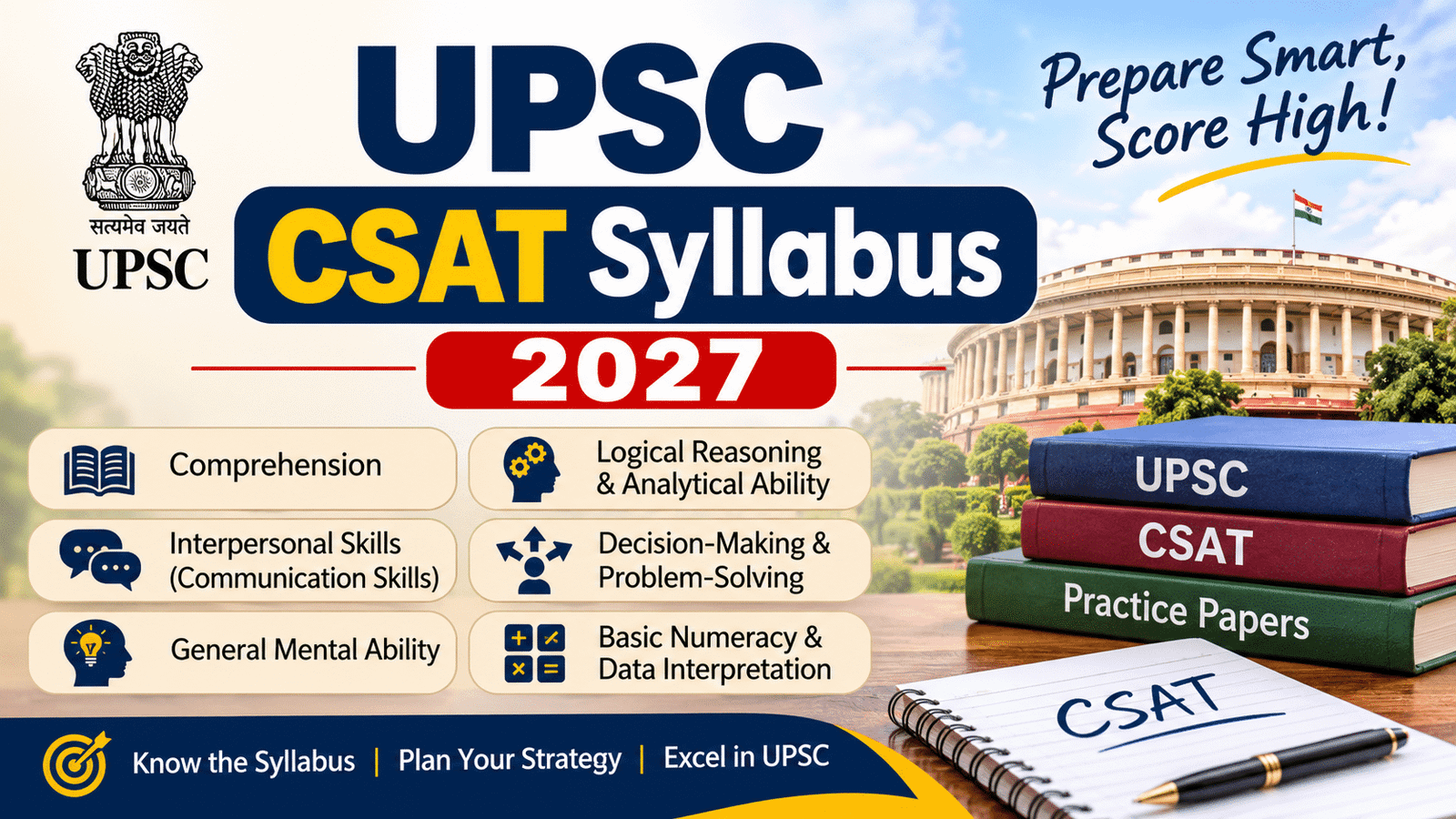
The UPSC CSAT Syllabus 2027 is an important component of the Civil Services Preliminary Examination. CSAT, or the Civil Services Aptitude Test, is conducted as General Studies Paper II to evaluate candidates’ comprehension, logical reasoning, analytical ability, decision-making skills and basic numeracy.
Although CSAT is qualifying in nature, candidates cannot ignore it during their UPSC preparation. A candidate must secure at least 33% marks in this paper to qualify for the next stage of the Civil Services Examination. Even candidates with strong General Studies knowledge can fail to clear Prelims if they do not meet the minimum CSAT qualifying requirement.
The UPSC CSAT paper covers six broad areas in the official syllabus, which can be further divided into practical preparation areas such as comprehension, quantitative aptitude, logical reasoning, analytical ability and data interpretation.
For UPSC CSE 2027 aspirants, understanding the complete syllabus, examination pattern, negative marking and question types is essential for developing an effective preparation strategy.
In this article, ENSURE IAS explains the complete UPSC CSAT Syllabus 2027, including topic-wise Maths and Reasoning, exam pattern, qualifying marks, recommended books, previous year questions and preparation tips.
What is the UPSC CSAT Examination?
CSAT stands for Civil Services Aptitude Test. It was introduced in 2011 as General Studies Paper II of the UPSC Civil Services Preliminary Examination.
The primary purpose of CSAT is to assess the aptitude and problem-solving abilities of candidates aspiring to join India’s Civil Services.
Unlike General Studies Paper I, which focuses on subjects such as History, Geography, Polity, Economy and Environment, CSAT evaluates a candidate’s ability to understand information, interpret data, solve numerical problems and apply logical reasoning.
CSAT is a compulsory paper in UPSC Prelims. However, it is qualifying in nature, which means its marks are not added to the Prelims cut-off or final merit list.
Candidates must secure a minimum of 33% marks in CSAT to qualify.
UPSC CSAT Syllabus 2027: Overview
The following table provides an overview of the CSAT examination based on the latest available official CSE 2026 notification.
| Particulars | Details |
|---|---|
| Examination | UPSC Civil Services Preliminary Examination |
| Paper | General Studies Paper II |
| Full Form | Civil Services Aptitude Test |
| Total Marks | 200 |
| Qualifying Marks | 33% |
| Minimum Qualifying Score | 66.67 marks |
| Question Type | Objective (Multiple Choice Questions) |
| Duration | 2 Hours |
| Examination Mode | Offline |
| Negative Marking | One-third of marks assigned to the question |
| Language | Hindi and English |
| Nature | Qualifying |
| Marks Counted in Final Merit | No |
Note: The 2026 examination paper contained 80 questions, carrying 2.5 marks each. UPSC’s official syllabus notification specifies the marks and duration but does not guarantee a fixed number of questions for future examinations. Candidates should verify the 2027 notification when released.
UPSC CSAT Syllabus 2027: Official Topics
According to the UPSC Civil Services Examination notification, General Studies Paper II covers the following six broad areas:
- Comprehension.
- Interpersonal skills including communication skills.
- Logical reasoning and analytical ability.
- Decision-making and problem-solving.
- General mental ability.
- Basic numeracy and data interpretation (Class X level).
For preparation purposes, these areas can be divided into seven practical sections:
- Reading Comprehension.
- Interpersonal and Communication Skills.
- Logical Reasoning.
- Analytical Ability.
- Decision-Making and Problem-Solving.
- Basic Numeracy and Quantitative Aptitude.
- Data Interpretation and Data Sufficiency.
Let’s understand each section in detail.
1. Reading Comprehension
Reading Comprehension is an important part of the UPSC CSAT examination. It evaluates a candidate’s ability to understand written information, identify the central idea, interpret arguments and draw logical conclusions from a passage.
Candidates are provided with passages followed by multiple-choice questions. The answers generally require careful reading and an understanding of the information presented in the passage.
Important Topics in Reading Comprehension
- Main idea and central theme.
- Identification of the author’s argument.
- Inference-based questions.
- Logical conclusions.
- Assumptions made in a passage.
- Strengthening and weakening of arguments.
- Tone and attitude of the author.
- Meaning of words and phrases in context.
- Fact-based questions.
- Statement-based questions.
- Critical evaluation of arguments.
- Identifying the most appropriate conclusion.
How to Prepare for Reading Comprehension?
Candidates should develop a habit of reading passages carefully and understanding the author’s central argument.
Instead of reading a passage repeatedly, try to identify:
- What is the main subject of the passage?
- What argument is the author presenting?
- What information is explicitly mentioned?
- What can logically be inferred?
- Which options go beyond the information provided?
One of the most important rules in CSAT comprehension is to avoid selecting an answer based only on personal knowledge or assumptions. The answer should be supported by the passage.
Regular practice with previous year UPSC questions can help improve accuracy and reading speed.
2. Interpersonal Skills and Communication Skills
Interpersonal skills refer to the ability to interact effectively with other individuals and understand different perspectives.
The official UPSC syllabus includes interpersonal skills, including communication skills. However, it does not provide a detailed subtopic-wise list or a prescribed weightage for this area.
For preparation purposes, candidates should understand concepts related to:
- Effective communication.
- Verbal and non-verbal communication.
- Listening skills.
- Understanding different perspectives.
- Conflict resolution.
- Cooperation and teamwork.
- Social interaction.
- Communication barriers.
- Decision-making in interpersonal situations.
Candidates should focus on understanding the basic concepts rather than treating every topic as a separately guaranteed question area.
3. Logical Reasoning and Analytical Ability
Logical reasoning and analytical ability evaluate a candidate’s capacity to understand relationships, recognise patterns, interpret statements and reach logical conclusions.
This section requires conceptual understanding and regular problem-solving practice.
Important Topics in Logical Reasoning
A. Verbal Reasoning
- Analogy.
- Classification.
- Coding and Decoding.
- Blood Relations.
- Direction and Distance.
- Ranking and Ordering.
- Alphabet and Number Series.
- Statement and Conclusion.
- Statement and Assumption.
- Statement and Argument.
- Cause and Effect.
- Syllogism.
- Logical Venn Diagrams.
- Seating Arrangement.
- Puzzle-Based Questions.
- Calendar and Clock Problems.
B. Analytical Reasoning
- Arrangement-based problems.
- Linear and Circular Arrangements.
- Logical Puzzles.
- Conditional Reasoning.
- Data Sufficiency.
- Sequence and Order.
- Deductive Reasoning.
- Inductive Reasoning.
- Pattern Recognition.
- Logical Relationships.
- Analytical Decision Problems.
C. Non-Verbal Reasoning
- Figure Series.
- Figure Classification.
- Mirror Images.
- Water Images.
- Paper Folding and Cutting.
- Cube and Dice Problems.
- Visual Pattern Recognition.
These are useful preparation categories, not a separate exhaustive official UPSC topic list.
How to Prepare for Logical Reasoning?
Candidates should understand the basic rules and methods used to solve different reasoning problems.
A useful preparation approach is:
- Begin with basic reasoning concepts.
- Understand the logic behind each question.
- Practise questions of increasing difficulty.
- Solve UPSC Previous Year Questions.
- Analyse incorrect answers.
- Develop methods to solve questions within a limited time.
Candidates should prioritise logical understanding rather than memorising shortcuts without understanding the underlying concept.
4. Decision-Making and Problem-Solving
Decision-making and problem-solving assess a candidate’s ability to evaluate situations, identify possible solutions and select an appropriate course of action.
These skills are relevant to administrative responsibilities, where civil servants may have to make decisions involving public welfare, limited resources and competing interests.
Important Areas for Preparation
- Situation-based questions.
- Problem identification.
- Evaluation of alternatives.
- Prioritisation of actions.
- Ethical decision-making.
- Resource allocation.
- Conflict resolution.
- Risk assessment.
- Practical problem-solving.
- Choosing appropriate administrative responses.
How to Approach Decision-Making Questions?
Candidates should carefully analyse the situation before selecting an answer.
A systematic approach involves:
- Identifying the actual problem.
- Understanding the people or stakeholders involved.
- Evaluating the available alternatives.
- Considering the consequences of each option.
- Selecting a practical and appropriate solution.
The objective should be to understand the problem logically and avoid emotionally driven or impractical responses.
5. General Mental Ability
General Mental Ability evaluates a candidate’s ability to solve mathematical, logical and analytical problems.
It covers a range of aptitude-based questions that require numerical understanding, logical thinking and the application of basic mathematical concepts.
Important Topics in General Mental Ability
- Number Series.
- Missing Number.
- Numerical Patterns.
- Mathematical Operations.
- Number Relationships.
- Basic Arithmetic.
- Quantitative Reasoning.
- Logical Sequences.
- Numerical Comparisons.
- Mathematical Puzzles.
- Pattern Recognition.
Candidates should develop strong fundamentals and practise different types of questions to improve their calculation speed and accuracy.
6. Basic Numeracy and CSAT Maths Syllabus 2027
Basic Numeracy is one of the most important areas of CSAT preparation, particularly for candidates who are uncomfortable with Mathematics.
According to the official UPSC syllabus, Basic Numeracy covers numbers and their relations, orders of magnitude and other mathematical concepts at the Class X level.
Topic-Wise CSAT Maths Syllabus
| Topic | Important Subtopics |
|---|---|
| Number System | Natural numbers, whole numbers, integers, prime and composite numbers |
| LCM and HCF | Factors, multiples, divisibility |
| Percentage | Percentage increase, decrease and comparison |
| Ratio and Proportion | Direct and inverse proportion |
| Average | Simple and weighted averages |
| Profit and Loss | Cost price, selling price, discount |
| Simple Interest | Principal, rate and time |
| Compound Interest | Compounding and growth |
| Time and Work | Efficiency, work distribution |
| Pipes and Cisterns | Filling and emptying tanks |
| Time, Speed and Distance | Relative speed, average speed |
| Trains | Train crossing and relative motion |
| Boats and Streams | Upstream and downstream |
| Mixtures and Alligation | Mixture ratios and replacement |
| Partnership | Investment and profit sharing |
| Mensuration | Area, perimeter, surface area and volume |
| Geometry | Basic geometrical concepts |
| Algebra | Equations and basic algebraic operations |
| Probability | Basic probability concepts |
| Permutation and Combination | Arrangements and selections |
| Data Sufficiency | Evaluating whether given information is sufficient |
The above topics form a practical preparation framework. UPSC does not publish a separate exhaustive chapter-wise Mathematics syllabus or assign fixed marks to each topic.
Important Mathematical Concepts for CSAT
1. Number System
The number system is the foundation of quantitative aptitude.
Candidates should understand:
- Natural numbers.
- Whole numbers.
- Integers.
- Rational and irrational numbers.
- Prime and composite numbers.
- Divisibility rules.
- Remainders.
- Factors and multiples.
2. Percentage
Percentage questions involve comparing quantities and calculating changes in values.
Important concepts include:
- Percentage conversion.
- Percentage increase.
- Percentage decrease.
- Successive percentage changes.
- Population growth.
- Price changes.
3. Ratio and Proportion
Ratio and proportion are used to compare quantities and solve problems involving relationships between numbers.
Important concepts include:
- Simplification of ratios.
- Equivalent ratios.
- Direct proportion.
- Inverse proportion.
- Compound ratios.
- Distribution of quantities.
4. Average
Average questions evaluate the ability to calculate central values from a given set of observations.
Important concepts include:
- Arithmetic mean.
- Weighted average.
- Combined average.
- Average age.
- Average speed.
5. Profit and Loss
This topic focuses on commercial calculations involving buying and selling prices.
Important concepts include:
- Cost Price (CP).
- Selling Price (SP).
- Profit percentage.
- Loss percentage.
- Discount.
- Marked Price.
6. Time and Work
Time and Work questions assess the relationship between work completed, time taken and individual efficiency.
Important concepts include:
- Work efficiency.
- Combined work.
- Individual work.
- Work distribution.
- Pipes and cisterns.
7. Time, Speed and Distance
This topic evaluates the relationship between distance, speed and time.
Important concepts include:
- Average speed.
- Relative speed.
- Trains.
- Boats and streams.
- Meeting and crossing problems.
7. Data Interpretation and Data Sufficiency
Data Interpretation involves analysing numerical information presented in different formats, such as tables, graphs and charts.
Data Sufficiency evaluates whether the information provided in a question is adequate to answer it.
Both are explicitly mentioned in the official UPSC CSAT syllabus under Basic Numeracy.
Important Topics in Data Interpretation
- Tabular Data.
- Bar Graphs.
- Line Graphs.
- Pie Charts.
- Mixed Graphs.
- Data Comparison.
- Percentage-Based Interpretation.
- Ratio-Based Interpretation.
- Average-Based Interpretation.
- Data Sufficiency.
- Numerical Analysis.
Important Topics in Data Sufficiency
- Evaluating given statements.
- Identifying sufficient information.
- Identifying insufficient information.
- Combining multiple statements.
- Applying logical and numerical reasoning.
How to Prepare for Data Interpretation?
Candidates should practise interpreting data without spending excessive time on calculations.
A good approach includes:
- Understanding the question before examining all the data.
- Identifying relevant figures.
- Comparing values carefully.
- Using percentage and ratio concepts.
- Avoiding unnecessary calculations.
- Checking units and numerical relationships.
Regular practice can improve both calculation speed and accuracy.
UPSC CSAT Exam Pattern 2027
Understanding the examination pattern is essential before beginning CSAT preparation.
Based on the latest available official examination rules, CSAT is conducted as General Studies Paper II of the Preliminary Examination.
CSAT Exam Pattern
| Particulars | Details |
|---|---|
| Paper | General Studies Paper II |
| Total Marks | 200 |
| Duration | 2 Hours |
| Question Type | Multiple Choice Questions |
| Examination Mode | Offline |
| Qualifying Percentage | 33% |
| Qualifying Marks | 66.67 |
| Negative Marking | One-third of marks assigned to the question |
| Language | Hindi and English |
The 2026 CSAT question paper contained 80 questions. Each question carried 2.5 marks.
Negative Marking in UPSC CSAT
UPSC follows a negative marking system in the CSAT examination.
For every incorrect answer, one-third of the marks assigned to that question are deducted.
For a question carrying 2.5 marks:
- Correct answer: +2.5 marks.
- Incorrect answer: Approximately -0.83 marks.
- Unanswered question: No negative marking.
For example, if a candidate answers 50 questions correctly and 10 questions incorrectly, the score would be:
Correct answers = 50 × 2.5 = 125 marks.
Incorrect answers = 10 × 0.833 = 8.33 marks deducted.
Final score = 125 – 8.33 = 116.67 marks.
Candidates should avoid blind guessing because incorrect answers can reduce their overall score.
UPSC CSAT Qualifying Marks 2027
CSAT is a qualifying paper, and candidates must secure at least 33% marks to qualify.
The minimum qualifying score is:
[
200 \times \frac{33}{100} = 66
]
However, the official qualifying threshold is commonly expressed as 66.67 marks out of 200.
Candidates should aim to score comfortably above the qualifying threshold rather than targeting only the minimum required marks.
Is CSAT Compulsory for UPSC Prelims?
Yes. CSAT is compulsory for all candidates appearing in the UPSC Civil Services Preliminary Examination.
Candidates must appear in both General Studies Paper I and General Studies Paper II.
Even if a candidate scores very high marks in GS Paper I, they will not qualify for Mains if they fail to secure the minimum qualifying marks in CSAT.
Are CSAT Marks Added to the UPSC Final Merit List?
No. CSAT marks are not included in the final merit calculation.
The marks obtained in CSAT are considered only to determine whether a candidate has fulfilled the qualifying requirement for the Preliminary Examination.
The GS Paper I score determines the Prelims cut-off, provided the candidate also qualifies in CSAT.
Difference Between UPSC GS Paper I and CSAT Paper II
Both papers are part of the Preliminary Examination, but they evaluate different abilities.
| Basis | GS Paper I | CSAT Paper II |
|---|---|---|
| Paper Name | General Studies | Civil Services Aptitude Test |
| Total Marks | 200 | 200 |
| Duration | 2 Hours | 2 Hours |
| Nature | Merit for Prelims Screening | Qualifying |
| Questions | 100 in the 2026 paper | 80 in the 2026 paper |
| Major Subjects | History, Polity, Geography, Economy, Environment, Current Affairs and Science | Comprehension, Reasoning, Aptitude, Numeracy and Data Interpretation |
| Qualifying Requirement | Category-wise cut-off | Minimum 33% |
| Final Merit Contribution | No | No |
The major difference is that GS Paper I determines the Prelims cut-off, while CSAT is used to assess whether candidates meet the minimum aptitude requirement.
UPSC CSAT Previous Year Question Papers
Previous Year Question Papers (PYQs) are among the most useful resources for CSAT preparation.
They help candidates understand the examination’s question patterns, difficulty level and the way UPSC tests comprehension, reasoning and mathematical concepts.
Candidates should practise previous year papers from at least the last 10 years, wherever available.
Why Are CSAT PYQs Important?
1. Understanding the Examination Pattern
PYQs help candidates understand how UPSC frames questions and tests different aptitude skills.
2. Identifying Weak Areas
Solving previous papers helps identify areas where candidates make repeated mistakes.
3. Improving Time Management
Timed practice helps candidates develop an effective question-selection strategy.
4. Understanding Question Difficulty
Candidates can become familiar with different levels of comprehension, reasoning and numerical problems.
5. Improving Accuracy
Analysing incorrect answers helps candidates understand the reason behind mistakes and avoid repeating them.
Candidates can download official question papers from the <a href=”https://upsc.gov.in/examinations/previous-question-papers” target=”_blank” rel=”noopener”>UPSC Previous Question Papers section</a>.
How to Prepare for UPSC CSAT 2027?
A successful CSAT preparation strategy should focus on conceptual clarity, regular practice, time management and accuracy.
Candidates should not assume that CSAT is easy simply because it is a qualifying paper.
The difficulty of the examination varies, and the level of preparation required depends on the candidate’s aptitude and existing mathematical and reasoning skills.
1. Understand the Complete CSAT Syllabus
Start by reading the official syllabus and identifying all the topics.
Divide the syllabus into three major preparation areas:
- Comprehension.
- Mathematics and Basic Numeracy.
- Logical Reasoning and Analytical Ability.
This division makes preparation more organised and helps candidates monitor their progress.
2. Assess Your Current Preparation Level
Before starting detailed preparation, attempt a previous year CSAT question paper under actual examination conditions.
Analyse your performance in:
- Reading Comprehension.
- Quantitative Aptitude.
- Logical Reasoning.
- Data Interpretation.
This will help identify whether you need more attention on Mathematics, Comprehension or Reasoning.
3. Build Strong Mathematical Fundamentals
Candidates who are weak in Mathematics should begin with basic concepts before attempting advanced questions.
Focus on:
- Number System.
- Percentage.
- Ratio and Proportion.
- Average.
- Profit and Loss.
- Time and Work.
- Time, Speed and Distance.
- Data Interpretation.
Practise questions gradually, starting from basic to examination-level difficulty.
4. Practise Reading Comprehension Regularly
Reading Comprehension should be practised consistently.
Read passages carefully and try to identify the central argument, author’s intention and logical implications.
Do not depend entirely on shortcuts or assumptions while solving comprehension questions.
5. Solve Previous Year Questions
Previous Year Questions should form an important part of CSAT preparation.
Practise questions topic-wise before attempting complete papers.
Once your fundamentals improve, start solving full-length CSAT papers within the prescribed two-hour duration.
6. Attempt Regular Mock Tests
Mock tests help candidates assess their preparation under time constraints.
Aspirants should practise full-length tests and analyse:
- Total attempted questions.
- Correct answers.
- Incorrect answers.
- Unattempted questions.
- Time spent on each section.
- Accuracy percentage.
The objective is to improve performance while maintaining accuracy.
7. Develop a Question Selection Strategy
Candidates do not need to attempt every question to qualify in CSAT.
They should identify questions that can be solved accurately within a reasonable amount of time.
A practical approach is to:
- Attempt familiar and manageable questions first.
- Avoid spending too much time on difficult calculations.
- Return to lengthy questions later.
- Avoid blind guessing.
- Reserve time for checking marked responses.
8. Revise Regularly
Revision is essential for retaining mathematical formulas, reasoning methods and important concepts.
Maintain a short notebook containing:
- Important mathematical formulas.
- Common calculation methods.
- Reasoning concepts.
- Frequently repeated mistakes.
- Difficult question types.
Regular revision helps improve speed and confidence.
UPSC CSAT 2027: Recommended Books and Study Resources
Selecting appropriate study material is important for systematic preparation.
Candidates should avoid collecting too many books and focus on a limited number of reliable resources.
| Book / Resource | Purpose |
|---|---|
| NCERT Mathematics Class 6–10 | Basic mathematical concepts |
| Quantitative Aptitude by R.S. Aggarwal | Arithmetic and quantitative practice |
| Verbal and Non-Verbal Reasoning by R.S. Aggarwal | Reasoning fundamentals |
| Previous Year UPSC CSAT Papers | Understanding actual UPSC questions |
| UPSC Official Syllabus | Understanding the prescribed topics |
| CSAT Mock Test Papers | Timed practice and performance evaluation |
Important: Books should supplement the official syllabus and PYQ-based preparation. Candidates should prioritise UPSC-level questions rather than spending excessive time on unrelated competitive examination material.
UPSC CSAT 2027: 30-Day Preparation Strategy
Candidates who have limited time can follow a structured 30-day revision and practice plan.
The following plan is suitable for aspirants who already have basic familiarity with Mathematics and Reasoning.
| Days | Topics to Cover | Preparation Focus |
|---|---|---|
| Day 1–5 | Number System, Percentage, Ratio and Average | Mathematical fundamentals |
| Day 6–10 | Profit and Loss, Time and Work, Speed and Distance | Arithmetic practice |
| Day 11–14 | Logical Reasoning and Analytical Ability | Reasoning questions |
| Day 15–18 | Reading Comprehension | Passage-based questions |
| Day 19–21 | Data Interpretation and Data Sufficiency | Charts, tables and graphs |
| Day 22–25 | Previous Year Questions | Topic-wise revision |
| Day 26–28 | Full-Length Mock Tests | Time management |
| Day 29–30 | Revision and Error Analysis | Final preparation |
Candidates who are weak in Mathematics or have not studied CSAT before should begin preparation earlier instead of depending entirely on a 30-day revision plan.
Common Mistakes to Avoid in UPSC CSAT Preparation
Many candidates underestimate CSAT because it is qualifying in nature. This can create unnecessary difficulties during the Preliminary Examination.
Some common mistakes include:
- Ignoring CSAT until the last few weeks before Prelims.
- Assuming that a non-mathematics background means CSAT cannot be cleared.
- Practising only Mathematics while neglecting Comprehension.
- Ignoring Logical Reasoning and Data Interpretation.
- Not solving previous year question papers.
- Attempting too many questions without considering negative marking.
- Spending excessive time on one difficult question.
- Taking mock tests without analysing mistakes.
- Memorising formulas without understanding their applications.
- Targeting only the minimum qualifying score without maintaining a safety margin.
A balanced preparation strategy can help candidates avoid these mistakes and improve their chances of qualifying.
How ENSURE IAS Helps Aspirants Prepare for UPSC CSAT
CSAT preparation requires consistent practice, proper assessment and conceptual clarity.
At ENSURE IAS, aspirants are guided through a structured UPSC preparation approach that focuses on examination requirements, regular assessment and individual improvement.
Under the guidance of Sachin Jain Sir (IRS 2016), ENSURE IAS provides preparation programmes designed for different stages of the Civil Services Examination.
Sachin Jain Sir has cleared all six UPSC Prelims examinations and secured final selections twice, with AIR 712 in CSE 2015 and AIR 286 in CSE 2016.
PRE-SURE Programme
The PRE-SURE programme is designed to help candidates strengthen their Preliminary Examination preparation.
Key features include:
- Structured Prelims preparation.
- Monthly targets and study planning.
- GS and CSAT-focused assessment.
- Previous Year Question-based practice.
- Regular performance monitoring.
- Personalised mentorship and guidance.
SELECTION-SURE Programme
SELECTION-SURE provides an integrated preparation approach covering both Prelims and Mains.
It combines Prelims preparation, GS and CSAT assessment, Mains answer-writing practice, test series and mentorship.
Personal Mentorship by Sachin Jain Sir
The Personal Mentorship Programme includes Selection-SURE along with weekly one-to-one interaction with Sachin Jain Sir.
It is designed to provide individual guidance, preparation planning and regular progress assessment.
Start your UPSC preparation with a structured strategy at ENSURE IAS.
Website: https://www.ensureias.com/
Contact: 7900-44-7900
Address: Near Karol Bagh Metro Gate No. 8, Pusa Road, New Delhi.
Conclusion
The UPSC CSAT Syllabus 2027 focuses on evaluating a candidate’s aptitude, comprehension, logical reasoning, analytical ability, decision-making and numerical skills.
Although CSAT is qualifying in nature, it remains a compulsory component of the Civil Services Preliminary Examination. Candidates must secure at least 33% marks to qualify for Mains.
Aspirants should begin by understanding the official syllabus, assessing their current preparation level and developing strong fundamentals in Mathematics, Reasoning and Comprehension.
Regular practice of Previous Year Questions, mock tests, revision and time management can significantly improve performance.
The most effective approach is to treat CSAT as an integral part of UPSC preparation rather than leaving it until the final stage.
Prepare consistently, practise strategically and make CSAT a strength in your UPSC journey with ENSURE IAS.
Frequently Asked Questions (FAQs) on UPSC CSAT Syllabus 2027
Q1. What is the UPSC CSAT Syllabus 2027?
The UPSC CSAT Syllabus 2027 covers Comprehension, Interpersonal Skills including Communication Skills, Logical Reasoning and Analytical Ability, Decision-Making and Problem-Solving, General Mental Ability, Basic Numeracy and Data Interpretation. It is conducted as General Studies Paper II of the Preliminary Examination.
Q2. Is CSAT compulsory for UPSC Prelims 2027?
Yes. CSAT is compulsory for all candidates appearing in the UPSC Civil Services Preliminary Examination. Candidates must appear in both General Studies Paper I and General Studies Paper II and secure the minimum qualifying marks in CSAT.
Q3. How many marks are required to qualify for UPSC CSAT?
Candidates must secure at least 33% marks in CSAT. Since the paper carries 200 marks, the qualifying threshold is 66.67 marks.
Q4. Is there negative marking in the UPSC CSAT examination?
Yes. UPSC deducts one-third of the marks assigned to a question for every incorrect answer. For a question carrying 2.5 marks, approximately 0.83 marks are deducted for an incorrect response.
Q5. How many questions are asked in the UPSC CSAT paper?
The 2026 CSAT question paper contained 80 multiple-choice questions carrying 2.5 marks each. However, UPSC does not guarantee a fixed number of questions in its official syllabus, so candidates should check the examination booklet and notification for their examination year.
Q6. Is Mathematics compulsory in UPSC CSAT?
Mathematics is included in the CSAT syllabus under Basic Numeracy and General Mental Ability. Candidates must prepare the prescribed aptitude topics, but there is no separate minimum qualifying score for Mathematics alone.
Q7. Can a candidate clear UPSC CSAT without Mathematics?
Yes. Candidates can qualify through a balanced performance across Comprehension, Logical Reasoning, Analytical Ability and Numerical Aptitude. However, they should not ignore Basic Numeracy because it is part of the official syllabus.
Q8. Are CSAT marks counted in the UPSC final merit list?
No. CSAT is qualifying in nature. Its marks are not added to the Preliminary Examination cut-off or the final merit list. Candidates only need to meet the prescribed qualifying requirement.
Q9. Which books are best for UPSC CSAT preparation?
NCERT Mathematics textbooks from Classes 6 to 10, Quantitative Aptitude by R.S. Aggarwal, Verbal and Non-Verbal Reasoning by R.S. Aggarwal and UPSC Previous Year CSAT Papers are useful preparation resources.
Q10. How many months are required to prepare for UPSC CSAT?
Preparation time depends on a candidate’s existing aptitude and mathematical ability. Candidates with strong fundamentals may need a few weeks of focused practice, whereas those with weak mathematical or reasoning skills should start several months before Prelims.
Q11. What is the difference between UPSC GS Paper I and CSAT Paper II?
GS Paper I tests General Studies knowledge and determines the Prelims cut-off. CSAT Paper II evaluates comprehension, reasoning, analytical ability and numerical aptitude. CSAT is qualifying in nature and requires at least 33% marks.
Q12. Where can I download the official UPSC CSAT syllabus and previous year question papers?
Candidates can download the official examination notification and previous year question papers from the UPSC website at https://upsc.gov.in/. The notification contains the prescribed syllabus, while the previous year papers help aspirants understand the actual examination pattern.