The UPSC Selection Process 2027 is a multi-stage recruitment procedure conducted by the Union Public Service Commission (UPSC) to select candidates for the Indian Administrative Service (IAS), Indian Police Service (IPS), Indian Foreign Service (IFS), Indian Revenue Service (IRS), and other Group A and Group B civil services.
The Civil Services Examination (CSE) is one of India’s most competitive examinations. Every year, lakhs of aspirants apply for the examination, but only a limited number qualify for the final merit list and receive service allocation.
The UPSC Civil Services Examination consists of three major stages:
- UPSC Preliminary Examination (Prelims): An objective screening examination.
- UPSC Main Examination (Mains): A descriptive written examination.
- Personality Test (Interview): The final stage of assessment.
Candidates must qualify at each stage to progress to the next. Their final rank is determined by their performance in the Mains written examination and Personality Test, subject to the prescribed eligibility requirements and applicable service allocation rules.
This article explains the complete UPSC selection process, including the examination pattern, marking scheme, eligibility criteria, number of attempts, document verification, medical examination and final service allocation.
UPSC Selection Process 2027: Overview
The UPSC Civil Services Examination is conducted to recruit candidates for various administrative, police, diplomatic, revenue and other government services.
The selection process has three examination stages. Preliminary Examination marks are used only for screening, whereas Mains and Interview marks determine the final merit ranking.
| Particulars | Details |
|---|---|
| Exam Conducting Body | Union Public Service Commission |
| Examination Name | Civil Services Examination (CSE) |
| Selection Stages | Prelims, Mains and Interview |
| Prelims Total Marks | 400 |
| Mains Written Examination | 1,750 |
| Personality Test | 275 |
| Final Merit Total | 2,025 |
| Examination Mode | Offline (written examination) |
| Prelims Question Type | Objective (MCQ) |
| Mains Question Type | Descriptive |
| Interview Type | Personality Assessment |
| Recruitment | IAS, IPS, IFS, IRS and other Civil Services |
Important: The Preliminary Examination carries 400 marks, but these marks are not added to the final merit score. The final merit list is prepared using 1,750 marks from the Mains written examination and 275 marks from the Personality Test.
1. UPSC Preliminary Examination 2027
The UPSC Preliminary Examination is the first stage of the Civil Services Examination. It is conducted to screen candidates for admission to the Main Examination.
The examination consists of two compulsory objective-type papers:
- General Studies Paper I
- General Studies Paper II (CSAT)
Both papers carry 200 marks each and have a duration of two hours.
Candidates must appear in both papers. General Studies Paper I determines whether a candidate meets the applicable Prelims cut-off, while CSAT is qualifying in nature.
UPSC Prelims Exam Pattern 2027
| Particulars | General Studies Paper I | CSAT Paper II |
|---|---|---|
| Subject | General Studies | Civil Services Aptitude Test |
| Total Questions | 100 | 80 |
| Maximum Marks | 200 | 200 |
| Duration | 2 Hours | 2 Hours |
| Question Type | Objective | Objective |
| Qualifying Criteria | UPSC Cut-off | 33% |
| Minimum Qualifying Marks | Varies | 66.67 |
| Negative Marking | 1/3 of marks assigned | 1/3 of marks assigned |
General Studies Paper I
General Studies Paper I evaluates a candidate’s understanding of important subjects related to Indian society, history, geography, polity, economy, environment and current affairs.
The major areas covered include:
- Current events of national and international importance.
- History of India and the Indian National Movement.
- Indian and World Geography.
- Indian Polity and Governance.
- Economic and Social Development.
- Environmental Ecology, Biodiversity and Climate Change.
- General Science.
The marks obtained in this paper determine whether a candidate clears the Preliminary Examination cut-off, provided the candidate also qualifies in CSAT.
General Studies Paper II (CSAT)
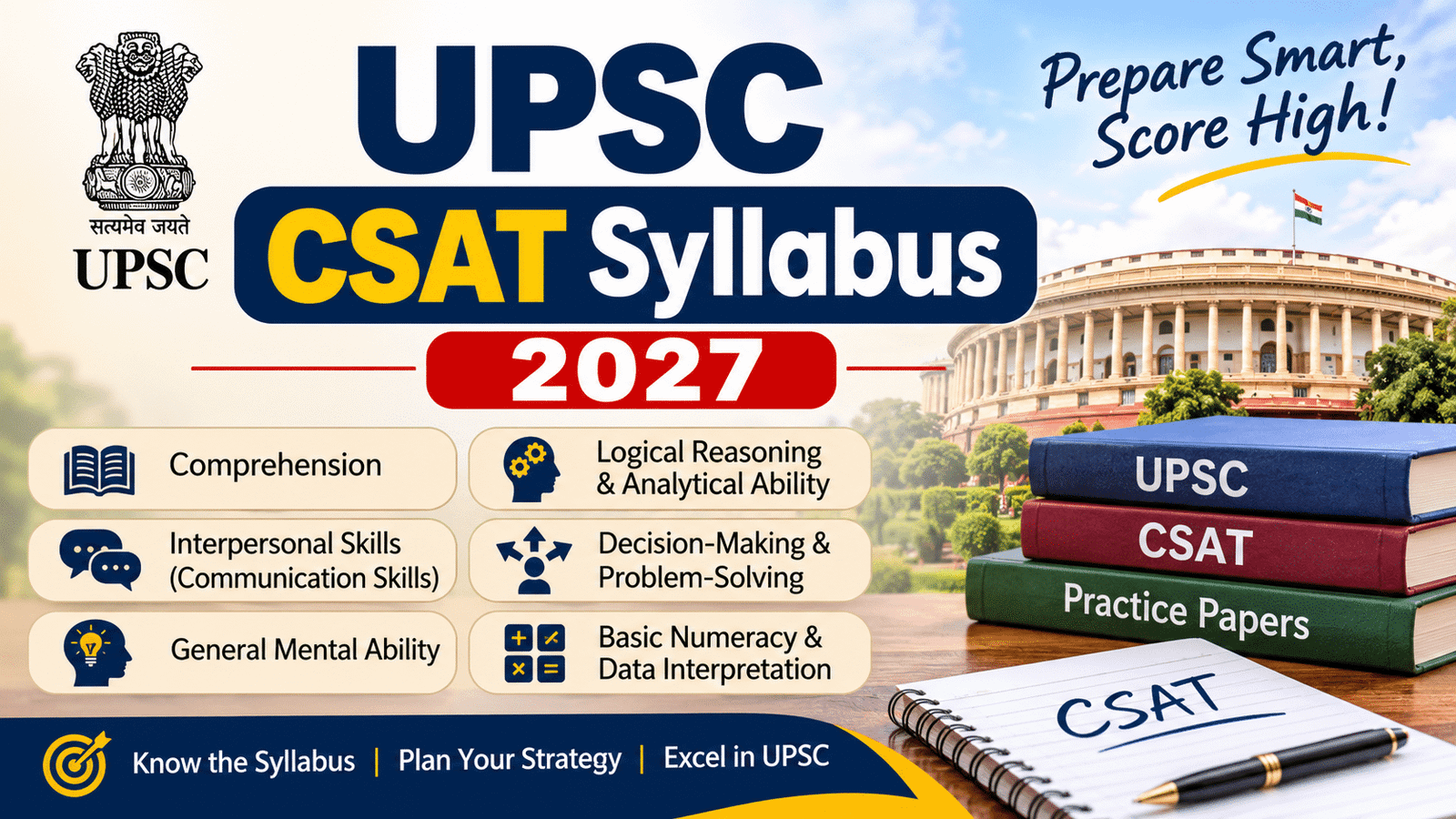
CSAT evaluates a candidate’s analytical, logical and comprehension abilities.
The major topics include:
- Comprehension.
- Interpersonal skills and communication.
- Logical reasoning and analytical ability.
- Decision-making and problem-solving.
- General mental ability.
- Basic numeracy.
- Data interpretation.
Candidates must secure at least 33% marks, equivalent to 66.67 out of 200, to qualify in CSAT.
Note: CSAT is qualifying in nature. Its marks are not added to the final merit list.
Negative Marking in UPSC Prelims
UPSC follows a negative marking system in both Preliminary Examination papers.
For every incorrect answer, one-third of the marks assigned to that question are deducted.
For example:
- Correct answer: +2 marks for a 2-mark question.
- Incorrect answer: -0.66 marks.
- Unanswered question: No deduction.
For CSAT questions carrying 2.5 marks, the penalty for an incorrect answer is approximately 0.83 marks.
How Many Candidates Qualify for UPSC Mains?
The number of candidates shortlisted for the Main Examination is generally around 12 to 13 times the total approximate vacancies announced for that examination.
The final cut-off for General Studies Paper I varies every year depending on factors such as:
- Difficulty level of the examination.
- Number of vacancies.
- Overall performance of candidates.
- Category-wise reservation provisions.
Candidates who clear the Prelims cut-off and meet the qualifying requirements are eligible to appear for the UPSC Main Examination.
Important: Prelims is only a screening stage. Marks obtained in this examination do not contribute to the final selection or service allocation.
2. UPSC Main Examination 2027
The UPSC Main Examination is the second and one of the most important stages of the selection process.
Candidates who qualify in the Preliminary Examination are eligible to appear for Mains, subject to the prescribed requirements and completion of the necessary application formalities.
Unlike Prelims, the Mains Examination is descriptive in nature. It evaluates a candidate’s conceptual understanding, analytical ability, writing skills, critical thinking and ability to present balanced arguments.
The written examination consists of nine papers, out of which seven are counted for merit ranking and two are qualifying papers.
UPSC Mains Exam Pattern 2027
The Mains Examination carries a total of 1,750 marks for merit ranking.
Qualifying Papers
| Paper | Subject | Maximum Marks |
|---|---|---|
| Paper A | Indian Language | 300 |
| Paper B | English | 300 |
Merit-Based Papers
| Paper | Subject | Maximum Marks |
|---|---|---|
| Paper I | Essay | 250 |
| Paper II | General Studies I | 250 |
| Paper III | General Studies II | 250 |
| Paper IV | General Studies III | 250 |
| Paper V | General Studies IV | 250 |
| Paper VI | Optional Subject Paper I | 250 |
| Paper VII | Optional Subject Paper II | 250 |
| Total | Seven Merit Papers | 1,750 |
The total marks for all nine papers are 2,350, but only 1,750 marks are counted for merit ranking.
Qualifying Papers in UPSC Mains
Paper A and Paper B are qualifying in nature. Candidates generally need to secure at least 25% marks in each paper, subject to the applicable examination rules.
Paper A: Indian Language
Candidates must choose one language from the languages included in the Eighth Schedule of the Indian Constitution, subject to applicable exemptions.
Paper B: English
This paper assesses a candidate’s understanding and use of the English language.
The qualifying papers generally assess:
- Comprehension of given passages.
- Precis writing.
- Usage and vocabulary.
- Short essays.
- Translation, where applicable.
Candidates must qualify in both language papers for their merit-based Mains papers to be considered.
Certain exemptions from Paper A are available under the UPSC rules for specified candidates, including candidates from certain northeastern states and eligible candidates with hearing impairment.
Merit-Based Papers in UPSC Mains
1. Essay Paper – 250 Marks
The Essay paper evaluates the ability to understand a topic, organise ideas, develop arguments and present a coherent discussion.
Candidates are generally required to write essays on multiple topics from the subjects provided in the question paper.
A good essay should demonstrate:
- Clarity of thought.
- Logical organisation.
- Relevant examples.
- Balanced arguments.
- Effective introduction and conclusion.
- Analytical depth.
2. General Studies Paper I – 250 Marks
GS Paper I focuses on Indian Heritage and Culture, History, Geography and Society.
Important areas include:
- Indian Art and Culture.
- Modern Indian History.
- Freedom Struggle.
- World History.
- Indian Society.
- Social Issues.
- Physical Geography.
- Indian and World Geography.
3. General Studies Paper II – 250 Marks
GS Paper II covers Governance, Constitution, Polity, Social Justice and International Relations.
Important topics include:
- Indian Constitution.
- Parliament and State Legislatures.
- Executive and Judiciary.
- Constitutional and Statutory Bodies.
- Government Policies and Interventions.
- Welfare Schemes.
- Social Justice.
- India and its Neighbourhood.
- International Relations.
4. General Studies Paper III – 250 Marks
GS Paper III focuses on Economic Development, Science and Technology, Environment, Biodiversity, Internal Security and Disaster Management.
Major topics include:
- Indian Economy.
- Inclusive Growth.
- Budgeting.
- Agriculture.
- Infrastructure.
- Science and Technology.
- Environmental Conservation.
- Disaster Management.
- Internal Security.
5. General Studies Paper IV – 250 Marks
GS Paper IV evaluates Ethics, Integrity and Aptitude.
It assesses the ethical and administrative values expected from civil servants.
Important topics include:
- Ethics and Human Interface.
- Attitude.
- Aptitude and Foundational Values for Civil Services.
- Emotional Intelligence.
- Contributions of Moral Thinkers and Philosophers.
- Public Service Values.
- Probity in Governance.
- Case Studies.
6. Optional Subject Paper I – 250 Marks
Candidates must select one optional subject from the list prescribed by UPSC.
The optional subject is assessed through two descriptive papers, each carrying 250 marks.
7. Optional Subject Paper II – 250 Marks
This paper is the second part of the selected optional subject. It tests the candidate’s conceptual understanding and analytical knowledge of the subject.
What Happens After UPSC Mains?
After evaluating the written examination, UPSC declares the Mains result.
Candidates who obtain the prescribed minimum qualifying marks in the written examination are shortlisted for the Personality Test.
The number of candidates called for the Personality Test is generally around twice the total number of vacancies to be filled.
Candidates must also complete the required Detailed Application Form (DAF) and related formalities within the stipulated deadline.
3. UPSC Personality Test (Interview) 2027
The Personality Test is the third and final examination stage of the UPSC Civil Services Examination.
Candidates who qualify in the Mains written examination are called for the interview conducted by the Union Public Service Commission.
The Personality Test carries 275 marks, which are added to the Mains written examination marks to prepare the final merit list.
Unlike a conventional academic interview, the UPSC Personality Test is designed to assess whether a candidate possesses the qualities required for a career in public service.
Important Details About the UPSC Interview
| Particulars | Details |
|---|---|
| Stage | Third and Final Stage |
| Maximum Marks | 275 |
| Minimum Qualifying Marks | No prescribed minimum |
| Conducting Authority | UPSC |
| Venue | UPSC, Dholpur House, New Delhi |
| Interview Type | Personality Test |
| Final Merit Contribution | 275 Marks |
What Does UPSC Assess in the Interview?
The interview panel evaluates a candidate’s overall personality, awareness, judgement and suitability for administrative responsibilities.
Some important qualities assessed include:
1. Mental Alertness: The ability to understand questions quickly and respond appropriately.
2. Critical Thinking: The ability to analyse complex situations and consider different perspectives.
3. Clear Expression: The ability to communicate ideas logically and effectively.
4. Social Awareness: Understanding of social issues, public concerns and developments in the country.
5. Leadership Qualities: The ability to take responsibility, coordinate with others and make decisions.
6. Intellectual and Moral Integrity: Honesty, objectivity, ethical judgement and consistency.
7. Interest in Current Affairs: Awareness of national and international developments and their implications.
Important Topics for UPSC Interview Preparation
Candidates should prepare thoroughly for questions related to:
- Detailed Application Form (DAF).
- Educational background.
- Home state and hometown.
- Hobbies and interests.
- Graduation subject.
- Work experience, if applicable.
- Current national and international affairs.
- Administrative and governance issues.
- Situational and ethical questions.
- Optional subject and related developments.
There is no fixed list of questions for the Personality Test. The board may ask questions based on the candidate’s DAF, knowledge, opinions and responses during the interaction.
4. Document Verification in UPSC Selection Process
Document verification is an important part of the Civil Services Examination procedure.
UPSC verifies the eligibility and claims made by candidates, particularly those who qualify for the Personality Test.
Candidates may be required to produce original documents supporting their educational qualifications, age, category, nationality and other claims.
Important documents generally include:
- Class 10 certificate or equivalent proof of date of birth.
- Graduation degree or provisional degree certificate.
- Category certificate, where applicable.
- OBC Non-Creamy Layer certificate, where applicable.
- EWS certificate, where applicable.
- PwBD certificate, where applicable.
- Photo identity proof.
- Other documents specified by UPSC.
Candidates should carefully follow the document requirements and deadlines mentioned in the official notification and DAF instructions.
Admission to the examination at earlier stages is provisional. Issuance of an admit card does not mean that UPSC has finally verified a candidate’s eligibility.
5. Medical Examination After UPSC Interview
Candidates recommended for appointment are required to satisfy the prescribed medical and physical standards applicable to their allotted services.
Medical examination is conducted according to the rules and guidelines notified for the Civil Services Examination.
The assessment may include:
- General physical health.
- Vision and eyesight standards.
- Hearing and other relevant medical assessments.
- Physical fitness requirements.
- Service-specific medical standards.
Certain services, particularly the Indian Police Service, have specific physical and medical standards.
Candidates should refer to the applicable official medical guidelines because requirements may differ across services and categories.
Important: Clearing the written examination and interview does not automatically guarantee appointment. Final appointment remains subject to eligibility verification, medical fitness, applicable service requirements and government procedures.
6. UPSC Final Merit List and Service Allocation
After the Personality Test, UPSC prepares the final merit list based on the combined marks obtained in the Mains written examination and Personality Test.
The final score is calculated out of 2,025 marks.
| Examination Stage | Marks Considered for Final Merit |
|---|---|
| Preliminary Examination | Not counted |
| Mains Written Examination | 1,750 |
| Personality Test | 275 |
| Total | 2,025 |
The final rank of a candidate depends on their combined performance in the seven merit-based Mains papers and the Personality Test.
How Are Services Allocated After the UPSC Final Result?
Service allocation is made by the Government based on several factors, including:
- Candidate’s final rank.
- Service preferences submitted by the candidate.
- Category and applicable reservation rules.
- Number of vacancies in different services.
- Eligibility and medical or physical standards applicable to the service.
For example, candidates securing higher ranks may have a better opportunity to receive their preferred services, depending on the vacancies and preferences of other candidates.
A candidate’s final selection does not mean that everyone receives the IAS. Depending on rank, preferences, vacancies and eligibility, candidates may be allocated to IAS, IPS, IFS, IRS or other participating services.
Major Services Through UPSC CSE
Some of the important services recruited through the Civil Services Examination include:
- Indian Administrative Service (IAS).
- Indian Foreign Service (IFS).
- Indian Police Service (IPS).
- Indian Revenue Service (Income Tax).
- Indian Revenue Service (Customs and Indirect Taxes).
- Indian Audit and Accounts Service.
- Indian Civil Accounts Service.
- Indian Corporate Law Service.
- Indian Defence Accounts Service.
- Indian Information Service.
- Indian Postal Service.
- Indian Railway Management Service.
- DANICS and DANIPS.
- Pondicherry Civil Service and Pondicherry Police Service.
The exact list of participating services should be checked in the relevant year’s official notification.
7. UPSC Eligibility Criteria 2027
Candidates must fulfil the prescribed eligibility requirements to participate in the Civil Services Examination.
The major eligibility conditions relate to nationality, age, educational qualifications and the number of attempts.
The following details are based on the latest published UPSC CSE 2026 rules. Candidates preparing for CSE 2027 should verify the final eligibility conditions in the 2027 notification.
Nationality
For IAS, IFS and IPS, the candidate must be a citizen of India.
For certain other services, eligibility is also available to specified categories, including subjects of Nepal and Bhutan, eligible Tibetan refugees and certain persons of Indian origin, subject to the conditions and certificates prescribed by the Government of India.
Age Limit
As per the UPSC CSE 2026 notification, candidates must have attained the age of 21 years and must not have attained 32 years of age on 1 August 2026.
The general age limit and applicable relaxations are:
| Category | Upper Age Limit |
|---|---|
| General / EWS | 32 Years |
| OBC (Non-Creamy Layer) | 35 Years |
| SC / ST | 37 Years |
| PwBD | Up to 42 Years, subject to applicable rules |
Additional relaxations are available for certain eligible ex-servicemen and defence personnel.
The exact date of birth criteria are specified in the examination notification every year.
Educational Qualification
Candidates must possess a graduate degree from a recognised university or an equivalent qualification recognised by the Government.
Students who are appearing for their final degree examination may also apply provisionally, subject to fulfilling the prescribed conditions and producing proof of qualification within the stipulated time.
There is no restriction on the academic stream. Candidates from Arts, Commerce, Science, Engineering, Medical and other recognised disciplines can apply.
Number of Attempts in UPSC
The number of attempts permitted depends on the candidate’s category.
As per the CSE 2026 examination rules:
| Category | Number of Attempts |
|---|---|
| General | 6 |
| EWS | 6 |
| OBC | 9 |
| SC / ST | Unlimited, subject to age eligibility |
| PwBD (General / EWS / OBC) | 9 |
| PwBD (SC / ST) | Unlimited, subject to age eligibility |
An attempt is counted when a candidate actually appears in at least one paper of the Preliminary Examination.
Merely submitting the application form or receiving an admit card does not count as an attempt if the candidate does not appear in either Prelims paper.
Important: The 2026 rules also introduced specific restrictions concerning candidates already allocated or appointed to certain services. These rules affect repeat attempts and service allocation and should be checked carefully by candidates who have already been recommended in an earlier CSE cycle.
8. Important UPSC CSE 2026 Updates Aspirants Should Know
Candidates preparing for UPSC CSE 2027 should remain aware of changes introduced in the 2026 examination rules.
Some important developments include:
1. Updated Online Application System
UPSC introduced a structured online application portal involving Account Creation, Universal Registration Number (URN), Common Application Form (CAF) and an examination-specific application module.
Candidates should carefully follow the latest instructions while registering and submitting their applications.
2. Revised Rules for Candidates Already Allocated to Services
The CSE 2026 rules introduced specific restrictions and one-time provisions concerning candidates already allocated to IAS, IFS, IPS and certain Group A services.
For example, eligible candidates allocated to IPS or a Central Service Group A through CSE 2026 may be permitted to appear in CSE 2027 under specified conditions, including obtaining the prescribed exemption from joining training.
Candidates previously allocated services through CSE 2025 or earlier have also been provided a one-time opportunity to appear in either CSE 2026 or CSE 2027, subject to the applicable conditions.
3. Revised Prelims Application and Identity Verification Requirements
The 2026 application process includes requirements such as live photograph capture, photograph upload, signature upload and identity verification instructions.
Candidates should read the application guidelines carefully rather than relying on procedures followed in earlier years.
4. Updated Examination and Vacancy Information
UPSC initially notified approximately 933 vacancies for CSE 2026. Subsequently, the number reported by the Government for the Prelims-to-Mains stage was 1,016 vacancies.
This demonstrates why aspirants should follow official updates rather than rely exclusively on figures published at the beginning of the examination cycle.
5. Pratibha Setu Portal
The 2026 notification also contains provisions for sharing information about eligible, willing candidates who reached the Personality Test stage but were not recommended, with registered organisations through the Pratibha Setu Portal, subject to the prescribed consent and policy conditions.
These developments highlight the importance of reading the latest UPSC examination notification and rules every year.
9. How to Prepare for the UPSC Selection Process 2027?
The UPSC examination requires a structured preparation strategy because each stage tests different abilities.
A candidate should not prepare for Prelims, Mains and Interview as completely separate examinations. Instead, preparation should be integrated from the beginning, with appropriate changes in focus as the examination approaches.
Step 1: Understand the UPSC Syllabus
The first step is to understand the complete UPSC syllabus for Prelims and Mains.
Aspirants should identify the topics, subtopics and areas frequently asked in previous years.
The syllabus should be used as a reference point while selecting books, preparing notes and studying current affairs.
Step 2: Analyse Previous Year Question Papers
Previous Year Questions (PYQs) help candidates understand the nature, difficulty and changing trends of the examination.
Aspirants should analyse:
- Subject-wise question distribution.
- Frequently tested concepts.
- Static and current affairs integration.
- Question framing and difficulty.
- Repeated themes across examination years.
PYQ analysis should be a continuous part of preparation rather than a one-time exercise.
Step 3: Build Strong Fundamentals
Aspirants should first develop a sound understanding of core subjects such as History, Geography, Polity, Economy, Environment and Science and Technology.
NCERT textbooks and standard reference books can help establish conceptual clarity.
Instead of collecting too many resources, candidates should focus on limited and reliable study material with regular revision.
Step 4: Integrate Current Affairs with Static Subjects
Current affairs play an important role in both Prelims and Mains.
Candidates should follow reliable newspapers, government reports, official publications and relevant current affairs resources.
The focus should be on understanding the background, significance, constitutional provisions, government initiatives and broader implications of important developments.
Step 5: Practise Answer Writing for Mains
Mains preparation requires regular descriptive answer-writing practice.
Aspirants should practise writing answers within the prescribed word limits and time constraints.
Important areas to improve include:
- Understanding the demand of the question.
- Structuring answers logically.
- Using relevant examples and data.
- Incorporating constitutional provisions and case studies.
- Developing balanced arguments.
- Writing clear introductions and conclusions.
Regular evaluation and feedback can help identify weaknesses and improve answer quality.
Step 6: Prepare for Prelims Through Mock Tests
Prelims requires conceptual clarity, factual accuracy and effective time management.
Candidates should practise sectional and full-length mock tests to improve their performance.
After each test, aspirants should analyse mistakes, revise weak areas and understand why incorrect options were selected.
Mock tests should be used as a learning and assessment tool rather than merely a way to calculate scores.
Step 7: Prepare for the Personality Test
Interview preparation should focus on developing awareness, balanced opinions, communication skills and administrative understanding.
Candidates should prepare their Detailed Application Form thoroughly and follow important national and international developments.
Mock interviews can help candidates become familiar with the interview environment and receive constructive feedback.
Step 8: Follow a Consistent Revision Strategy
Revision is essential throughout the preparation journey.
Aspirants should maintain concise notes, revise important concepts regularly and periodically assess their progress through tests.
A well-planned study schedule, consistent practice and continuous evaluation are important for improving performance across all three stages.
10. Common Mistakes to Avoid During UPSC Preparation
Many aspirants work hard but fail to achieve the desired results because of an unstructured approach.
Some common mistakes include:
- Preparing without understanding the official syllabus.
- Ignoring Previous Year Questions.
- Collecting too many books and study resources.
- Neglecting answer-writing practice.
- Ignoring CSAT until the final stage.
- Not revising previously studied topics.
- Depending entirely on current affairs without building static fundamentals.
- Taking mock tests without analysing mistakes.
- Choosing an optional subject without proper evaluation.
- Preparing for Prelims while completely ignoring Mains.
Avoiding these mistakes can help aspirants develop a more balanced and examination-oriented preparation strategy.
11. How ENSURE IAS Can Help in UPSC Preparation
Preparing for the Civil Services Examination requires more than access to books and study material. Aspirants need a systematic strategy, regular evaluation, conceptual clarity and guidance throughout their preparation.
ENSURE IAS, under the guidance of Sachin Jain Sir (IRS 2016), provides structured UPSC preparation programmes designed to support aspirants at different stages of the examination.
Sachin Jain Sir has cleared all six UPSC Civil Services Preliminary Examinations and secured final selections twice, with AIR 712 in CSE 2015 and AIR 286 in CSE 2016.
UPSC Preparation Programmes at ENSURE IAS
1. PRE-SURE Programme
The PRE-SURE programme focuses on Prelims preparation through structured study planning, monthly targets, regular assessments and mentorship.
Key features include:
- Personalised preparation strategy.
- Monthly targets and progress monitoring.
- Prelims-focused GS and CSAT tests.
- Previous Year Question-based preparation.
- Regular performance evaluation.
- Guidance for effective time management.
2. MAINS-SURE Programme
MAINS-SURE is designed for aspirants focusing on improving their Mains performance through structured answer-writing practice and evaluation.
Key features include:
- Mains answer-writing practice.
- Sectional and full-length tests.
- Essay writing practice.
- Live answer-writing sessions.
- Value addition and feedback.
- Guidance from experienced mentors.
3. SELECTION-SURE Programme
SELECTION-SURE provides an integrated preparation approach covering both Prelims and Mains.
It combines structured Prelims preparation, Mains answer writing, regular testing and mentorship to help candidates prepare for the complete examination cycle.
4. Sachin Jain Sir’s Personal Mentorship Programme
The personal mentorship programme provides additional individual guidance and structured preparation support.
It includes the Selection-SURE programme along with weekly one-to-one mentorship sessions with Sachin Jain Sir.
Why Choose ENSURE IAS?
- Guidance under an IRS 2016 officer.
- Structured preparation for Prelims and Mains.
- Regular tests and performance analysis.
- Daily Mains Answer Writing Practice.
- Personalised mentorship and preparation planning.
- Exam-oriented study material and revision support.
Explore the programmes and preparation resources at ENSURE IAS.
Website: https://www.ensureias.com/
Contact: 7900-44-7900
Visit: ENSURE IAS, Near Karol Bagh Metro Gate No. 8, Pusa Road, New Delhi.
Conclusion
The UPSC Selection Process 2027 consists of three important stages: Preliminary Examination, Main Examination and Personality Test.
While Prelims acts as a screening examination, Mains and Interview marks determine the final merit ranking. Candidates must also fulfil the prescribed eligibility requirements and applicable service-specific conditions to receive an appointment.
Success in the Civil Services Examination requires conceptual clarity, effective answer writing, regular revision, consistent assessment and a well-defined preparation strategy.
Aspirants should begin by understanding the syllabus, analysing previous year questions and developing strong fundamentals. With disciplined preparation, proper mentorship and continuous improvement, candidates can strengthen their performance throughout the UPSC selection process.
Start your UPSC preparation with the right strategy and guidance at ENSURE IAS.
Frequently Asked Questions (FAQs) on UPSC Selection Process 2027
Q1. What are the three stages of the UPSC Selection Process 2027?
The UPSC Civil Services Examination consists of three stages: Preliminary Examination, Main Examination and Personality Test (Interview). Candidates must qualify at each stage to proceed to the next stage.
Q2. How many marks are required to clear UPSC Prelims?
There is no fixed qualifying mark for General Studies Paper I. The cut-off changes every year depending on examination conditions and vacancies. Candidates must secure at least 33% marks, or 66.67 out of 200, in CSAT to qualify.
Q3. Are UPSC Prelims marks counted in the final merit list?
No. Preliminary Examination marks are used only for screening candidates for Mains. The final merit list is prepared using 1,750 marks from the Mains written examination and 275 marks from the Personality Test.
Q4. How many papers are there in UPSC Mains?
UPSC Mains consists of nine descriptive papers. Two papers, Indian Language and English, are qualifying in nature, while seven papers, including Essay, four General Studies papers and two Optional Subject papers, are counted for merit ranking.
Q5. What is the total marks of the UPSC Civil Services Examination?
The final merit is calculated out of 2,025 marks. The Mains written examination contributes 1,750 marks, while the Personality Test contributes 275 marks.
Q6. Is there any minimum qualifying mark for the UPSC Interview?
No. UPSC does not prescribe a separate minimum qualifying mark for the Personality Test. However, the marks obtained in the interview are added to the Mains written examination marks to determine the final rank.
Q7. How many attempts are allowed in UPSC CSE?
Under the CSE 2026 rules, General and EWS candidates are allowed six attempts, OBC candidates nine attempts and SC/ST candidates unlimited attempts subject to age eligibility. PwBD candidates have category-specific attempt limits. Candidates should verify the applicable rules for their examination year.
Q8. Is graduation compulsory for the UPSC Civil Services Examination?
Yes. Candidates must possess a recognised graduate degree or an equivalent qualification. Candidates appearing in their qualifying degree examination may also apply provisionally, subject to UPSC’s prescribed conditions.
Q9. How are IAS and IPS officers selected through UPSC?
IAS and IPS officers are selected through the Civil Services Examination. Their final selection and service allocation depend on the candidate’s final rank, service preferences, category, vacancies and applicable eligibility and medical standards.
Q10. How can I prepare for all three stages of the UPSC Selection Process?
Candidates should begin with syllabus-based preparation, develop strong conceptual fundamentals, analyse previous year questions, practise mock tests and integrate current affairs. Regular Mains answer writing, revision and Personality Test preparation are also essential for a balanced strategy.