Context
Researchers from the Wildlife Institute of India (WII) have documented the first verified photographic evidence of an Asiatic black bear (Ursus thibetanus) preying on an endangered red panda (Ailurus fulgens) in Singalila National Park, West Bengal.
About the Asiatic Black Bear
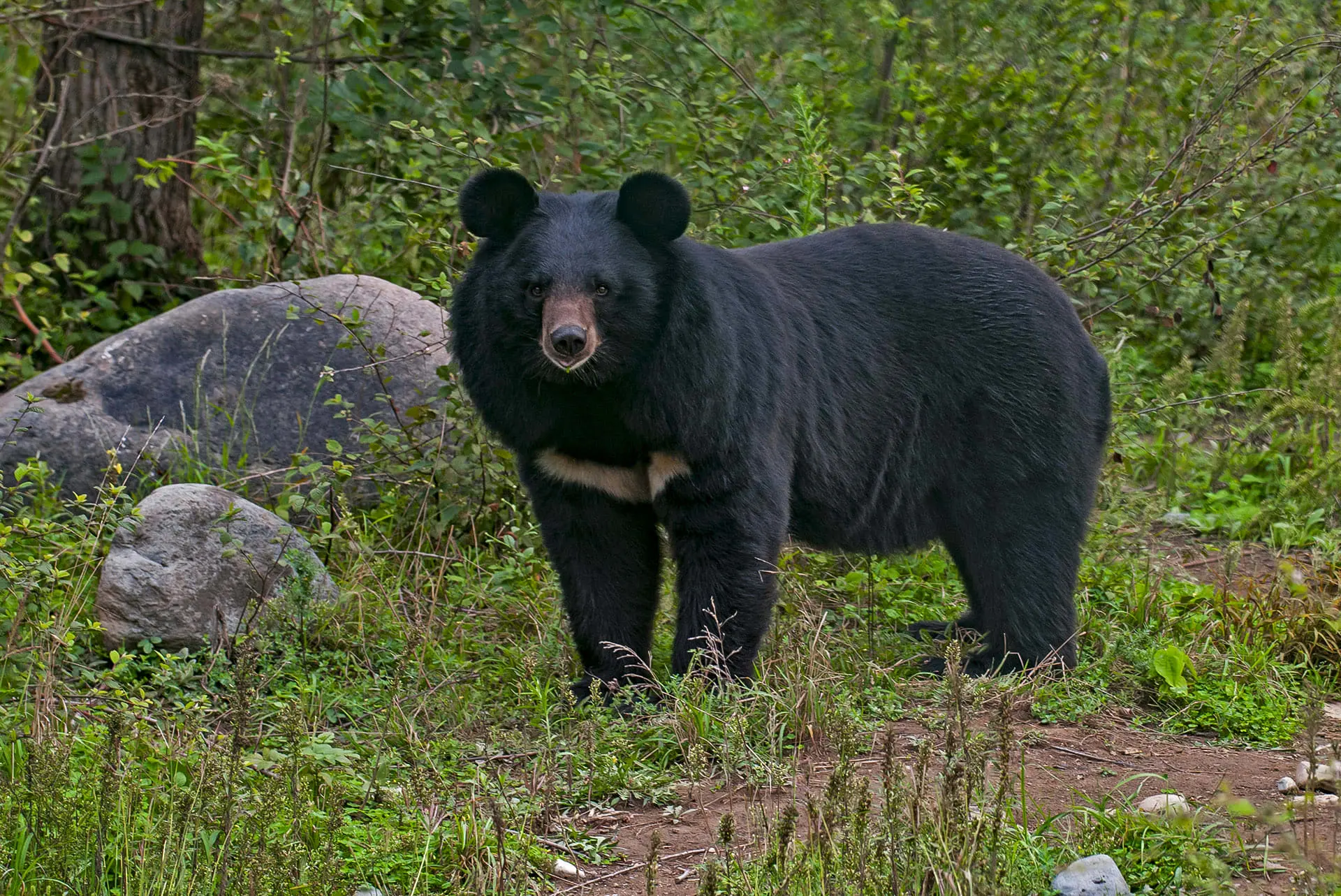
- The Asiatic black bear is a medium-sized bear species native to Asia. It is also known as the Moon Bear because of the distinctive crescent-shaped marking on its chest.
- It is scientifically known as Ursus thibetanus and belongs to the family Ursidae.
- It is relatively well adapted to an arboreal lifestyle, meaning that it spends considerable time climbing and foraging in trees.
- Its body is covered with black fur and has a characteristic V-shaped, light beige to white patch on its chest. It also has a small pale crescent on its throat and a white spot on its chin.
Habitat and Distribution
- The Asiatic black bear prefers heavily forested habitats, particularly broad-leaved and coniferous forests.
- It is distributed across several Asian countries, including India, Bangladesh, Bhutan, Cambodia, China, Iran, Japan and South Korea.
- In India, it is mainly found across the Himalayan ranges, extending from the eastern to the western Himalayas.
- It generally inhabits elevations between 2,600 feet and 11,400 feet in the Indian Himalayan region.
- It also uses orchards, agricultural fields and areas near human settlements to move between fragmented forest patches.
Physical Features and Behaviour
- Climbing ability: The Asiatic black bear is an excellent climber. Its strong limbs and curved claws help it climb trees while searching for food.
- Swimming ability: It is also a capable swimmer and is often observed foraging near rivers and water bodies.
- Diet: It is an omnivore and feeds on berries, cherries, acorns, insects, squirrels and frogs.
- Hibernation: It typically hibernates from late November to March, although its hibernation pattern may vary depending on climatic conditions and geographical location.
- Arboreal behaviour: It frequently climbs fruit-bearing trees to obtain food, particularly in forested and orchard areas.
FAQs
Q1. What is the scientific name of the Asiatic black bear?
Ans: The scientific name of the Asiatic black bear is Ursus thibetanus.
Q2. Why is it also known as the Moon Bear?
Ans: It is called the Moon Bear because it has a distinctive white or cream-coloured crescent-shaped mark on its chest.
Q3. Where is the Asiatic black bear found?
Ans: It is found across parts of Asia, including India, Nepal, Bhutan, China, Japan, Myanmar and Iran. In India, it inhabits the Himalayan region and the northeastern hill states.
Q4. What type of habitat does it prefer?
Ans: It mainly inhabits forested areas, including broad-leaved and coniferous forests. It can also use orchards and agricultural fields when moving between forest patches.
Q5. Is the Asiatic black bear a herbivore or a carnivore?
Ans: It is an omnivore. Its diet includes fruits, nuts, berries, insects, larvae and small animals.
Q6. Is the Asiatic black bear a good climber?
Ans: Yes. It has strong forelimbs and curved claws that help it climb trees, where it often searches for food.