Context
The Central Pollution Control Board (CPCB) has directed pollution control authorities in Delhi-NCR to take strict action, including closure of industrial units that have failed to place orders for installing or upgrading prescribed air pollution control equipment. The move is part of the broader effort to reduce winter air pollution in Delhi-NCR.
What exactly does the CPCB order require?
Industries covered by Commission for Air Quality Management (CAQM) directions must show concrete steps to meet the revised particulate–matter emission standards.
- Industries covered: The direction concerns units in 17 highly polluting industrial categories in Delhi-NCR and nearby areas.
- Emission standard: The revised particulate-matter emission limit is 50 mg/Nm³ (milligrams per normal cubic metre), applicable from 1 October 2026.
- Five-day compliance window: Units that have not placed work orders for installing or upgrading pollution-control equipment must provide satisfactory evidence of compliance-related action within five days.
- Possible closure: Units that fail to provide acceptable evidence can face closure directions and may remain closed until they place work orders and submit a credible compliance timeline accepted by the pollution control board.
- Other compliance routes: Units may also need to submit an adequacy assessment report or a valid exemption certificate, wherever applicable.
Why does air pollution become severe in Delhi-NCR during winter?
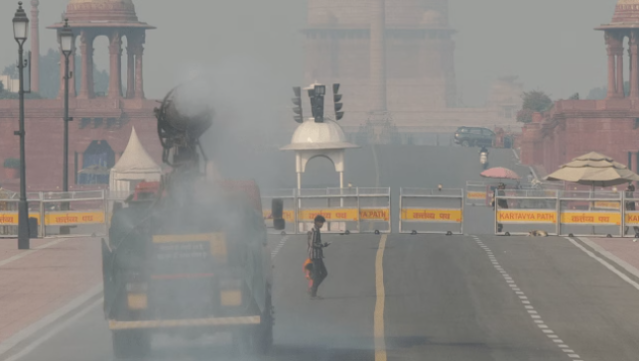
Delhi’s winter pollution is not caused by a single source. It results from the combined effect of high emissions, regional transport of pollutants and unfavourable weather conditions.
- Stubble burning in neighbouring states: It worsens Delhi-NCR’s air quality by increasing particulate matter concentrations, contributing to smog and respiratory health problems.
- Temperature inversion: Under normal conditions, air near the Earth’s surface is generally warmer than the air above it. However, during winter, temperature inversion can occur.
- It is a condition in which a layer of warmer air lies above cooler air near the Earth’s surface, restricting the upward movement of the cooler air.
- It traps pollution by restricting vertical air circulation, causing pollutants to accumulate near the ground instead of dispersing into the atmosphere.
- Low wind speed and a shallow mixing layer: During winter, slow winds prevent pollutants from spreading horizontally, while a shallow mixing layer limits their upward movement. As a result, pollutants accumulate near the ground, increasing pollution levels.
- Reduced rainfall and withdrawal of the monsoon: Rain normally helps remove suspended particles from the atmosphere through a process known as wet deposition. With less rainfall, pollutants remain suspended in the air for longer periods.
- Geographical and Regional Factors: Delhi lies in the densely populated Indo-Gangetic Plain, where pollution comes from nearby industrial, urban and agricultural areas. Regional weather patterns and Himalayan influences affect air circulation and pollutant dispersal, contributing to pollution accumulation.
- Rapid Urbanisation and Human Activities: Rapid urban expansion in Delhi-NCR increases pollution through vehicular emissions, construction dust, road dust, industrial activities, diesel generators and waste burning. It also increases energy demand and reduces green spaces in some areas.
Additional Concepts
- Particulate Matter: It refers to extremely small solid particles and liquid droplets suspended in the air. These particles may come from vehicles, industries, construction activities, road dust, burning of fuels and crop residues.
- They are classified according to their size: PM10 (Particles with a diameter of 10 micrometres or less) & PM2.5 (Particles with a diameter of 2.5 micrometres or less)
- PM2.5 is more dangerous as its extremely small size allows it to penetrate deep into the lungs. Long-term exposure is associated with asthma, bronchitis, reduced lung function, heart disease, stroke and premature deaths.
- Air Pollution Control Devices: They are technologies installed in industrial units to reduce the release of harmful pollutants through exhaust systems or chimneys. Examples:
- Electrostatic Precipitator (ESP) – Uses an electric charge to remove dust and fine particles from industrial gases
- Bag Filters – Pass exhaust gases through fabric filters that trap particulate matter
- Cyclone Separators – Use centrifugal force to separate larger dust particles from gases
- Wet Scrubbers – Use liquid sprays to capture certain particles and gaseous pollutants
- Flue Gas Desulphurisation (FGD) – Primarily removes sulphur dioxide (SO₂) from exhaust gases
- Flue Gas Desulphurisation (FGD): FGD is a pollution-control technology used mainly in coal-based thermal power plants to remove sulphur dioxide (SO₂) from flue gases before they are released through chimneys. Importance:
- Reduces sulphur dioxide emissions from coal-based power plants.
- Helps control the formation of secondary particulate matter.
- Reduces the risk of acid rain and associated environmental damage.
- Primary vs Secondary Pollutants: Air pollution can also be classified according to how pollutants enter the atmosphere.
- Primary pollutants: Released directly into the atmosphere from sources such as vehicles, industries, power plants and burning of biomass. Examples: Carbon monoxide (CO), Sulphur dioxide (SO₂), Nitrogen oxides (NOx), Volatile organic compounds (VOCs) and Particulate matter (PM2.5 and PM10).
- Secondary pollutants: These are formed in the atmosphere when primary pollutants react with one another or with substances such as oxygen, water vapour and sunlight. Examples: Ground-level ozone, Sulphuric acid and nitric acid, Sulphate and nitrate aerosols and secondary particulate matter.
Industrial emissions: The often-overlooked contributor to Delhi’s pollution
While stubble burning receives considerable attention during October and November, industrial emissions also contribute to Delhi-NCR’s air pollution. Industries and thermal power plants release pollutants such as particulate matter, sulphur dioxide (SO₂), nitrogen oxides (NOx), etc.
- Sulphur Dioxide Emissions as a major source: Sulphur dioxide is a colourless gas with a sharp, pungent smell. It is mainly released through the burning of sulphur-containing fuels, particularly coal. When SO₂ undergoes atmospheric chemical reactions, it can form sulphate aerosols. These particles contribute to PM2.5 pollution.
- Secondary ammonium sulphate and Delhi’s pollution Its formation involves two major precursor pollutants – SO₂ & Ammonia (NH₃). Ammonium sulphate contributes to secondary PM2.5. These particles can travel across regions. They increase the overall particulate pollution burden even when the original gaseous pollutants are not directly visible.
Government regulations for controlling industrial emissions
- Revised particulate-matter emission standards for industries: CAQM issued directions in February 2026 to strengthen particulate-matter emission standards for industries operating in Delhi-NCR.
- CPCB prescribed a uniform particulate-matter emission limit of 50 mg/Nm³ for identified industrial categories, with the compliance deadline extended to 1 October 2026. Its 30 October 2026 order seeks strict enforcement against industries that have not taken steps to install or upgrade pollution-control equipment.
- FGD requirements for coal-based thermal power plants: Ministry of Environment, Forest and Climate Change (MoEFCC) has prescribed sulphur dioxide emission standards for coal-based thermal power plants. These plants are categorised according to their location.
Why is strict enforcement necessary?
- Industrial emissions contribute to both direct particulate pollution and secondary particulate formation.
- Failure to install pollution-control equipment allows harmful emissions to continue.
- Delayed compliance weakens environmental regulations.
- Winter weather makes the consequences of uncontrolled emissions more severe.
- Closure directions create pressure on industries to comply rather than indefinitely postpone installation. However, enforcement must also be accompanied by technical assistance, access to approved equipment suppliers and reasonable compliance monitoring.
Other government initiatives to control air pollution
- National Clean Air Programme (NCAP): Launched in January 2019 by MoEFCC, it aims to improve air quality through coordinated national, state and city-level action plans and to achieve up to a 40% reduction in PM10 concentration or meet the prescribed national air-quality standard by 2025–26.
- Commission for Air Quality Management (CAQM): It is a statutory body which coordinates air-pollution control efforts across Delhi-NCR and adjoining areas and can issue directions to state governments and other authorities.
- Bharat Stage-VI (BS-VI) emission standards: They help regulate the pollutants released by motor vehicles by prescribing the limits for pollutants. India introduced BS-VI fuel and vehicles nationwide from 1 April 2020. These standards help reduce vehicular emissions and improve urban air quality.
- Promotion of electric vehicles: Government initiatives such as the FAME scheme and PM E-DRIVE aim to encourage electric mobility.
- Sustainable Alternative Towards Affordable Transportation (SATAT) initiative: It promotes the production and use of Compressed Biogas (CBG). It can create an economic use for agricultural residue and reduce dependence on conventional fossil fuels.
- Crop-Residue Management: Promoting subsidised machinery, such as Happy Seeders and Super SMS, along with biomass utilisation, awareness programmes and state-level action plans to prevent stubble burning.
- Graded Response Action Plan (GRAP): Depending on pollution severity, measures may include restrictions on construction, certain vehicles, industrial operations and other polluting activities.
- Other Important Measures: Promoting cleaner industrial fuels, controlling construction and road dust, expanding urban green cover, and preventing open waste burning through scientific waste management.
Challenges and Way Forward
| Challenges | Way Forward |
| 1. Fragmented Governance: Multiple states and agencies manage pollution separately. | Strengthen CAQM-led coordination and regional planning. |
| 2. Crop-Residue Burning: Farmers face high costs and limited time to manage stubble. | Provide subsidised machinery, incentives and alternative uses for stubble. |
| 3. Industrial Non-Compliance: Industries delay installing pollution-control equipment. | Enforce emission standards and provide technical support. |
| 4. Vehicular Pollution: Rising vehicle numbers and traffic congestion increase emissions. | Promote public transport, EVs and stricter emission checks. |
| 5. Poor Urban Management: Construction dust, waste burning and loss of green spaces worsen pollution. | Improve dust control, waste management and urban green cover. |
Conclusion
Delhi-NCR’s air pollution crisis is not merely a seasonal problem. It is the result of long-term dependence on polluting fuels, industrial emissions, vehicular growth, unsustainable agricultural practices, construction dust and weak regional coordination.
Frequently Asked Questions (FAQs)
Q1. What action has the CPCB taken against industries violating pollution-control requirements?
CPCB has directed pollution control authorities to take strict action, including closure of industrial units that have failed to place work orders for installing or upgrading prescribed pollution-control equipment.
Q2. What particulate-matter emission limit applies to identified industries in Delhi-NCR?
A uniform limit of 50 mg/Nm³ applies to identified industrial categories from 1 October 2026. Non-compliant units must provide satisfactory evidence of compliance-related action within five days.
Q3. Why does air pollution become severe in Delhi-NCR during winter?
Temperature inversion, low wind speed, a shallow mixing layer, reduced rainfall, stubble burning, industrial emissions and vehicular pollution restrict pollutant dispersal and increase their accumulation near the ground.
Q4. What is the difference between primary and secondary air pollutants?
- Primary pollutants: Released directly into the atmosphere, such as CO, SO₂, NOx and particulate matter.
- Secondary pollutants: Formed through atmospheric chemical reactions, such as ground-level ozone, sulphate aerosols and nitrate aerosols.
Q5. What are the major government initiatives to control air pollution in India?
Important initiatives include the National Clean Air Programme (NCAP), CAQM, BS-VI emission standards, FAME, PM E-DRIVE, SATAT, crop-residue management measures and the Graded Response Action Plan (GRAP).