Context
India and Mexico signed the Terms of Reference on 28 October 2026, formally launching negotiations for a Preferential Trade Agreement (PTA). Negotiations will cover areas including market access, rules of origin, customs procedures, trade facilitation and trade remedies.
Location and Boundaries
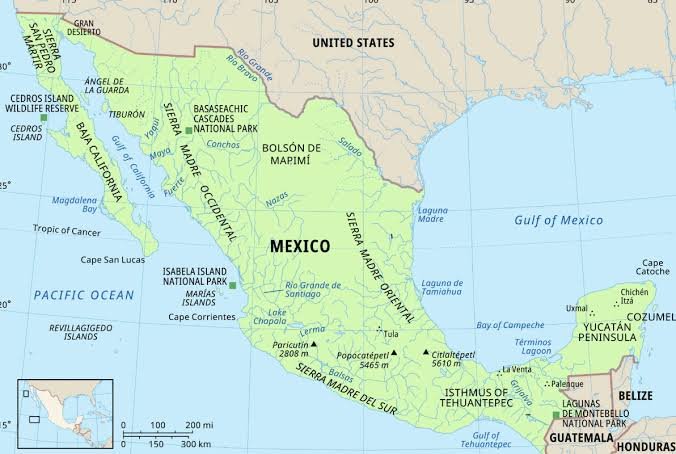
- Location: Mexico lies in southern North America, bordering the Central American region to its southeast.
- Land borders: It shares boundaries with the United States to the north and Guatemala and Belize to the southeast.
- Maritime setting: Mexico faces the Pacific Ocean to the west and south, and the Gulf of Mexico and Caribbean Sea to the east, giving it access to both Pacific and Atlantic maritime systems.
- Capital: Mexico City, located on the central Mexican highlands, is the national capital.
Major Physical Features
- Mountain systems: The Sierra Madre Occidental and Sierra Madre Oriental border the Mexican Plateau, while the Trans-Mexican Volcanic Belt crosses central Mexico.
- Ring of Fire: Mexico lies along the Circum-Pacific Ring of Fire; interaction of tectonic plates along its Pacific margin makes it prone to earthquakes and volcanism.
- Peninsulas: The Baja California Peninsula extends between the Pacific Ocean and Gulf of California, while the Yucatán Peninsula separates the Gulf of Mexico from the Caribbean Sea.
- Highest peak: Pico de Orizaba (Citlaltépetl), a volcanic peak in the Trans-Mexican Volcanic Belt, is Mexico’s highest mountain.
Rivers, Lakes and Resources
- Rio Grande: It forms a substantial part of the Mexico–United States international boundary, giving the river major geographical and political importance.
- Major drainage: Important river systems include the Lerma–Santiago, Balsas and Grijalva–Usumacinta, draining different parts of Mexico.
- Major lakes: Lake Chapala, Mexico’s largest freshwater lake, and Lake Cuitzeo are important inland water bodies.
- Mineral and energy resources: Mexico possesses significant petroleum, natural gas, silver, copper, gold, lead and zinc, supporting its energy and mining sectors.
India–Mexico Current Relevance
- Trade negotiations: The 2026 ToR formally launched negotiations for a Preferential Trade Agreement, aimed at expanding bilateral trade and investment.
- Sectoral complementarities: Both sides identified opportunities in automobiles, pharmaceuticals, electronics, chemicals, agri-food, energy, critical minerals and advanced manufacturing.
- Global value chains: Mexico has strong links with global manufacturing networks; a future PTA could therefore improve opportunities for Indian exporters and investors while supporting more diversified supply chains.
FAQs
Q1. What is the capital of Mexico?
Mexico City.
Q2. Which countries share land borders with Mexico?
The United States, Guatemala and Belize.
Q3. Which major peninsulas are located in Mexico?
The Baja California Peninsula and Yucatán Peninsula.
Q4. Why is Mexico prone to earthquakes and volcanism?
It lies along the Circum-Pacific Ring of Fire.
Q5. Why was Mexico in news in 2026?
India and Mexico formally launched negotiations for a Preferential Trade Agreement.