Context
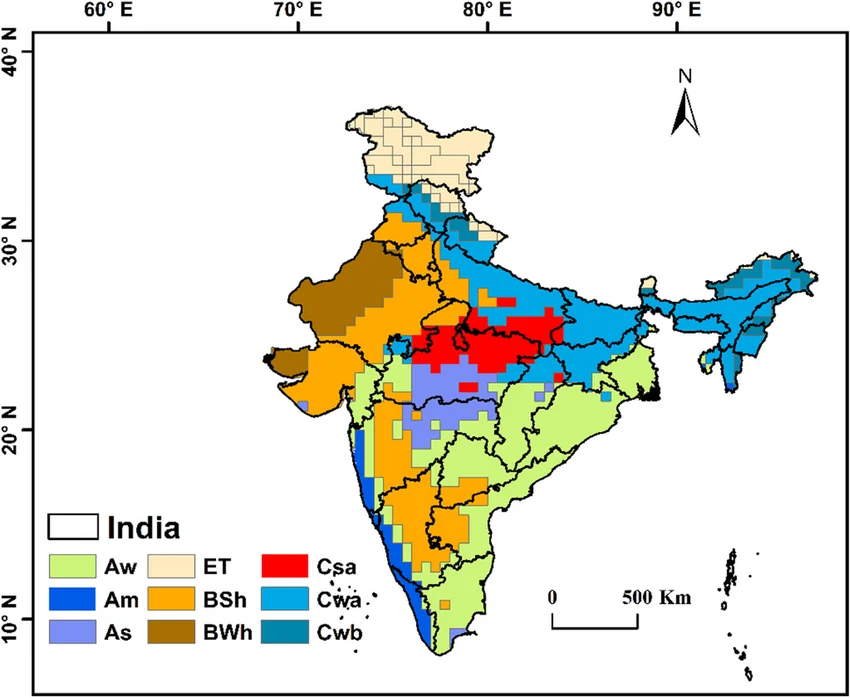
A study by India Meteorological Department (IMD) and Indian Institute of Tropical Meteorology (IITM), Pune, examines changes in India’s climate zones between 1951–80 and 1991–2020 and links the drying trend in northern India partly to the negative phase of the Victoria Mode.
Key Findings: Shifting Climate Zones in India
- Study Methodology: Analysis of IMD (India Meteorological Department) temperature and rainfall data (1951–1980 vs. 1991–2020) based on Köppen climate classification.
- North-West India (Drying & Aridity):
- Hot Semi-Arid Steppe expanded (7% to 33.1%), spreading east up to Eastern Uttar Pradesh, West Vidarbha, and Marathwada.
- Subtropical Temperate Zone shrank (8% to 18.7%).
- Kutch and Western Saurashtra shifted from dry arid to semi-arid conditions.
- Gangetic Plains & North-East:
- Gangetic West Bengal and Bihar faced declining monsoon rainfall, shifting toward temperate conditions.
- Tropical Savannah in North-East India shrank from 18% to 12%.
- Peninsular India (Wetter Trends):
- Hot Semi-Arid Steppe shrank (3% to 16.4%), while Tropical Savannah expanded (61.6% to 75.7%).
- Tropical Monsoon Zones broadened along Konkan-Goa, Coastal Karnataka, and Kerala.
- Overall Spatial Pattern: Clear drying trend across Northern India versus increased moisture and rainfall along Western and Southern coasts.
Causes of Shifting Climate Zones
- Victoria Mode (VM): Its negative phase reduces moisture transport towards northern India, lowering rainfall and expanding dry zones.
- Other Monsoon Drivers: ENSO and Indian Ocean Dipole (IOD) also influence the Indian monsoon; VM is only one of several factors.
- Rising Temperature: Climate change raises temperatures, which can shift climate zones based on the Köppen classification.
- Declining Rainfall: Reduced rainfall over Bengal and Bihar since 1981 has contributed to regional climate shifts, as highlighted by the study
Implications for India
- Agricultural Risk: Threatens traditional crop cycles and rice production across Northern India.
- Water Insecurity: Accelerates groundwater depletion and water shortages in expanding semi-arid belts.
- Improved Forecasting: Requires IMD (India Meteorological Department) to integrate Pacific Ocean models like VM (Victoria Mode) into long-term monsoon predictions.
- Driver Matrix: Driven by a combination of natural ocean patterns (VM) and human-induced global warming.
Victoria Mode (VM)
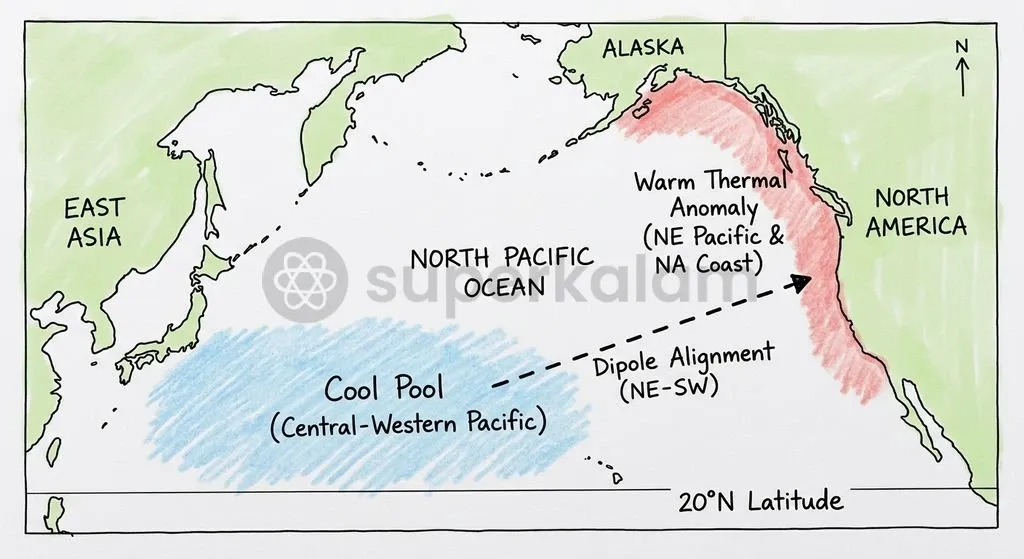
- Definition & Location: A recurring ocean-atmosphere pattern marked by fluctuating SST (Sea Surface Temperature) in the extratropical North Pacific Ocean (north of 20°N).
- Dipole Phases:
- Positive Phase: Warm waters in the North-Eastern Pacific; cool waters in the Central/Western Pacific.
- Negative Phase: Cool waters in the North-Eastern Pacific; warm waters in the Central/Western Pacific.
- Link with El Niño: Positive phases frequently precede ENSO (El Niño-Southern Oscillation) events (e.g., 2014–15 positive VM preceded the major 2015–16 El Niño).
- Monsoon Impact on India:
- Negative Phase: Restricts moisture transport toward Northern India, driving rainfall deficits and expanding semi-arid climate zones.
- Monsoon Onset: Influences the timing and onset of the Indian Summer Monsoon (South-West Monsoon).
FAQs
Q1. How is Victoria Mode different from the PDO?
Ans. The PDO is the first dominant mode (EOF1), while VM is the second (EOF2) of North Pacific SST variability; both are statistically independent.
Q2. How does the negative phase of VM affect India?
Ans. It reduces moisture transport towards northern India, contributing to lower rainfall and drier conditions.
Q3. Does the study link VM directly to El Niño?
Ans. No, the study establishes no direct link, although earlier research found that many VM events were followed by El Niño.