Context
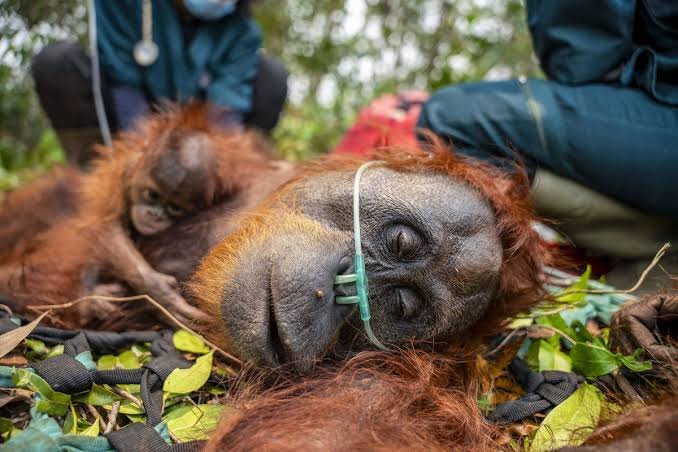
Forest and land fires in Indonesia’s West Kalimantan province have destroyed orangutan habitats, forcing animals into plantations and human settlements in search of food and shelter.
About Orangutans
- Meaning: The word orangutan comes from Malay and Indonesian words meaning “person of the forest.”
- Classification: Orangutans are great apes belonging to the family Hominidae, which also includes humans, chimpanzees and gorillas.
- Species: Three species are recognised: the Bornean orangutan (Pongo pygmaeus), Sumatran orangutan (Pongo abelii) and Tapanuli orangutan (Pongo tapanuliensis).
- Distribution: They are found in the forests of Borneo and Sumatra in Southeast Asia.
- Habitat: They inhabit tropical rainforests, including peat-swamp, lowland and mountainous forests.
- Conservation Status: All three species are classified as Critically Endangered on the IUCN Red List.
Key Characteristics
- Arboreal Lifestyle: Orangutans spend much of their lives in trees. Their long arms and grasping hands and feet help them move through the forest canopy.
- Diet: They are primarily frugivorous, feeding mainly on fruits, but also consume leaves, bark, insects and other plant material.
- Intelligence: Orangutans demonstrate advanced learning and problem-solving abilities and can use tools to obtain food or perform other tasks.
- Behaviour: They are generally more solitary than other great apes and depend on large, connected forest habitats for food, movement and nesting.
Why are Orangutans facing growing threats?
- Forest and Land Fires: Fires destroy trees used for feeding, nesting and movement. Orangutans may suffer burns, smoke inhalation, dehydration and malnutrition when forced out of their habitats.
- Climate Change and El Niño: El Niño-related drought can intensify dry conditions and increase fire risk. In 2026, prolonged dryness, land clearing using fire and water shortages affecting firefighting efforts contributed to worsening fires in parts of Indonesian Borneo.
- Expansion of Oil Palm Plantations: The conversion of forests into oil palm plantations removes natural habitat and can leave orangutans isolated in small patches of trees surrounded by agricultural land.
- Deforestation and Habitat Fragmentation: Logging, land conversion and forest clearance reduce habitat quality and break continuous forests into disconnected patches. This limits movement between populations and reduces access to food.
- Poaching and Human–Wildlife Conflict: As orangutans enter plantations or settlements after losing their habitat, conflict with people can increase. Hunting and illegal wildlife trade add further pressure on already threatened populations.
Rescue and Relocation: Why is it not enough?
The recent operation shows the importance of emergency wildlife rescue, but relocating orangutans requires careful ecological assessment.
- Rescue: Animals are removed from immediate danger, such as burning forests or isolated plantation areas.
- Health Assessment: Veterinarians examine rescued animals and provide treatment for injuries, smoke exposure, dehydration and nutritional deficiencies.
- Translocation: Healthy animals are moved to a suitable alternative habitat after rehabilitation and assessment.
Why was Batu Nyambu Protection Forest selected?
Batu Nyambu, in Ketapang district, covers approximately 23,000 hectares. It was selected following an assessment of its ecological suitability and capacity to support orangutans. The forest offers:
- Primary and secondary forest cover.
- Adequate food and water resources.
- Trees suitable for nesting and shelter.
- Sufficient space for movement and access to connected forest areas.
Conclusion
The fires in Indonesian Borneo demonstrate how climate-related dryness, land-use change and habitat fragmentation can combine to threaten endangered wildlife. Rescuing and relocating orangutans can save individual animals, but their long-term survival depends on protecting forests, maintaining ecological corridors and preventing destructive land clearing.
Frequently Asked Questions (FAQs)
Q1. What are orangutans, and where are they found?
Orangutans are great apes belonging to the family Hominidae. The three species are found in the forests of Borneo and Sumatra in Southeast Asia.
Q2. What is the conservation status of orangutans?
All three species—the Bornean, Sumatran and Tapanuli orangutans—are classified as Critically Endangered on the IUCN Red List.
Q3. How do forest fires threaten orangutans?
Fires destroy feeding, nesting and movement habitats, while smoke, burns, dehydration and food shortages threaten orangutans and may force them into plantations and settlements.
Q4. Why was Batu Nyambu Protection Forest selected for orangutan relocation?
Located in Ketapang district, it covers approximately 23,000 hectares and offers forest cover, food, water, nesting trees and space for movement.