Context
Prime Minister Narendra Modi recently inaugurated the RBI’s Data Centre and Cybersecurity Training Institute in Bhubaneswar, strengthening technological infrastructure and cyber-security capacity for India’s increasingly digital financial system. The development highlights the need to protect financial institutions, digital services and critical infrastructure from evolving cyber threats.
Emerging Cyber Threat Landscape
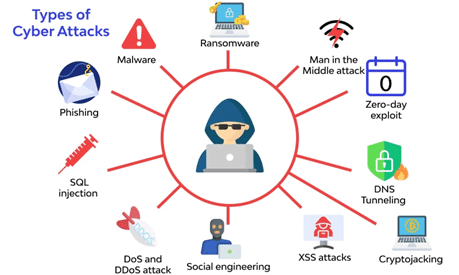
- Social-engineering attacks: Phishing, impersonation and digital fraud exploit human trust, making users an important point of vulnerability in the cyber ecosystem.
- Ransomware: Attackers can encrypt or block organisational systems and demand payment, causing financial loss, operational disruption and service delays.
- Denial-of-Service attacks: Overloading digital systems can make essential services unavailable, showing that cyber attacks can disrupt service continuity even without stealing data.
- Data and supply-chain breaches: Attackers may compromise organisations or trusted vendors to access sensitive information, making cyber security dependent on the entire digital ecosystem.
- Critical-infrastructure attacks: Targeting sectors such as banking, power or transport can turn a cyber intrusion into a wider economic and national-security risk.
- AI-enabled threats: Artificial intelligence can speed up information gathering, impersonation and exploitation of vulnerabilities, increasing the scale and sophistication of cyber attacks.
Why India Is Increasingly Vulnerable
- Expanding digital footprint: Digital banking, payments, e-governance and online commerce have widened access to services, but also increased the number of users and systems exposed to cyber risks.
- Critical-infrastructure dependence: Essential sectors increasingly rely on connected digital systems; disruption can therefore affect economic activity and national security.
- Human vulnerability: Weak passwords, unsafe links and limited digital awareness remain common entry points, showing that technology alone cannot ensure cyber security.
- Legacy systems and capability gaps: Outdated software and uneven security practices can create weak links, allowing a local vulnerability to cause wider disruption.
- Cross-border nature of attacks: Attackers, servers, victims and financial channels may operate in different countries, making investigation and enforcement dependent on international coordination.
India’s Cyber Security Architecture
- CERT-In: India’s national agency for cyber-security incident response, responsible for alerts, advisories, coordination and emergency response.
- NCIIPC: Protects Critical Information Infrastructure whose disruption could seriously affect national security, the economy or essential services.
- I4C & NCRP: The Indian Cyber Crime Coordination Centre coordinates cybercrime response, while the National Cyber Crime Reporting Portal allows citizens to report cyber offences and financial fraud.
- Defence Cyber Agency: Strengthens preparedness against state-sponsored cyber threats and cyber warfare.
- Cyber Swachhta Kendra: Functions as a botnet cleaning and malware analysis centre, helping users detect and remove malicious software.
- Legal framework: The Information Technology Act, 2000 addresses cyber offences and electronic systems, while the Digital Personal Data Protection Act, 2023 governs digital personal data protection.
- Sectoral regulation: RBI and other regulators issue cyber-security and resilience norms, improving sector-specific preparedness.
- RBI’s Bhubaneswar facilities: The new Data Centre and Cybersecurity Training Institute strengthen financial-sector computing resilience, training and research capacity.
Strengthening Cyber Resilience
- Secure-by-design systems: Regular updates, vulnerability management and security audits can reduce weaknesses before attackers exploit them.
- Skilled cyber workforce: Greater expertise in incident response, digital forensics and cyber defence can help institutions respond to rapidly changing threats.
- AI-enabled defence: AI can improve threat detection and faster response, but human oversight and access controls remain essential.
- Better institutional coordination: Faster information-sharing among CERT-In, NCIIPC, I4C, regulators and private operators can improve response during major incidents.
- Cyber-aware citizens: Awareness of phishing, fraudulent links and unsafe digital practices can reduce common entry points for cyber fraud and intrusion.
- International cooperation: Since cyber threats cross borders, stronger information-sharing, digital-forensic cooperation and common norms can improve collective resilience.
FAQs
Q1. What is cyber security?
It is the protection of digital systems, networks and data from unauthorised access, disruption or damage.
Q2. What is the CIA Triad?
It refers to Confidentiality, Integrity and Availability, the three basic objectives of information security.
Q3. What is CERT-In?
It is India’s national agency for cyber-security incident response.
Q4. What is NCIIPC?
It is the national nodal agency responsible for protecting Critical Information Infrastructure.
Q5. Why are the new RBI facilities significant?
They strengthen the computing resilience, cyber-security training and technological capacity of India’s financial system.