Context
The National Statistics Office (NSO) under MoSPI released India’s first National Household Travel Survey (NHTS), providing nationwide evidence on commuting modes, travel costs, duration and gender differences.
India’s Commuting Pattern
- Two-wheelers dominate work travel, accounting for about 42.6% of workers travelling to fixed workplaces.
- Walking accounts for 28.3%, showing the continuing importance of short-distance and non-motorised mobility.
- Only about 9% of workers primarily use bus or rail-based public transport, indicating limited dependence on formal mass transit.
- Average monthly commuting expenditure is higher in urban areas than rural areas, reflecting greater travel costs.
- Overall, India’s work mobility remains strongly dependent on private two-wheelers and walking rather than public transport.
- Regional differences are visible, with some States showing high dependence on walking while Kerala records relatively higher bus use.
Gendered Mobility Gap
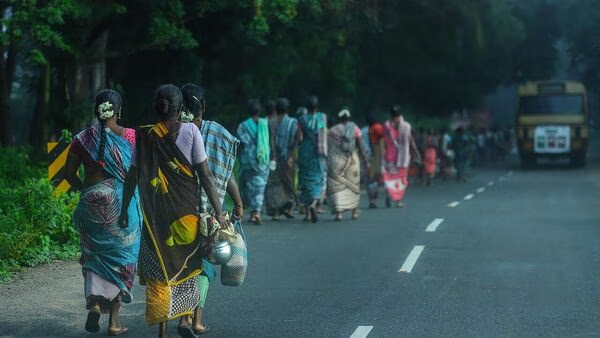
- Around 67% of commuting women rely on walking or public transport, compared with roughly 33% of men, indicating lower access to private mobility.
- Women undertake fewer longer-distance work trips, suggesting a narrower geographical range of employment access.
- Urban women depend much more heavily on buses, making public transport availability important for female labour-force participation.
- These differences may reflect affordability, safety, care responsibilities, route availability and preference for workplaces closer to home.
Policy Implications
- Affordable and reliable public transport can expand women’s access to employment beyond nearby locations.
- Safe stops, better lighting and last-mile connectivity can reduce gender-specific mobility barriers.
- High dependence on walking requires stronger footpaths, crossings and pedestrian infrastructure.
- Public transport planning should therefore be treated as part of employment policy, gender equality and social inclusion, not merely congestion management.
FAQs
Q1. Which agency conducted the National Household Travel Survey?
The National Statistics Office (NSO) under MoSPI.
Q2. What is the dominant mode of travel to work in India?
Two-wheelers.
Q3. What share of commuting women rely on walking or public transport?
Around 67%.
Q4. Why are buses particularly important for women?
Women depend more heavily on public transport for access to workplaces.
Q5. What is the main policy lesson from the survey?
India needs accessible, affordable and gender-responsive mobility systems.