Context
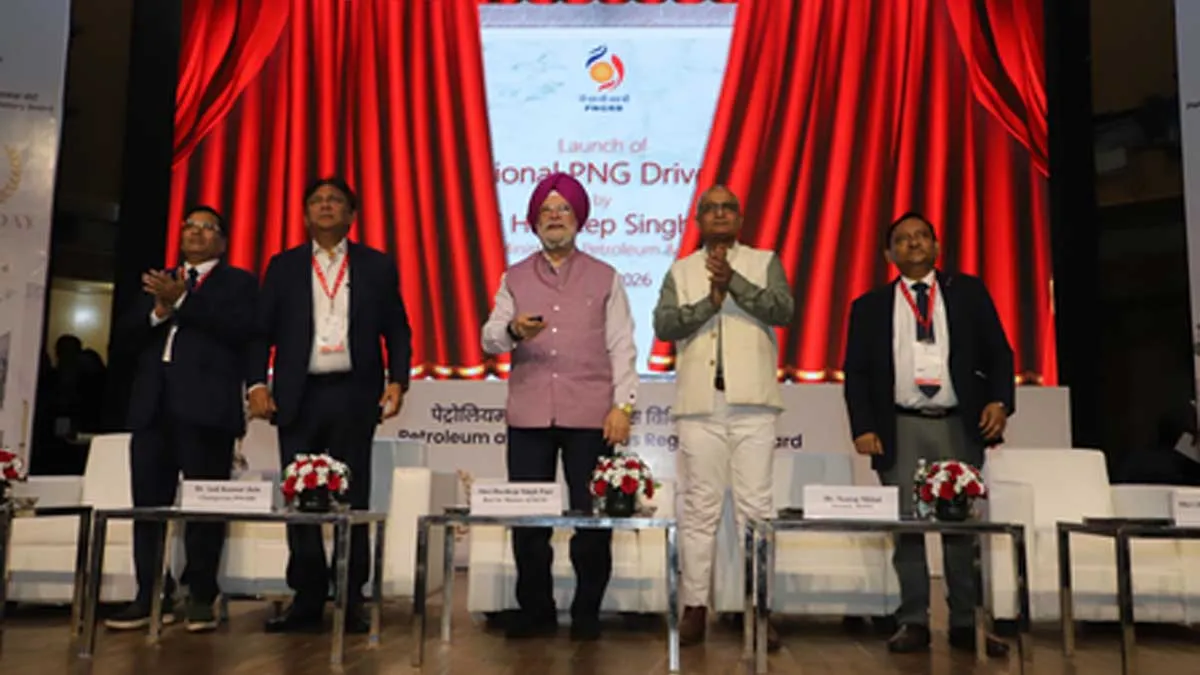
The Petroleum and Natural Gas Regulatory Board (PNGRB) launched National PNG Drive 3.0 to accelerate Domestic Piped Natural Gas (D-PNG) adoption and improve City Gas Distribution (CGD) network utilisation. The six-month drive will continue until 31 March 2027, focusing on consumer uptake and activation of existing connections.
About PNG
- Composition: Piped Natural Gas (PNG) consists mainly of methane (CH₄) with small amounts of other hydrocarbons.
- Source: India meets its natural gas requirement through domestic production and Liquefied Natural Gas (LNG) imports. In FY2024, around 52% came from domestic production and 48% from LNG imports.
- Supply: Natural gas is transported through pipelines and supplied to households through City Gas Distribution (CGD) networks with metered billing.
- Household Use: PNG provides continuous supply, with consumers paying for actual consumption, eliminating the need for cylinder booking, storage and replacement.
About National PNG Drive 3.0
- Three Targets: By 31 March 2027, the drive aims to add 50 lakh new D-PNG connections, activate 40 lakh unbilled connections, and secure 50 lakh additional registrations.
- Utilisation Gap: India had around 1.74 crore PNG consumers, of whom only 1.15 crore were billed consumers, indicating a significant gap between connections and actual usage.
- Core Focus: The drive seeks to increase active PNG consumption and improve utilisation of existing City Gas Distribution (CGD) infrastructure, particularly in rural and semi-urban areas. Top of FormBottom of Form
Key Features
- Targeted Expansion: Focuses on new connections, activation of unbilled connections and fresh registrations.
- Infrastructure Capacity: Around 88 lakh inch-km of CGD pipelines can support nearly 1.3 crore additional connections.
- Supply Readiness: Requires coordinated availability of meters, valves, GI pipes and MDPE pipes among CGD entities, regulators and suppliers.
- Learning from PNG Drive 2.0: Builds on the earlier campaign by shifting focus from registration to actual consumption.
- CGD Incentive: Eligible entities can receive an additional 200 Standard Cubic Metres (SCM) of lower-priced Administered Price Mechanism (APM) gas for each incremental billed D-PNG connection above the prescribed threshold.
Significance
- Cleaner Fuel: PNG can reduce household dependence on more carbon-intensive fuels.
- Energy Security: Wider gas use can support fuel diversification and reduce vulnerability to global supply disruptions.
- Infrastructure Utilisation: Activating existing connections improves the use of CGD infrastructure and strengthens its economic viability.
- Energy Transition: Natural gas accounts for about 6% of India’s primary energy mix, with a target of 15% by 2030.
- Consumer Adoption: The drive shifts focus from pipeline expansion to affordable access and regular PNG consumption.
Challenges
- Limited Consumer Awareness: Uneven awareness and acceptance of PNG across regions restrict adoption.
- High Initial Cost: Upfront connection and installation costs can deter households.
- Difficult Last-Mile Expansion: Low population density in rural and semi-urban areas raises infrastructure costs and creates demand uncertainty.
- Low Conversion of Connections: Many registered connections do not translate into regular billed consumption, reducing network utilisation.
- Weak Commercial Viability: Low consumer density and uncertain demand can make CGD investments difficult to recover.
- Methane Emissions: Methane leakage across the gas supply chain can reduce the climate benefits of natural gas.
Way Forward
- Affordable Access: Reduce upfront connection costs and support low-income households.
- Last-Mile Expansion: Extend CGD networks to rural and semi-urban areas based on viable demand.
- Consumer Awareness: Promote awareness of PNG’s cost, safety and benefits.
- Reliable Supply: Ensure adequate gas availability and timely supply of meters, valves and pipes.
- Digital Services: Use the MyPNG Portal for easier registration, billing and grievance redressal.
- Environmental Monitoring: Control methane leakage and improve network efficiency while expanding PNG
FAQs
Q1. What are the three targets of PNG Drive 3.0?
Ans: It targets 50 lakh new D-PNG connections, activation of 40 lakh unbilled connections and 50 lakh additional registrations by March 2027.
Q2. What is APM gas?
Ans: Administered Price Mechanism (APM) gas is natural gas supplied at prices determined under the government’s administered pricing framework.
Q3. What is City Gas Distribution (CGD)?
Ans: CGD is a network that supplies natural gas through pipelines to households, industries and other consumers within designated geographical areas.